Review
doi: 10.1136/jme.2006.017913.
Can evidence-based medicine implicitly rely on current concepts of disease or does it have to develop its own definition?
Affiliations
- PMID: 17601866
- PMCID: PMC2598145
- DOI: 10.1136/jme.2006.017913
Item in Clipboard
Review
Can evidence-based medicine implicitly rely on current concepts of disease or does it have to develop its own definition?
J Med Ethics.
2007 Jul.
Abstract
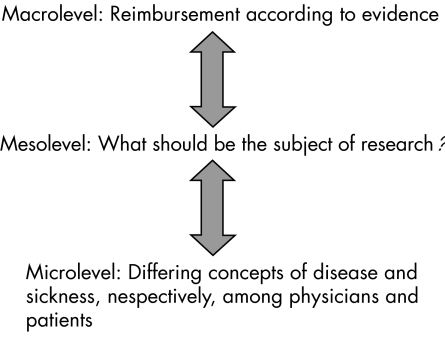
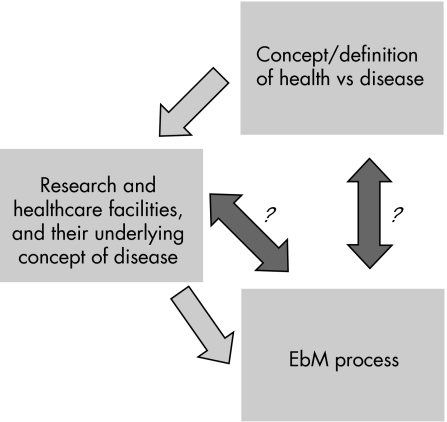
Decisions in healthcare are made against the background of cultural and philosophical definitions of disease, sickness and illness. These concepts or definitions affect both health policy (macro level) and research (meso level), as well as individual encounters between patients and physicians (micro level). It is therefore necessary for evidence-based medicine to consider whether any of the definitions underlying research prior to the hierarchisation of knowledge are indeed compatible with its own epistemological principles.
Conflict of interest statement
Competing interests: None.
References
-
- Hofmann B. Complexity of the concept of disease as shown through rival theoretical frameworks. Theor Med 200122211–236. - PubMed
-
- Liberati A, Vineis P. Defining a proper background for discussing evidence‐based medicine. In: Meulen RT, Biller‐Andorno N, Lenk C, et al, eds. Evidence‐based practice in medicine and health care. A discussion of ethical issues. Berlin: Springer, 2005
-
- Bobbert M. Die Problematik des Krankheitsbegriffs und der Entwurf eines moralisch‐informativen Krankheitsbegriffs im Anschluss an die Moralphilosophie von Alan Gewirth. Ethica 20008405–440.
-
- In: Mazouz N, Werner MH, Wiesing U, eds. Krankheitsbegriff und Mittelverteilung. Beiträge zum Gesundheitsmanagement Bd. 8. Baden‐Baden: Nomos Verlagsgesellschaft, 2004
Publication types
MeSH terms
LinkOut - more resources
Full Text Sources