


The relationship between resting lung-to-lung circulation time and peak exercise capacity in chronic heart failure patients
- PMID: 17602986
- PMCID: PMC2263144
- DOI: 10.1016/j.cardfail.2007.02.002
The relationship between resting lung-to-lung circulation time and peak exercise capacity in chronic heart failure patients
Abstract
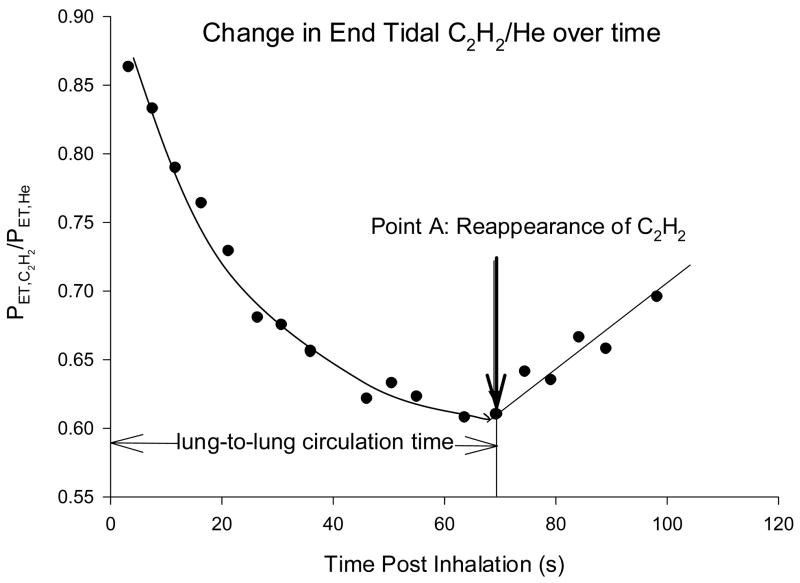
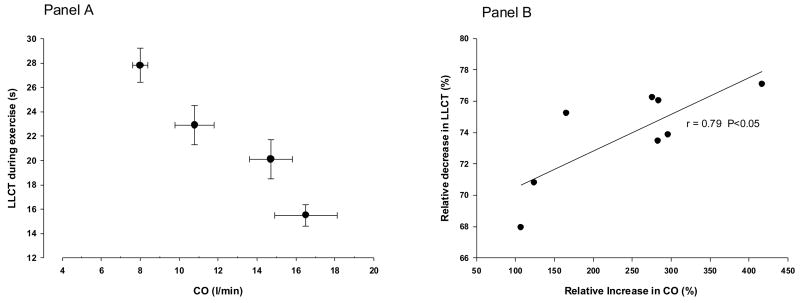
Background: Peak exercise capacity (VO2peak) is a measure of the severity of chronic heart failure (CHF); however, few indices of resting cardiopulmonary function have been shown to predict VO2peak. A prolonged circulation time has been suggested as an index of increased severity of CHF. The aim of this study was to investigate the relationship between resting lung-to-lung circulation time (LLCT) and VO2peak in CHF.
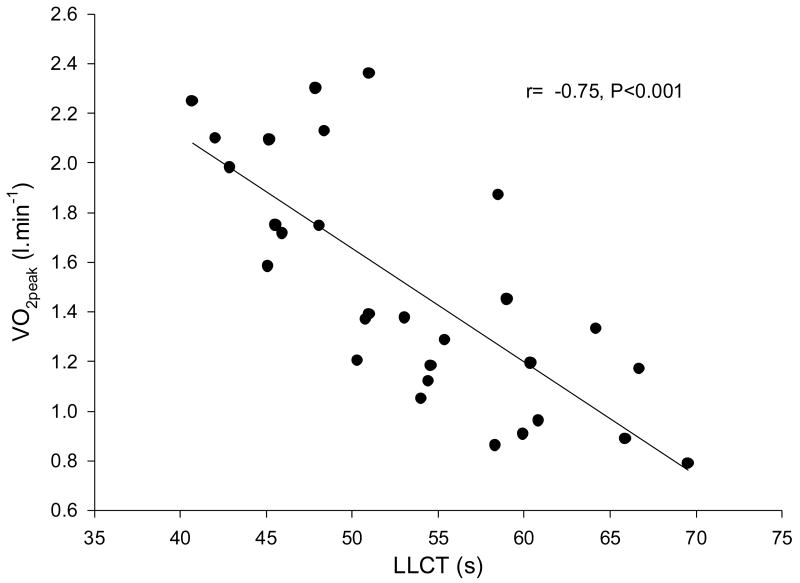
Methods and results: Thirty CHF patients (59 +/- 13 years, New York Heart Association: 1.9 +/- 1.0) undertook the study. Each subject completed resting pulmonary and echocardiography measures and an incremental exercise test. LLCT was measured using the reappearance of end-tidal acetylene (P(ET),C2H2) after a single inhalation. Univariate and multivariate stepwise linear regression was used to determine the predictors of VO2peak. Univariate correlates of VO2peak (group mean 1.53 +/- 0.44 L/min(-1)) included LLCT (r = -0.75), inspiratory capacity (r = 0.41), ejection fraction (r = 0.33), peak early flow velocity (r = -0.39), and the ratio of early to late flow velocity (r = -0.31). LLCT was the only independent predictor where VO(2peak) = 3.923-0.045 (LLCT); r2 = 54%.
Conclusions: These results suggest that resting LLCT determined using the soluble inert gas technique represents a simple, noninvasive method that provides additional information regarding exercise capacity in CHF.
Figures
References
-
- Mancini DM, Eisen H, Kussmaul W, Mull R, Edmunds LH, Jr, Wilson JR. Value of peak exercise oxygen consumption for optimal timing of cardiac transplantation in ambulatory patients with heart failure. Circulation. 1991;83(3):778–86. - PubMed
-
- Carell ES, Murali S, Schulman DS, Estrada-Quintero T, Uretsky BF. Maximal exercise tolerance in chronic congestive heart failure. Relationship to resting left ventricular function. Chest. 1994;106(6):1746–52. - PubMed
-
- Nanas S, Nanas J, Papazachou O, Kassiotis C, Papamichalopoulos A, Milic-Emili J, et al. Resting lung function and hemodynamic parameters as predictors of exercise capacity in patients with chronic heart failure. Chest. 2003;123(5):1386–93. - PubMed
-
- Meyer TE, Karamanoglu M, Ehsani AA, Kovacs SJ. Left ventricular chamber stiffness at rest as a determinant of exercise capacity in heart failure subjects with decreased ejection fraction. J Appl Physiol. 2004;97(5):1667–72. - PubMed
-
- Triebwasser JH, Johnson RLJ, Burpo RP, Campbell JC, Reardon WC, Blomqvist CG. Noninvasive determination of cardiac output by a modified acetylene rebreathing procedure utilizing mass spectrometer measurements. Aviat Space Environ Med. 1977;48(3):203–209. - PubMed
Publication types
MeSH terms
Substances
Grants and funding
LinkOut - more resources
Full Text Sources
Medical
