


Production of recombinant adeno-associated vectors using two bioreactor configurations at different scales
- PMID: 17606302
- PMCID: PMC2080829
- DOI: 10.1016/j.jviromet.2007.05.020
Production of recombinant adeno-associated vectors using two bioreactor configurations at different scales
Abstract
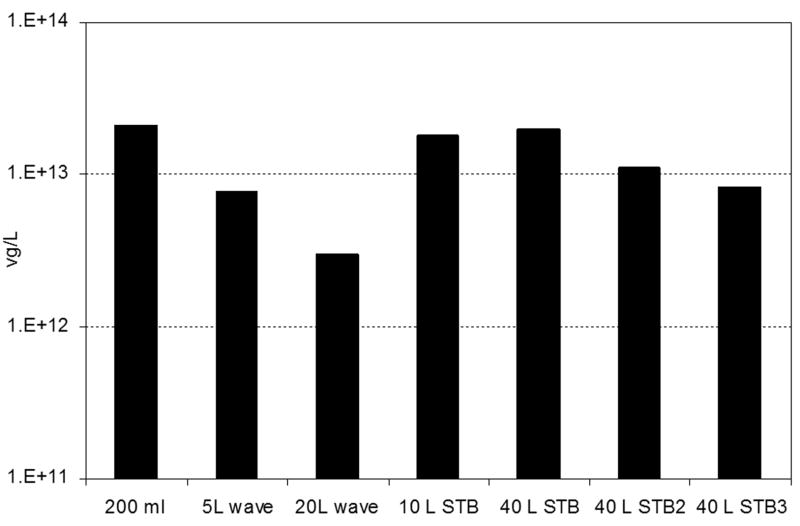
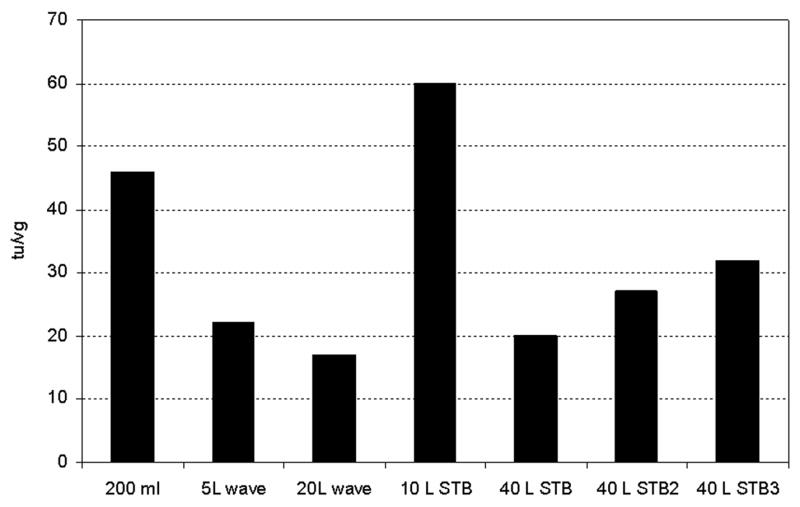
The conventional methods for producing recombinant adeno-associated virus (rAAV) rely on transient transfection of adherent mammalian cells. To gain acceptance and achieve current good manufacturing process (cGMP) compliance, clinical grade rAAV production process should have the following qualities: simplicity, consistency, cost effectiveness, and scalability. Currently, the only viable method for producing rAAV in large-scale, e.g. > or =10(16) particles per production run, utilizes baculovirus expression vectors (BEVs) and insect cells suspension cultures. The previously described rAAV production in 40 L culture using a stirred tank bioreactor requires special conditions for implementation and operation not available in all laboratories. Alternatives to producing rAAV in stirred tank bioreactors are single-use, disposable bioreactors, e.g. Wave. The disposable bags are purchased pre-sterilized thereby eliminating the need for end-user sterilization and also avoiding cleaning steps between production runs thus facilitating the production process. In this study, rAAV production in stirred tank and Wave bioreactors was compared. The working volumes were 10 L and 40 L for the stirred tank bioreactors and 5 L and 20 L for the Wave bioreactors. Comparable yields of rAAV, approximately 2E+13 particles per liter of cell culture were obtained in all volumes and configurations. These results demonstrate that producing rAAV in large scale using BEVs is reproducible, scalable, and independent of the bioreactor configuration.
Figures
References
-
- Galarza JM, Latham T, Cupo A. Virus-like particle vaccine conferred complete protection against a lethal influenza virus challenge. Viral Immunol. 2005;18:365–372. - PubMed
-
- Gotoh T, Chiba K, Kikuchi KI. Oxygen consumption profiles of SF-9 insect cells and their culture at low temperature to circumvent oxygen starvation. Biochem Eng J. 2004;17:71–78.
-
- Grieger JC, Samulski RJ. Adeno-associated virus as a gene therapy vector: development, production and clinical applications. Adv Biochem Eng Biotechnol. 2005;99:119–145. - PubMed
-
- Liu YL, Wagner K, Robinson N, Sabatino D, Margaritis P, Xiao W, Herzog RW. Optimized production of high-titer recombinant adeno-associated virus in roller bottles. Biotechniques. 2003;34:184–189. - PubMed
Publication types
MeSH terms
Grants and funding
LinkOut - more resources
Full Text Sources
Other Literature Sources
