


Palaeogenetic evidence supports a dual model of Neolithic spreading into Europe
- PMID: 17609193
- PMCID: PMC2706191
- DOI: 10.1098/rspb.2007.0465
Palaeogenetic evidence supports a dual model of Neolithic spreading into Europe
Abstract
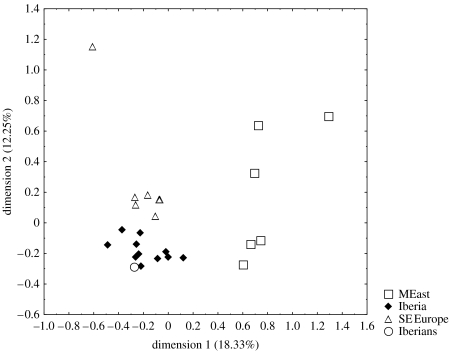
The peopling of Europe is a complex process. One of the most dramatic demographic events, the Neolithic agricultural revolution, took place in the Near East roughly 10000 years ago and then spread through the European continent. Nevertheless, the nature of this process (either cultural or demographic) is still a matter of debate among scientists. We have retrieved HVRI mitochondrial DNA sequences from 11 Neolithic remains from Granollers (Catalonia, northeast Spain) dated to 5500 years BP. We followed the proposed authenticity criteria, and we were also able, for the first time, to track down the pre-laboratory-derived contaminant sequences and consequently eliminate them from the generated cloning dataset. Phylogeographic analysis shows that the haplogroup composition of the Neolithic population is very similar to that found in modern populations from the Iberian Peninsula, suggesting a long-time genetic continuity, at least since Neolithic times. This result contrasts with that recently found in a Neolithic population from Central Europe and, therefore, raises new questions on the heterogeneity of the Neolithic dispersals into Europe. We propose here a dual model of Neolithic spread: acculturation in Central Europe and demic diffusion in southern Europe.
Figures

References
-
- Ammerman A.J, Cavalli-Sforza L.L. The Neolithic transition and the genetics of population in Europe. Princeton University Press; Princeton, NJ: 1984.
-
- Ammerman A.J, Pinhasi R, Banffy E. Comment on “Ancient DNA from the first European farmers in 7500-year-old Neolithic sites”. Science. 2006;312:1875. doi:10.1126/science.1123936 author reply 1875. - DOI - PubMed
-
- Anderson S, et al. Sequence and organization of the human mitochondrial genome. Nature. 1981;290:457–465. doi:10.1038/290457a0 - DOI - PubMed
-
- Barbujani G, Chikhi L. Population genetics: DNAs from the European Neolithic. Heredity. 2006;97:84–85. doi:10.1038/sj.hdy.6800852 - DOI - PubMed
-
- Barbujani G, Goldstein D.B. Africans and Asians abroad: genetic diversity in Europe. Annu. Rev. Genomics Hum. Genet. 2004;5:119–150. doi:10.1146/annurev.genom.5.061903.180021 - DOI - PubMed
Publication types
MeSH terms
Substances
LinkOut - more resources
Full Text Sources
