Clinical assessment of infant colour at delivery
- PMID: 17613535
- PMCID: PMC2675394
- DOI: 10.1136/adc.2007.120634
Clinical assessment of infant colour at delivery
Abstract
Objective: Use of video recordings of newborn infants to determine: (1) if clinicians agreed whether infants were pink; and (2) the pulse oximeter oxygen saturation (Spo(2)) at which infants first looked pink.
Methods: Selected clips from video recordings of infants taken immediately after delivery were shown to medical and nursing staff. The infants received varying degrees of resuscitation (including none) and were monitored with pulse oximetry. The oximeter readings were obscured to observers but known to the investigators. A timer was visible and the sound was inaudible. The observers were asked to indicate whether each infant was pink at the beginning, became pink during the clip, or was never pink. If adjudged to turn pink during the clip, observers recorded the time this occurred and the corresponding Spo(2) was determined.
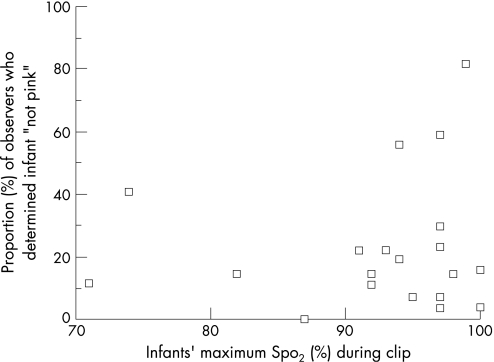
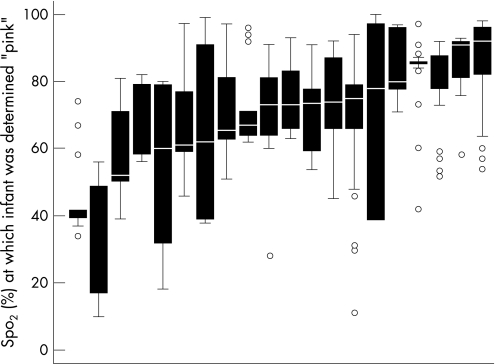
Results: 27 clinicians assessed videos of 20 infants (mean (SD) gestation 31(4) weeks). One infant (5%) was perceived to be pink by all observers. The number of clinicians who thought each of the remaining 19 infants were never pink varied from 1 (4%) to 22 (81%). Observers determined the 10 infants with a maximum Spo(2) >/=95% never pink on 17% (46/270) of occasions. The Spo(2) at which individual infants were perceived to turn pink varied from 10% to 100%.
Conclusion: Among clinicians observing the same videos there was disagreement about whether newborn infants looked pink with wide variation in the Spo(2) when they were considered to become pink.
Conflict of interest statement
Competing interests: None.
References
-
- International Liaison Committee on Resuscitation The International Liaison Committee on Resuscitation (ILCOR) consensus on science with treatment recommendations for pediatric and neonatal patients: neonatal resuscitation. Pediatrics 2006117e978–e988. - PubMed
-
- Panasonic, ideas for life, Australia Digital Video Camera. http://panasonic.com.au/products/details.cfm?objectID = 2558 (accessed 25 June 2007)
-
- Kelman G R, Nunn J F. Clinical recognition of hypoxaemia under fluorescent lamps. Lancet 196611400–1403. - PubMed
Publication types
MeSH terms
Substances
LinkOut - more resources
Full Text Sources
Medical