


Antibodies to selected minor target antigens in patients with anti-neutrophil cytoplasmic antibodies (ANCA)
- PMID: 17614969
- PMCID: PMC2219289
- DOI: 10.1111/j.1365-2249.2007.03453.x
Antibodies to selected minor target antigens in patients with anti-neutrophil cytoplasmic antibodies (ANCA)
Abstract
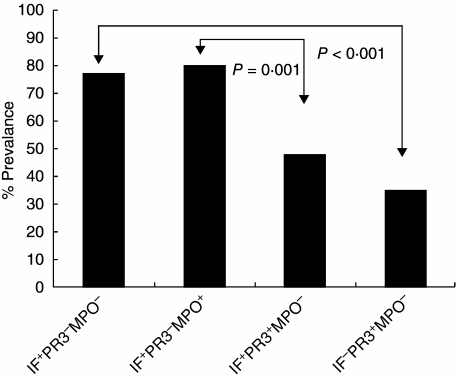
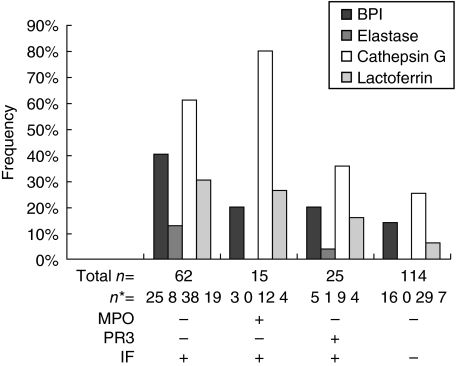
In patients with anti-neutrophil cytoplasmic antibodies (ANCA)-associated vasculitis, indirect immunofluorescence (IF) distinguishes between cytoplasmic (C-ANCA) and perinuclear (P-ANCA) neutrophil staining patterns. In patients with primary systemic vasculitis such as Wegener's granulomatosis, microscopic polyangiitis and Churg-Strauss syndrome, these IF staining patterns correspond broadly with antibodies to the two major antigens: the C-ANCA pattern is associated generally with antibodies to serine protease 3 (PR3) and the P-ANCA pattern with antibodies to myeloperoxidase (MPO). However, some sera positive for ANCA by IF are negative for anti-PR3 and anti-MPO antibodies, suggesting the presence of antibodies to minor antigens of PMN granules. We tested sera from a previously well-defined clinical cohort of patients for antibodies to four possible minor antigens: bactericidal permeability increasing protein, elastase, cathepsin G and lactoferrin. IF-positive (+) sera had significantly higher antibody frequencies to the minor antigens than did the IF-negative (-) sera (P < 0.01). Patients with IF(+) PR3(-)MPO(-) sera showed the most varied reactivity to the minor antigens. Among the IF(+) groups, the IF(+) PR3(+)/MPO(-) sera showed the lowest reactivity to the minor antigens. Patients with well-defined ANCA specificities, e.g. the PR3-ANCA response associated with Wegener's granulomatosis, are less likely than are other patient subsets to have antibodies to minor antigen targets. Autoantibodies to these minor antigens contribute to the overall pattern of ANCA identified by IF and help to explain why the correlation between IF and enzyme immunoassays show discrepancies. While the pathophysiological significance of antibodies to minor target antigens needs further evaluation, they may be markers of inflammation associated with disease processes.
Figures
References
-
- Van Der Woude FJ, Rassmussen N, Lobatto S, et al. Autoantibodies to neutrophils and monocytes: a new tool for diagnosis and a marker for disease activity in Wegener's granulomatosis. Lancet. 1985;1:425–9. - PubMed
-
- Stone JH, Talor M, Stebbing J, et al. Test characteristics of immunofluorescence and ELISA tests in 856 consecutive patients with possible ANCA-associated conditions. Arthritis Care Res. 2000;13:424–34. - PubMed
-
- Falk RJ, Jennette JC. Anti-neutrophil cytoplasmic autoantibodies with specificity for myeloperoxidase in patients with systemic vasculitis and idiopathic necrotizing and crescentic glomerulonephritis. N Engl J Med. 1988;318:1651–7. - PubMed
-
- Hoffman GS, Specks U. Antineutrophil cytoplasmic antibodies. Arthritis Rheum. 1998;41:1521–37. - PubMed
-
- Savige JA, Davies DJ, Gatenby PA. Anti-neutrophil cytoplasmic antibodies (ANCA). their detection and significance: report from workshops. Pathology. 1994;26:186–93. - PubMed
Publication types
MeSH terms
Substances
Grants and funding
LinkOut - more resources
Full Text Sources
Medical
Research Materials
Miscellaneous
