


The effect of walking and vitamin B supplementation on quality of life in community-dwelling adults with mild cognitive impairment: a randomized, controlled trial
- PMID: 17616840
- PMCID: PMC2039864
- DOI: 10.1007/s11136-007-9219-z
The effect of walking and vitamin B supplementation on quality of life in community-dwelling adults with mild cognitive impairment: a randomized, controlled trial
Abstract
Objectives: To examine the effect of walking and vitamin B supplementation on quality-of-life (QoL) in community-dwelling adults with mild cognitive impairment.
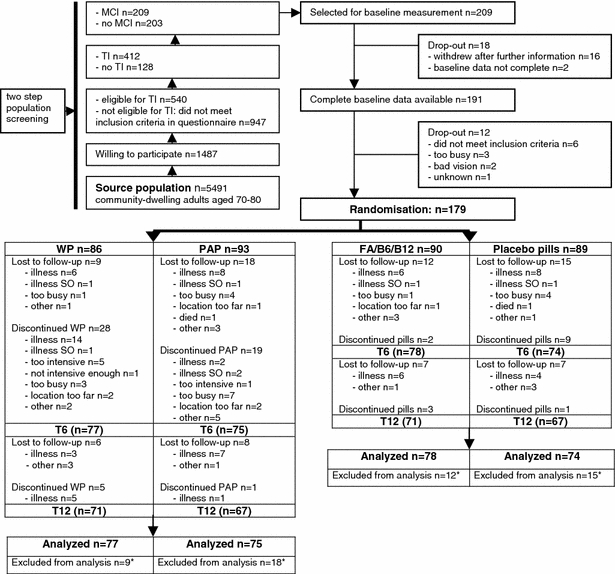
Methods: One year, double-blind, placebo-controlled trial. Participants were randomized to: (1) twice-weekly, group-based, moderate-intensity walking program (n = 77) or a light-intensity placebo activity program (n = 75); and (2) daily vitamin B pills containing 5 mg folic acid, 0.4 mg B12, 50 mg B6 (n = 78) or placebo pills (n = 74). QoL was measured at baseline, after six and 12 months using the population-specific Dementia Quality-of-Life (D-QoL) to assess overall QoL and the generic Short-Form 12 mental and physical component scales (SF12-MCS and SF12-PCS) to assess health-related QoL.
Results: Baseline levels of QoL were relatively high. Modified intention-to-treat analyses revealed no positive main intervention effect of walking or vitamin supplementation. In both men and women, ratings of D-QoL-belonging and D-QoL-positive affect subscales improved with 0.003 (P = 0.04) and 0.002 points (P = 0.06) with each percent increase in attendance to the walking program. Only in men, SF12-MCS increased with 0.03 points with each percent increase in attendance (P = 0.08).
Conclusion: Several small but significant improvements in QoL were observed with increasing attendance to the walking program. No effect of vitamin B supplementation was observed.
Trial registration: International Standard Randomized Controlled Trial Number Register, 19227688, http://www.controlled-trials.com/isrctn/.
Figures
References
-
- Mol, M., Carpay, M., Ramakers, I., Rozendaal, N., Verhey, F., & Jolles, J. (2006). The effect of perceived forgetfulness on quality of life in older adults; a qualitative review. International Journal of Geriatric Psychiatry. - PubMed
-
- Frisoni, G. B., Fratiglioni, L., Fastbom, J., Guo, Z., Viitanen, M., & Winblad, B. (2000). Mild cognitive impairment in the population and physical health: data on 1,435 individuals aged 75–95. Journals of Gerontology Series A-Biological Sciences and Medical Sciences, 55, M322–M328. - PubMed
-
- Gill, T. M., Richardson, E. D., & Tinetti, M. E. (1995). Evaluating the risk of dependence in activities of daily living among community-living older adults with mild to moderate cognitive impairment. Journals of Gerontology Series A-Biological Sciences and Medical Sciences, 50: M235–M241. - PubMed
-
- Borowiak, E., & Kostka, T. (2004). Predictors of quality of life in older people living at home and in institutions. Aging Clinical Experimental Research, 16, 212–220. - PubMed
Publication types
MeSH terms
Substances
Associated data
LinkOut - more resources
Full Text Sources
Medical
