


Reinforcement enhancing effect of nicotine and its attenuation by nicotinic antagonists in rats
- PMID: 17616849
- PMCID: PMC2826146
- DOI: 10.1007/s00213-007-0863-3
Reinforcement enhancing effect of nicotine and its attenuation by nicotinic antagonists in rats
Abstract
Rationale: Recent studies have demonstrated that nicotine can enhance operant responding for other nonpharmacological reinforcing stimuli. However, the nature of the reinforcement-enhancing effect of nicotine remains largely unknown.
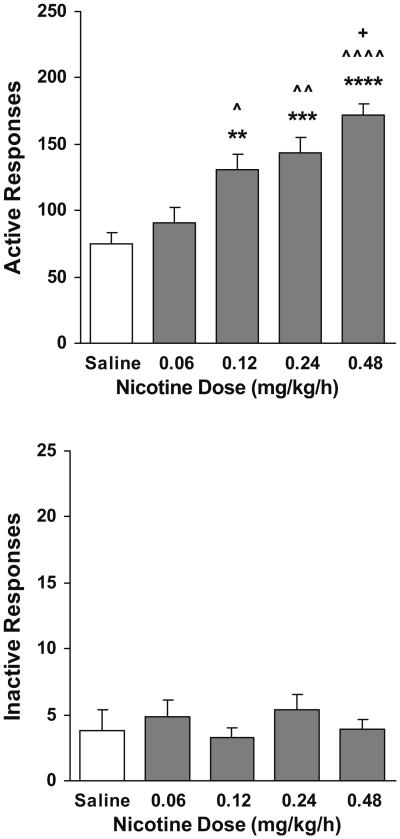
Objective: The present study determined the dose dependency of the ability of nicotine to increase lever-pressing responses maintained by a compound visual stimulus (VS) in rats and examined its sensitivity to pharmacological antagonism of nicotinic acetylcholine receptors (nAChRs).
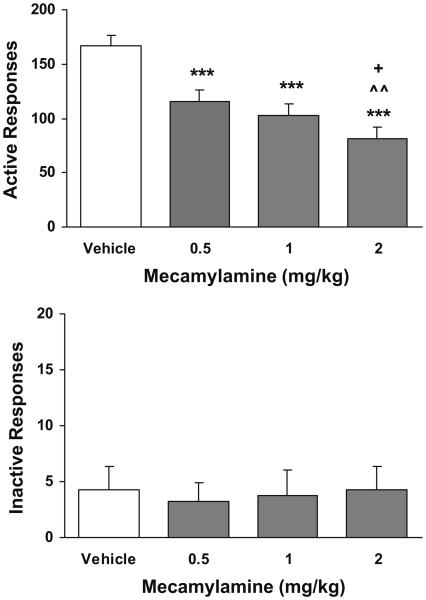
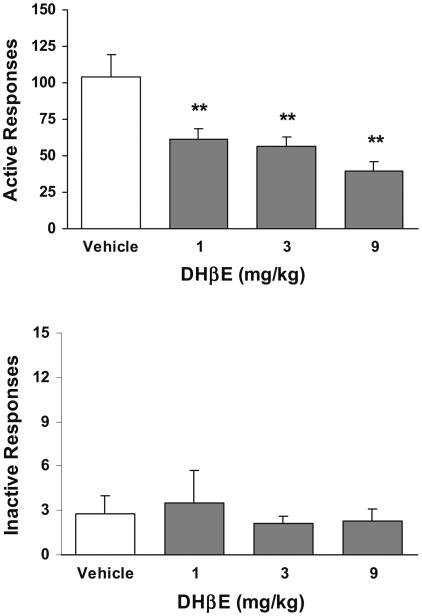
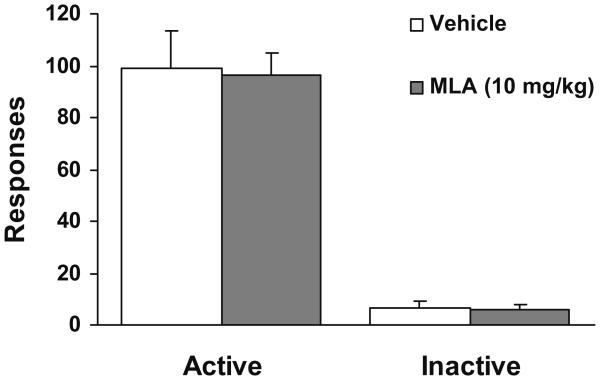
Materials and methods: Male Sprague-Dawley rats were trained in daily 1-h sessions to lever press for delivery of a VS (1 s lever light on and 60 s house light off) on a fixed ratio 5 schedule. During these sessions, eight scheduled response-independent intravenous infusions of nicotine (total amount: 0, 0.06, 0.12, 0.24, 0.48 mg kg(-1) h(-1)) were delivered. In pharmacological tests, a nonselective nAChR antagonist mecamylamine, alpha4beta2-selective antagonist dihydro-beta-erythroidine (DHbetaE), and alpha7-selective antagonist methyllycaconitine (MLA) were administered in different groups of rats 30 min before the session.
Results: The VS maintained a moderate level of lever-pressing responses and nicotine dose-dependently increased responses for the VS presentations. Preteatment of mecamylamine and DHbetaE but not MLA significantly attenuated the nicotine-enhanced responding. However, mecamylamine had no effect on responding for the VS in rats that received scheduled saline infusions.
Conclusions: These results demonstrate dose dependency of the reinforcement-enhancing effect of nicotine and suggest that activation of the alpha4beta2- but not alpha7-containing nAChRs may mediate this effect.
Figures


References
-
- Alkondon M, Pereira EF, Wonnacott S, Albuquerque EX. Blockade of nicotinic currents in hippocampal neurons defines methyllycaconitine as a potent and specific receptor antagonist. Mol Pharmacol. 1992;41:802–808. - PubMed
-
- Brunzell DH, Chang JR, Schneider B, Olausson P, Taylor JR, Picciotto MR. Beta2-subunit-containing nicotinic acetylcholine receptors are involved in nicotine-induced increases in conditioned reinforcement but not progressive ratio responding for food in C57BL/6 mice. Psychopharmacology (Berl) 2006;184:328–338. - PubMed
-
- Caggiula AR, Donny EC, White AR, Chaudhri N, Booth S, Gharib MA, Hoffman A, Perkins KA, Sved AF. Cue dependency of nicotine self-administration and smoking. Pharmacol Biochem Behav. 2001;70:515–530. - PubMed
-
- Caggiula AR, Donny EC, White AR, Chaudhri N, Booth S, Gharib MA, Hoffman A, Perkins KA, Sved AF. Environmental stimuli promote the acquisition of nicotine self-administration in rats. Psychopharmacology (Berl) 2002;163:230–237. - PubMed
-
- Chaudhri N, Caggiula AR, Donny EC, Palmatier MI, Liu X, Sved AF. Complex interactions between nicotine and nonpharmacological stimuli reveal multiple roles for nicotine in reinforcement. Psychopharmacology (Berl) 2006;184:353–366. - PubMed
Publication types
MeSH terms
Substances
Grants and funding
LinkOut - more resources
Full Text Sources
