. 2007 Jul 7:7:6.
doi: 10.1186/1471-2253-7-6.

Gabapentin and postoperative pain: a qualitative and quantitative systematic review, with focus on procedure

Affiliations

Gabapentin and postoperative pain: a qualitative and quantitative systematic review, with focus on procedure

Ole Mathiesen et al. BMC Anesthesiol. .

Abstract

Background: Gabapentin is an antiepileptic drug used in a variety of chronic pain conditions. Increasing numbers of randomized trials indicate that gabapentin is effective as a postoperative analgesic. This procedure-specific systematic review aims to analyse the 24-hour postoperative effect of gabapentin on acute pain in adults.

Methods: Medline, The Cochrane Library and Google Scholar were searched for double-blind randomized placebo controlled trials of gabapentin for postoperative pain relief compared with placebo, in adults undergoing a surgical procedure. Qualitative analysis of postoperative effectiveness was evaluated by assessment of significant difference (P < 0.05) in pain relief using consumption of supplemental analgesic and pain scores between study groups. Quantitative analyses of combined data from similar procedures, were performed by calculating the weighted mean difference (WMD) of 24-hour cumulated opioid requirements, and the WMD for visual analogue scale (VAS) pain, (early (6 h) and late (24 h) postoperatively), between study groups. Side-effects (nausea, vomiting, dizziness and sedation) were extracted for calculation of their relative risk (RR).

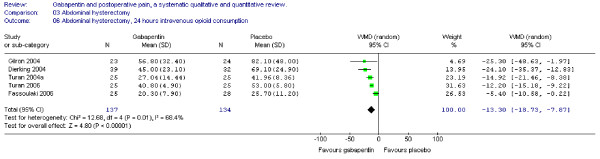
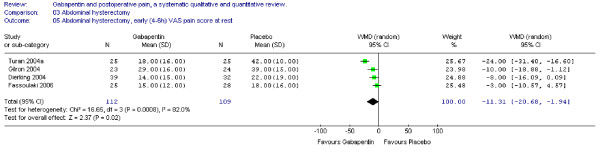
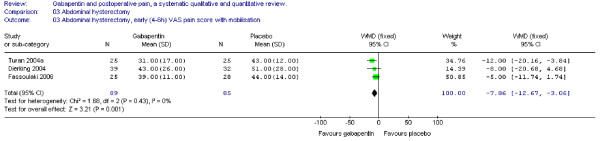
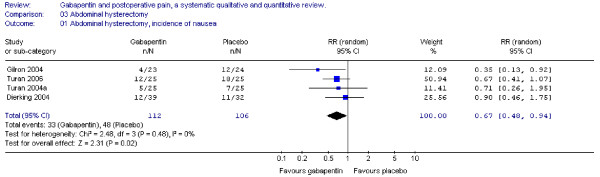
Results: Twenty-three trials with 1529 patients were included. In 12 of 16 studies with data on postoperative opioid requirement, the reported 24-hour opioid consumption was significantly reduced with gabapentin. Quantitative analysis of five trials in abdominal hysterectomy showed a significant reduction in morphine consumption (WMD - 13 mg, 95% confidence interval (CI) -19 to -8 mg), and in early pain scores at rest (WMD - 11 mm on the VAS, 95% CI -12 to -2 mm) and during activity (WMD -8 mm on the VAS; 95% CI -13 to -3 mm), favouring gabapentin. In spinal surgery, (4 trials), analyses demonstrated a significant reduction in morphine consumption (WMD of - 31 mg (95%CI - 53 to -10 mg) and pain scores, early (WMD - 17 mm on the VAS; 95 % CI -31 to -3 mm) and late (WMD -12 mm on the VAS; 95% CI -23 to -1 mm) also favouring gabapentin treatment. Nausea was improved with gabapentin in abdominal hysterectomy (RR 0.7; 95 % CI 0.5 to 0.9). Other side-effects were unaffected.

Conclusion: Perioperative use of gabapentin has a significant 24-hour opioid sparing effect and improves pain score for both abdominal hysterectomy and spinal surgery. Nausea may be reduced in abdominal hysterectomy.


Figures
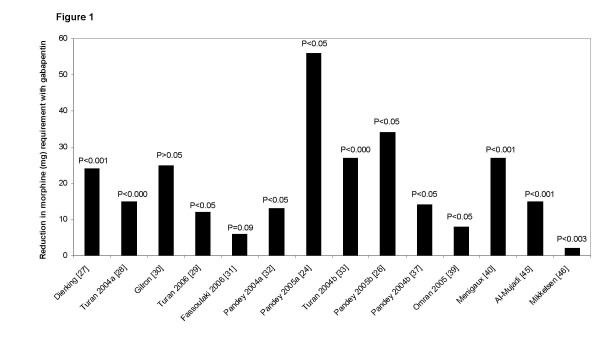
Figure 1
Figure 1
Reduction in post-operative morphine requirements with gabapentin vs. placebo. Data are calculated from the mean consumption of patient controlled analgesia (PCA) (21,23,24,25,26,27,28,30,36,37), 'on demand' administered analgesia (29,34) or analgesia 'administered at home by the patient' (43) in each study group from 0 to 24 h post-operatively.
Figure 2
Figure 2
Meta-analysis. 24 hours cumulative morphine (mg) consumption for patients in abdominal hysterectomy receiving gabapentin preoperatively. WMD, weighted mean difference; CI, confidence interval.
Figure 3
Figure 3
Meta-analysis. Visual analogue pain (VAS) score (0–100 mm) early (4–6 h) at rest for patients in abdominal hysterectomy receiving gabapentin preoperatively. WMD, weighted mean difference; CI, confidence interval.
Figure 4
Figure 4
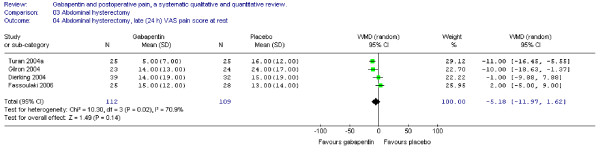
Meta-analysis. Visual analogue pain (VAS) score (0–100 mm) late (24 h) at rest for patients in abdominal hysterectomy receiving gabapentin preoperatively. WMD, weighted mean difference; CI, confidence interval.
Figure 5
Figure 5
Meta-analysis. Visual analogue pain (VAS) score (0–100 mm) early (4–6 h) with mobilization for patients in abdominal hysterectomy receiving gabapentin preoperatively. WMD, weighted mean difference; CI, confidence interval.
Figure 6
Figure 6
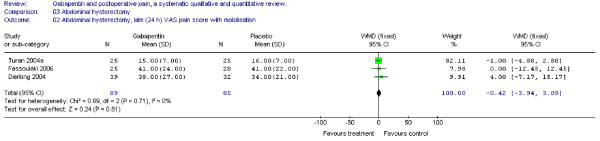
Meta-analysis. Visual analogue pain (VAS) score (0–100 mm) late (24 h) with mobilization for patients in abdominal hysterectomy receiving gabapentin preoperatively. WMD, weighted mean difference; CI, confidence interval.
Figure 7
Figure 7
Meta-analysis. Side-effects, incidence of nausea for patients in abdominal hysterectomy receiving gabapentin preoperatively. RR, relative risk; CI, confidence interval.
Figure 8
Figure 8
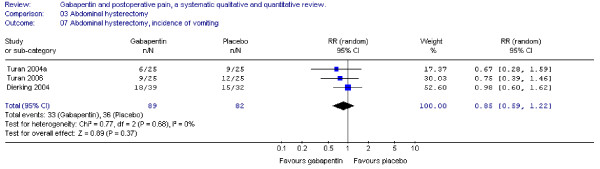
Meta-analysis. Side-effects, incidence of vomiting for patients in abdominal hysterectomy receiving gabapentin preoperatively. RR, relative risk; CI, confidence interval.
Figure 9
Figure 9
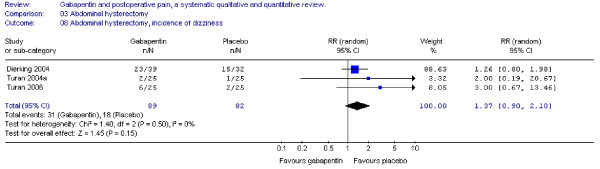
Meta-analysis. Side-effects, incidence of dizziness for patients in abdominal hysterectomy receiving gabapentin preoperatively. RR, relative risk; CI, confidence interval.
Figure 10
Figure 10
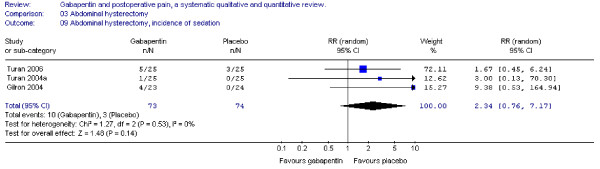
Side-effects, incidence of sedation for patients in abdominal hysterectomy receiving gabapentin preoperatively. RR, relative risk; CI, confidence interval.
Figure 11
Figure 11
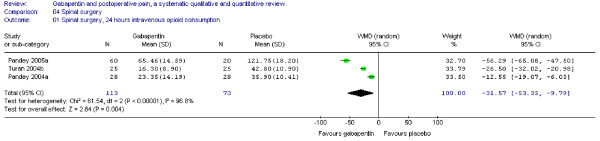
Meta-analysis. 24 hours cumulative morphine (mg) consumption for patients in spinal surgery receiving gabapentin preoperatively. WMD, weighted mean difference; CI, confidence interval.
Figure 12
Figure 12
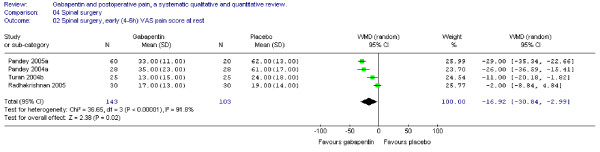
Meta-analysis. Visual analogue pain (VAS) score (0–100 mm) early (4–6 h) at rest for patients in spinal surgery receiving gabapentin preoperatively. WMD, weighted mean difference; CI, confidence interval.
Figure 13
Figure 13
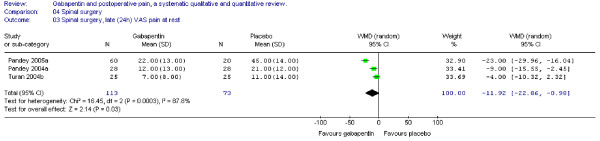
Meta-analysis. Visual analogue pain (VAS) score (0–100 mm) late (24 h) at rest for patients in spinal surgery receiving gabapentin preoperatively. WMD, weighted mean difference; CI, confidence interval.
Figure 14
Figure 14
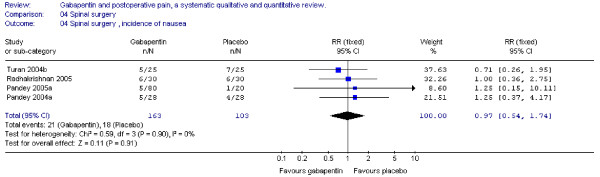
Meta-analysis. Side-effects, incidence of nausea for patients in spinal surgery receiving gabapentin preoperatively. RR, relative risk; CI, confidence interval.
Figure 15
Figure 15
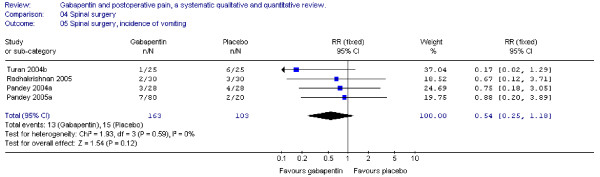
Meta-analysis. Side-effects, incidence of vomiting for patients in spinal surgery receiving gabapentin preoperatively. RR, relative risk; CI, confidence interval.
Figure 16
Figure 16
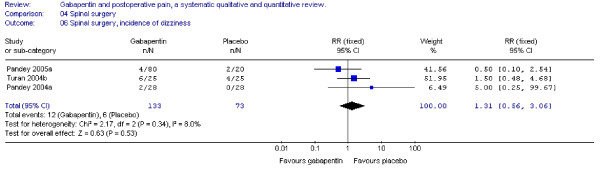
Meta-analysis. Side-effects, incidence of dizziness for patients in spinal surgery receiving gabapentin preoperatively. RR, relative risk; CI, confidence interval.
Figure 17
Figure 17
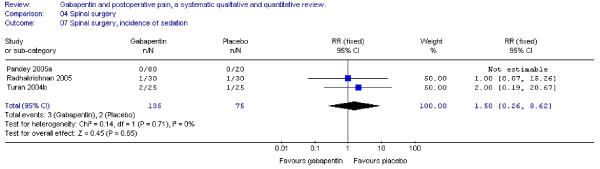
Meta-analysis. Side-effects, incidence of sedation for patients in spinal surgery receiving gabapentin preoperatively. RR, relative risk; CI, confidence interval.

References

    1. Kehlet H, Dahl JB. Anaesthesia, surgery, and challenges in postoperative recovery. The Lancet. 2003;362:1921–28. doi: 10.1016/S0140-6736(03)14966-5. - DOI - PubMed
    1. Backonja M, Beydoun A, Edwards KR, Schwarts SL, Fonseca V, Hes M, LaMoreaux L, Garofalo E. Gabapentin for the symptomatic treatment of painful neuropathy in patients with diabetes mellitus: a randomised controlled trial. JAMA. 1998;280:1831–1836. doi: 10.1001/jama.280.21.1831. - DOI - PubMed
    1. Rowbotham M, Harden N, Stacey B, Bernstein P, Magnus Muller L. Gabapentin for the treatment of postherpetic neuralgia. JAMA. 1998;280:1837–1842. doi: 10.1001/jama.280.21.1837. - DOI - PubMed
    1. Serpell MG. Gabapentin in neuropathic pain syndromes: a randomised, double-blind, placebo-controlled trial. Pain. 2002;99:557–566. doi: 10.1016/S0304-3959(02)00255-5. - DOI - PubMed
    1. Maneuf YP, Gonzalez MI, Sutton KS, Chung FZ, Pinnock RD, Lee K. Cellular and molecular action of the putative GABA-mimetic, gabapentin. Cell Mol Life Sci. 2003;60:742–750. doi: 10.1007/s00018-003-2108-x. - DOI - PMC - PubMed