


Homer proteins in Ca2+ signaling by excitable and non-excitable cells
- PMID: 17618683
- PMCID: PMC2100435
- DOI: 10.1016/j.ceca.2007.05.007
Homer proteins in Ca2+ signaling by excitable and non-excitable cells
Abstract
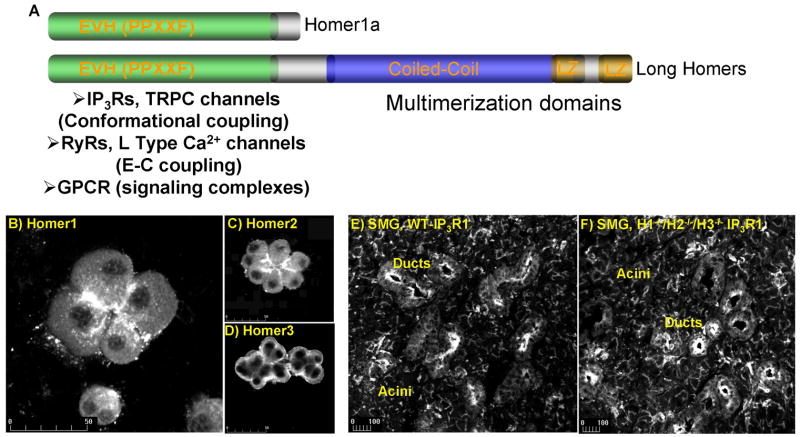
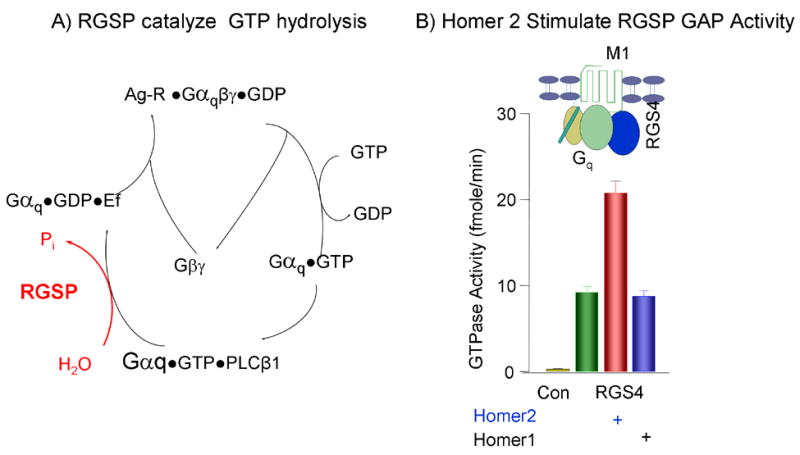
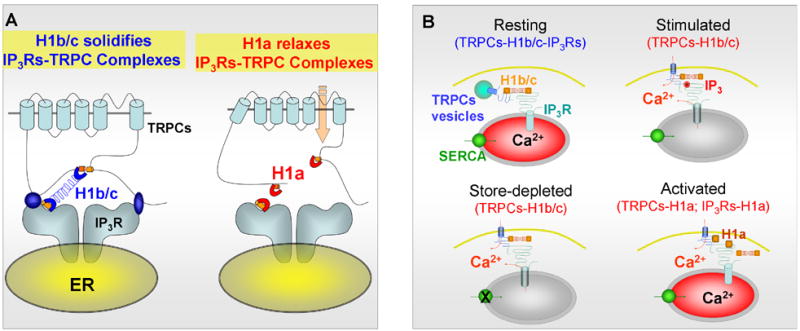
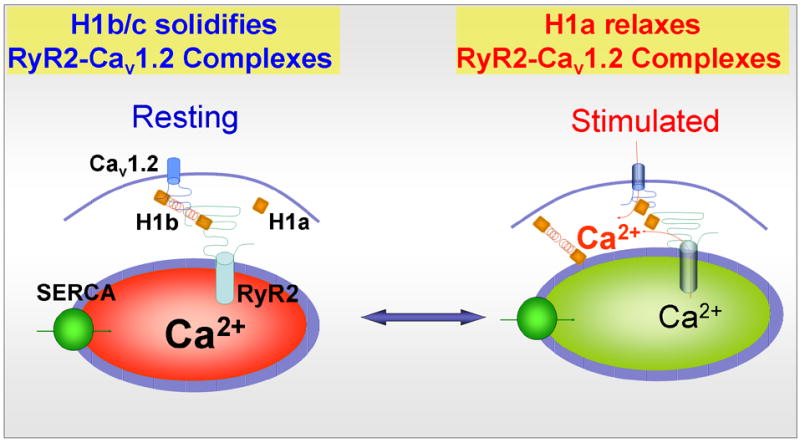
Homers are scaffolding proteins that bind Ca(2+) signaling proteins in cellular microdomains. The Homers participate in targeting and localization of Ca(2+) signaling proteins in signaling complexes. However, recent work showed that the Homers are not passive scaffolding proteins, but rather they regulate the activity of several proteins within the Ca(2+) signaling complex in an isoform-specific manner. Homer2 increases the GAP activity of RGS proteins and PLCbeta that accelerate the GTPase activity of Galpha subunits. Homer1 gates the activity of TRPC channels, controls the rates of their translocation and retrieval from the plasma membrane and mediates the conformational coupling between TRPC channels and IP(3)Rs. Homer1 stimulates the activity of the cardiac and neuronal L-type Ca(2+) channels Ca(v)1.2 and Ca(v)1.3. Homer1 also mediates the communication between the cardiac and smooth muscle ryanodine receptor RyR2 and Ca(v)1.2 to regulate E-C coupling. In many cases the Homers function as a buffer to reduce the intensity of Ca(2+) signaling and create a negative bias that can be reversed by the immediate early gene form of Homer1. Hence, the Homers should be viewed as the buffers of Ca(2+) signaling that ensure a high spatial and temporal fidelity of the Ca(2+) signaling and activation of downstream effects.
Figures
References
-
- Kato A, Ozawa F, Saitoh Y, Fukazawa Y, Sugiyama H, Inokuchi K. Novel members of the Vesl/Homer family of PDZ proteins that bind metabotropic glutamate receptors. J Biol Chem. 1998;273:23969–75. - PubMed
-
- Brakeman PR, Lanahan AA, O'Brien R, Roche K, Barnes CA, Huganir RL, Worley PF. Homer: a protein that selectively binds metabotropic glutamate receptors. Nature. 1997;386:284–8. - PubMed
-
- Xiao B, Tu JC, Worley PF. Homer: a link between neural activity and glutamate receptor function. Curr Opin Neurobiol. 2000;10:370–4. - PubMed
-
- Soloviev MM, Ciruela F, Chan WY, McIlhinney RA. Molecular characterisation of two structurally distinct groups of human homers, generated by extensive alternative splicing. J Mol Biol. 2000;295:1185–200. - PubMed
Publication types
MeSH terms
Substances
Grants and funding
LinkOut - more resources
Full Text Sources
Miscellaneous
