


Clinical relevance of ceramide metabolism in the pathogenesis of human head and neck squamous cell carcinoma (HNSCC): attenuation of C(18)-ceramide in HNSCC tumors correlates with lymphovascular invasion and nodal metastasis
- PMID: 17619081
- PMCID: PMC2084356
- DOI: 10.1016/j.canlet.2007.06.003
Clinical relevance of ceramide metabolism in the pathogenesis of human head and neck squamous cell carcinoma (HNSCC): attenuation of C(18)-ceramide in HNSCC tumors correlates with lymphovascular invasion and nodal metastasis
Abstract
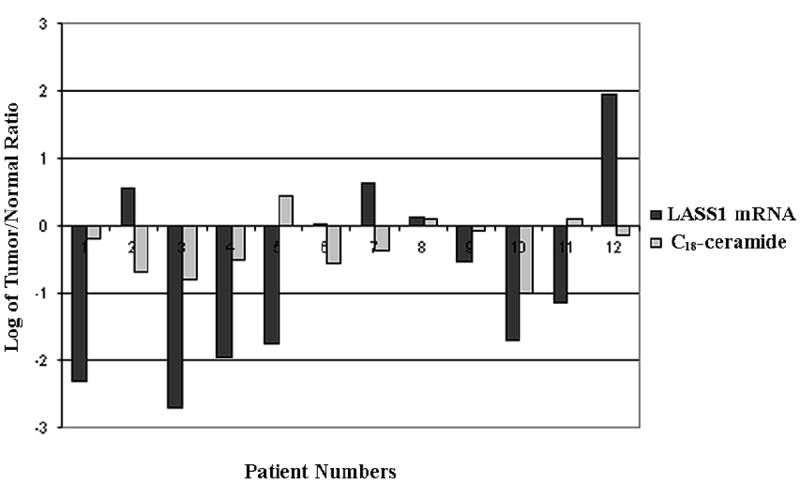
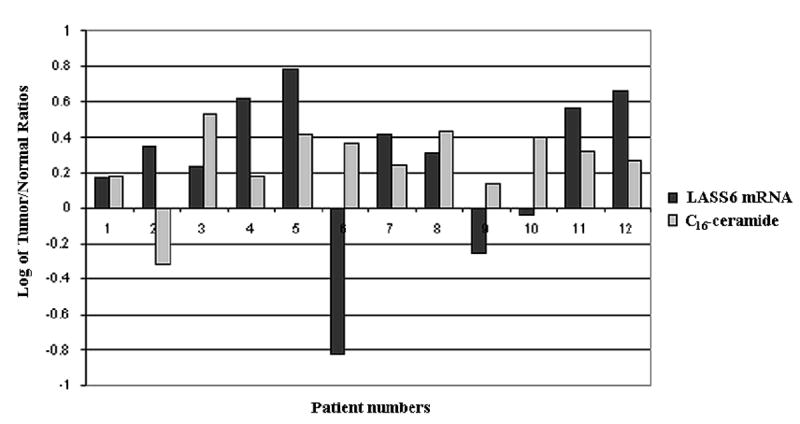
It has been documented previously that defects in the generation of C(18)-ceramide, a product of ceramide synthase 1 (CerS1), also known as longevity assurance gene 1 (hLASS1), play important roles in the pathogenesis and/or progression of HNSCC. However, whether altered levels of ceramide generation in HNSCC tumors have any clinical relevance remains unknown. In this study, the levels of endogenous ceramides were measured in tumor tissues of 45 HNSCC patients as compared to their normal tissues using high-pressure liquid chromatography/mass spectrometry (LC/MS), and then possible link between ceramide levels and the clinical parameters of HNSCC were examined. The data showed that the levels of C(16)-, C(24)-, C(24:1)-ceramides were significantly elevated in the majority of tumor tissues compared to their normal tissues, while the levels of only C(18)-ceramide were significantly decreased in HNSCC tumors, especially in tumor tissues of male patients. Importantly, it was also shown here that decreased C(18)-ceramide levels in HNSCC tumor tissues were significantly associated with the higher incidences of lymphovascular invasion, and pathologic nodal metastasis. Importantly, attenuation of C(18)-ceramide was also positively linked to the higher overall stages of the primary HNSCC tumors. Therefore, these data suggest, for the first time, that the defects in the generation/accumulation of C(18)-ceramide might have important clinical roles in HNSCC, especially in lymphovascular invasion and nodal disease.
Figures
References
-
- Jemal A, Murray T, Ward E, Samuels A, Tiwari RC, Ghafoor A, Feuer EJ, Thun MJ. Cancer statistics. CA Cancer J Clin. 2005;55:10–30. - PubMed
-
- Ogretmen B, Hannun YA. Biologically active sphingolipids in cancer pathogenesis and treatment. Nat Rev Cancer. 2004;4:604–616. - PubMed
-
- Igarashi Y, Kitamura K, Toyokuni T, Dean B, Fenderson B, Ogawass T, Hokomori S. A specific enhancing effect of N,N-dimethylsphingosine on epidermal growth factor receptor autophosphorylation. Demonstration of its endogenous occurrence (and the virtual absence of unsubstituted sphingosine) in human epidermoid carcinoma A431 cells. J Biol Chem. 1990;265:5385–5389. - PubMed
-
- Goldkorn T, Dressler KA, Muindi J, Radin NS, Mendelsohn J, Menaldino D, Liotta D, Kolesnick RN. Ceramide stimulates epidermal growth factor receptor phosphorylation in A431 human epidermoid carcinoma cells. Evidence that ceramide may mediate sphingosine action. J Biol Chem. 1991;266:16092–16097. - PubMed
Publication types
MeSH terms
Substances
Grants and funding
LinkOut - more resources
Full Text Sources
Other Literature Sources
Medical
