


An emerin "proteome": purification of distinct emerin-containing complexes from HeLa cells suggests molecular basis for diverse roles including gene regulation, mRNA splicing, signaling, mechanosensing, and nuclear architecture
- PMID: 17620012
- PMCID: PMC2635128
- DOI: 10.1021/bi602636m
An emerin "proteome": purification of distinct emerin-containing complexes from HeLa cells suggests molecular basis for diverse roles including gene regulation, mRNA splicing, signaling, mechanosensing, and nuclear architecture
Abstract
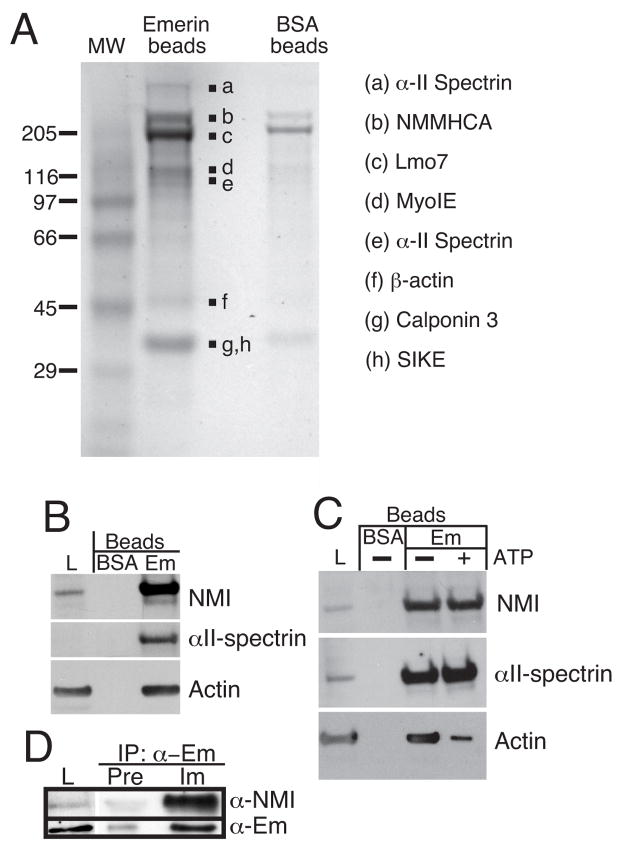
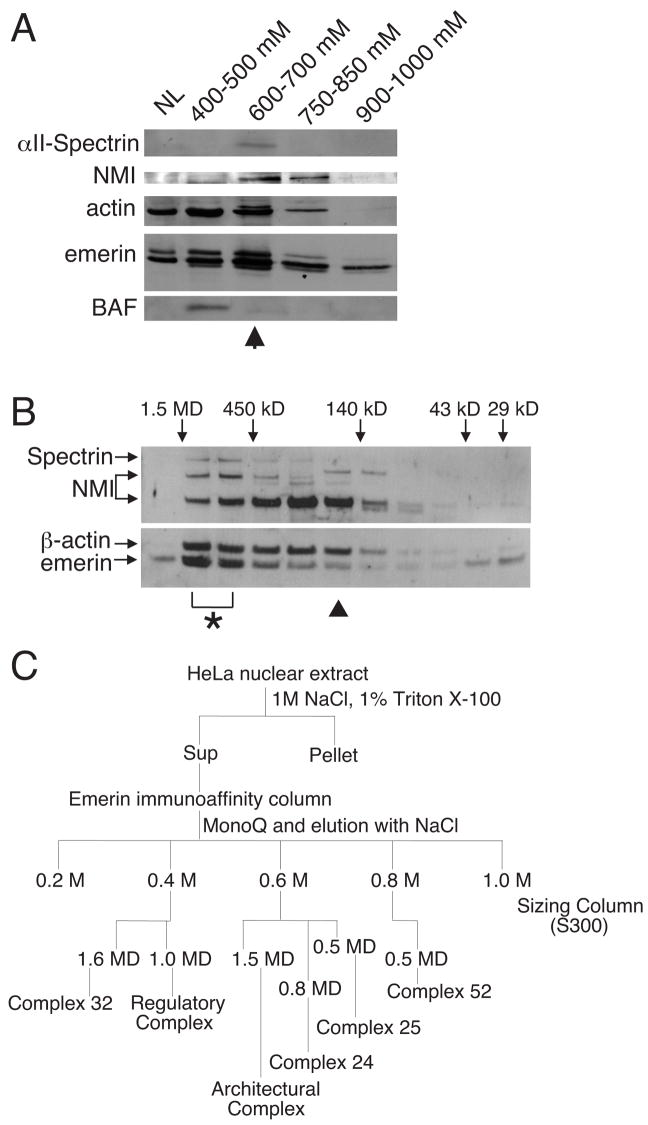
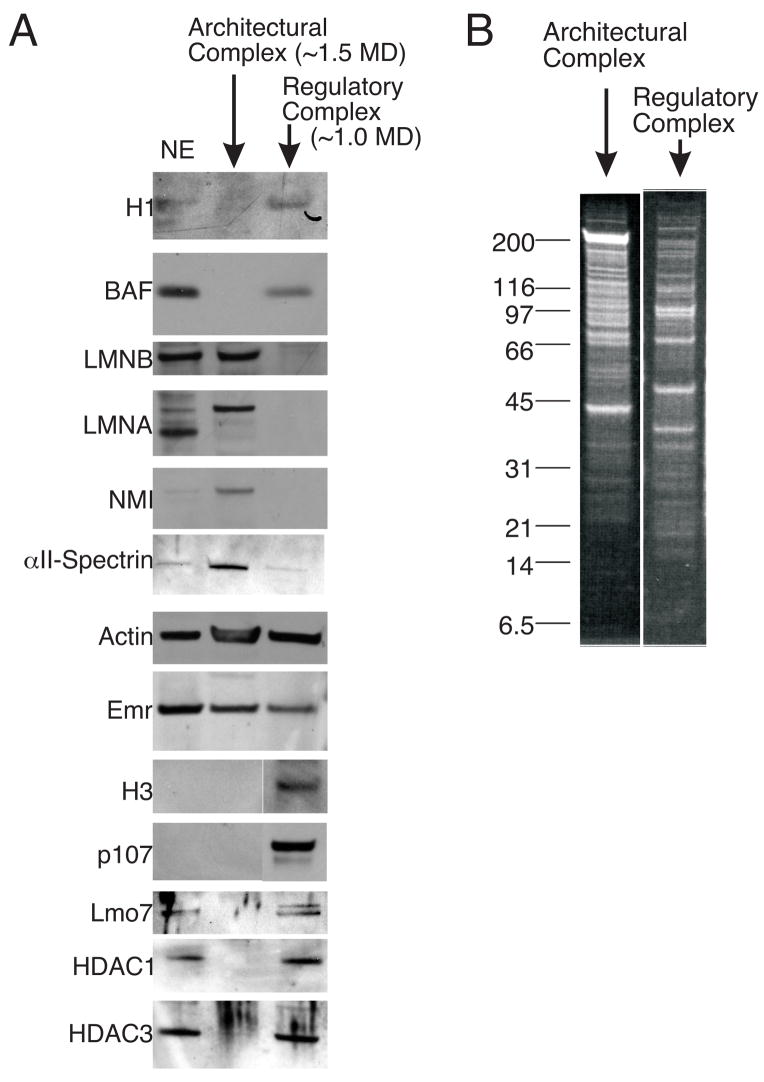
Using recombinant bead-conjugated emerin, we affinity-purified seven proteins from HeLa cell nuclear lysates that bind emerin either directly or indirectly. These proteins were identified by mass spectrometry as nuclear alphaII-spectrin, nonmuscle myosin heavy chain alpha, Lmo7 (a predicted transcription regulator; reported separately), nuclear myosin I, beta-actin (reported separately), calponin 3, and SIKE. We now report that emerin binds nuclear myosin I (NMI, a molecular motor) directly in vitro. Furthermore, bead-conjugated emerin bound nuclear alphaII-spectrin and NMI equally well with or without ATP (which stimulates motor activity), whereas ATP decreased actin binding by 65%. Thus alphaII-spectrin and NMI interact stably with emerin. To investigate the physiological relevance of these interactions, we used antibodies against emerin to affinity-purify emerin-associated protein complexes from HeLa cells and then further purified by ion-exchange chromatography to resolve by net charge and by size exclusion chromatography yielding six distinct emerin-containing fractions (0.5-1.6 MDa). Western blotting suggested that each complex had distinct components involved in nuclear architecture (e.g., NMI, alphaII-spectrin, lamins) or gene or chromatin regulation (BAF, transcription regulators, HDACs). Additional constituents were identified by mass spectrometry. One putative gene-regulatory complex (complex 32) included core components of the nuclear corepressor (NCoR) complex, which mediates gene regulation by thyroid hormone and other nuclear receptors. When expressed in HeLa cells, FLAG-tagged NCoR subunits Gps2, HDAC3, TBLR1, and NCoR each co-immunoprecipitated emerin, validating one putative complex. These findings support the hypothesis that emerin scaffolds a variety of functionally distinct multiprotein complexes at the nuclear envelope in vivo. Notably included are nuclear myosin I-containing complexes that might sense and regulate mechanical tension at the nuclear envelope.
Figures


References
-
- Emery AE. Emery-Dreifuss muscular dystrophy-a 40 year retrospective. Neuromuscul Disord. 2000;10:228–232. - PubMed
-
- Bengtsson L, Wilson KL. Multiple and surprising new functions for emerin, a nuclear membrane protein. Curr Opin Cell Biol. 2004;16:73–79. - PubMed
-
- Nagano A, Koga R, Ogawa M, Kurano Y, Kawada J, Okada R, Hayashi YK, Tsukahara T, Arahata K. Emerin deficiency at the nuclear membrane in patients with Emery- Dreifuss muscular dystrophy. Nat Genet. 1996;12:254–259. - PubMed
-
- Segura-Totten M, Wilson K. BAF: roles in chromatin, nuclear structure and retrovirus integration. Trends Cell Biol. 2004;14:261–266. - PubMed
-
- Margalit A, Brachner A, Gotzmann J, Foisner R, Gruenbaum Y. Barrier-to-autointegration factor--a BAFfling little protein. Trends Cell Biol. 2007;17:202–208. - PubMed
Publication types
MeSH terms
Substances
Grants and funding
LinkOut - more resources
Full Text Sources
