Review
. 2007 Jun;29(2):193-210.
doi: 10.1007/s00281-007-0077-0.

Neuroendocrine-immune disequilibrium and endometriosis: an interdisciplinary approach

Affiliations
Review

Neuroendocrine-immune disequilibrium and endometriosis: an interdisciplinary approach

Nadja Tariverdian et al. Semin Immunopathol. 2007 Jun.

Abstract

Endometriosis, a chronic disease characterized by endometrial tissue located outside the uterine cavity, affects one fourth of young women and is associated with chronic pelvic pain and infertility. However, an in-depth understanding of the pathophysiology and effective treatment strategies of endometriosis is still largely elusive. Inadequate immune and neuroendocrine responses are significantly involved in the pathophysiology of endometriosis, and key findings are summarized in the present review. We discuss here the role of different immune mechanisms particularly adhesion molecules, proteinglycan interactions, and pro-angiogenic mediators in the development and progression of the disease. Finally, we introduce the concept of endometrial dissemination as result of a neuroendocrine-immune disequilibrium in response to high levels of perceived stress caused by cardinal clinical symptoms of endometriosis.


Figures
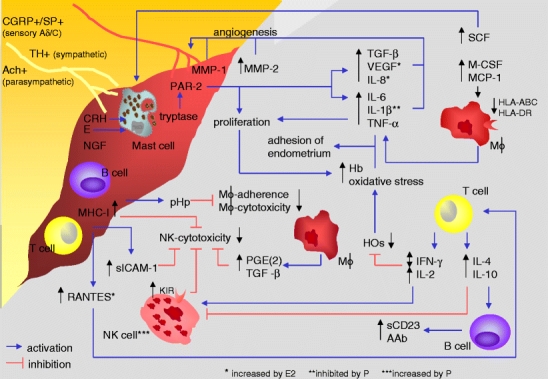
Fig. 1
Fig. 1
Neuroendocrine–immune disequilibrium in endometriosis. AAb autoantibodies, Ach achetylcholine, CGRP calcitonin-gene-related peptide, CRH corticotropin-releasing hormone, E estrogens, E2 estradiol, Hb hemoglobin, HO heme oxygenases, IL interleukin, HLA human leukocyte antigen, IFN-γ interferon-γ, KIR killer cell inhibitory receptor, M-CSF macrophage colony stimulating factor, MCP-1 monocyte chemotactic protein-1, MHC-I major histocompatibility complex class-I, MMP matrix metalloproteinase, NGF nerve growth factor, NK natural killer, P progesterone, PAR-2 protease-activated receptor-2, PGE(2) prostaglandin E(2), pHp peritoneal haptoglobin, RANTES regulated upon activation normal T cell expressed and secreted, sCD23 soluble CD23, SCF stem cell factor, sICAM-1 soluble intercellular adhesion molecule-1, SP substance P, TGF-β transforming growth factor-β, TH tyrosine hydroxylase, TNF-α tumor necrosis factor-α, VEGF vascular endothelial growth factor. In endometriosis, elevated levels of M-CSF, MCP-1, RANTES, and SCF in peritoneal fluid might lead to increased numbers of macrophages, T cells, and mast cells. Although markers of antigen presentation on macrophages such as HLA-ABC and HLA-DR are decreased in endometriosis, macrophage-derived IL-6, IL-1β, TNF-α, TGF-β, VEGF, and IL-8 are increased in peritoneal fluid, together with MMP-1 and MMP-2 stimulating angiogenesis. IL-6, IL-1β, and TNF-α support adhesion of endometrial cells to the peritoneum, and TNF-α stimulates the proliferation of ectopic tissue, resulting in high levels of Hb. T cell-derived IL-2 and IFN-γ decrease HO, leading to oxidative stress, and would, in sufficient levels, increase NK cell activity. IFN-γ has been inconsistently described as increased or decreased. Increased T cell-derived IL-4 and IL-10 inhibit cellular immunity and stimulate B cells to AAb production. sCD23 is increased in peritoneal fluid in endometriosis and might derive from activated B cells. Lymphocytes are increased in peritoneal fluid and abundantly present in ectopic tissue. Decreased NK cell cytotoxicity might be due to high anti-inflammatory T cytokines, increased KIR, high macrophage-derived PGE(2) and TGF-β, high MHC-I expression on ectopic cells, and high sICAM-1 levels in peritoneal fluid. Nerve fibers found within lesions are positive for CGRP, SP, TH, and Ach, and NGF and CRH were demonstrated. CRH and accumulated E can activate mast cells to release tryptase, activating PAR-2, which leads to increased secretion of VEGF, IL-8, and IL-6 and proliferation of ectopic tissue. pHp, expressed by ectopic tissue, decreases adherence and, in stage 3 and 4, cytotoxicity of peritoneal macrophages. E2 further increases RANTES, IL-8, and VEGF, whereas P inhibits IL-1β secretion from peritoneal macrophages and increases NK cell numbers
Fig. 2
Fig. 2
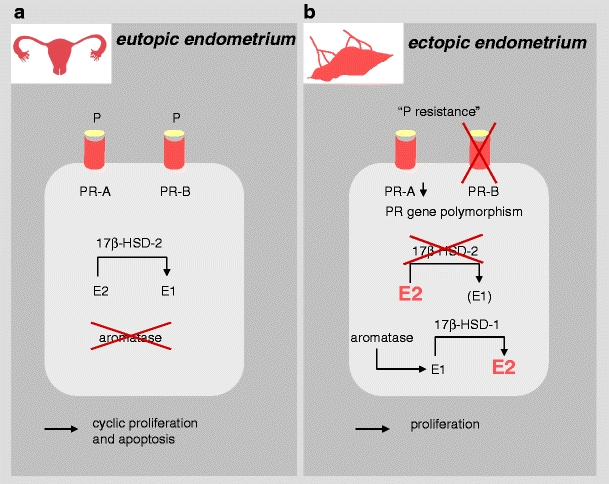
Progesterone resistance and estradiol accumulation in endometriosis. E1 estrone, E2 estradiol, P progesterone, PR progesterone receptor, 17β-HSD-1 17β-hydroxysteriod dehydrogenase type 1, 17β-HSD-2 17β-hydroxysteriod dehydrogenase type 2. a In normal endometrium, P actions are mediated by PR; its isoforms PR-A and PR-B are both expressed on the tissue. P indirectly induces 17β-HSD-2, which converts E2 to E1; aromatase is not expressed. Tissue proliferation is followed by cyclic apoptosis. b In endometriotic tissue, only low expression of PR-A and the lack of PR-B have been observed, which leads to a partial resistance to P actions. Additionally, a PR gene polymorphism has been described to be more frequent in patients with endometriosis, which may be additionally involved in the partial resistance to P actions. Low levels of 17β-HSD-2 along with the enzymatic activity of aromatase—which is exclusively found in endometriotic stroma—lead to an accumulation of E2. Hence, physiological cyclic regulation of proliferation and apoptosis is disrupted in endometriosis
Fig. 3
Fig. 3
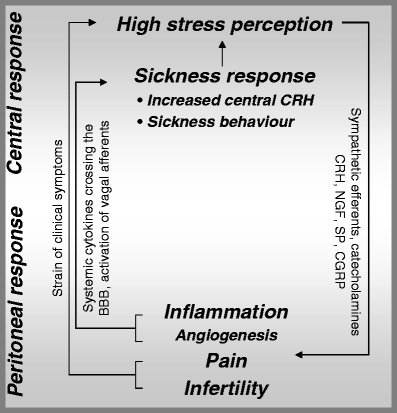
Hypothetical scenario for endometriosis: the ‘brain–body–brain cross talk’. BBB blood–brain barrier, CGRP calcitonin-gene-related peptide, CRH corticotropin-releasing hormone, NGF nerve growth factor, SP substance P. Perceived stress aggravates peritoneal inflammation and angiogenesis, chronic pain, and infertility in patients with endometriosis via neuronal pathways involving catecholamines, CRH, NGF, SP, and CGRP; this may be referred to as ‘brain–body cross talk’ because it involves central stress response pathways. Clearly, the aspect of infertility—a frequent clinical symptom in patients with endometriosis—may be perceived as an additional stressor besides stressors such as daily hassles. Peripheral ‘inflammatory stress’—as described in endometriosis—and the strain of clinical symptoms such as chronic pain may in turn induce a sickness response, which can be entitled ‘body–brain cross talk’. Such ‘body–brain cross talk’ may subsequently perpetuate stress perception and trigger the release of central CRH and the onset of behavioral alterations, i.e., sickness behavior, via elevated circulating pro-inflammatory cytokines bypassing/crossing the BBB or via stimulation of vagal afferents by peritoneal pro-inflammatory cytokines. As a result, a vicious circle of ‘brain–body–brain cross talk’ is closed in patients suffering from endometriosis

References

    1. None
    2. Rokitansky K (1860) Über Uterusdrüsen-Neubildung. Z Gesellschaft Aerzte (Wien) 16:577–581
    1. {'text': '', 'ref_index': 1, 'ids': [{'type': 'PubMed', 'value': '1939552', 'is_inner': True, 'url': 'https://pubmed.ncbi.nlm.nih.gov/1939552/'}]}
    2. Moen MH, Muus KM (1991) Endometriosis in pregnant and non-pregnant women at tubal sterilization. Hum Reprod 6:699–702 - PubMed
    1. {'text': '', 'ref_index': 1, 'ids': [{'type': 'PubMed', 'value': '2010001', 'is_inner': True, 'url': 'https://pubmed.ncbi.nlm.nih.gov/2010001/'}]}
    2. Koninckx PR, Meuleman C, Demeyere S, Lesaffre E, Cornillie FJ (1991) Suggestive evidence that pelvic endometriosis is a progressive disease, whereas deeply infiltrating endometriosis is associated with pelvic pain. Fertil Steril 55:759–765 - PubMed
    1. None
    2. Bruckner C (2004) Symptoms and diagnosis. In: Steck T, Felberbaum R, Küpker W, Bruckner C, Finas D (eds) Endometriosis. Development, diagnosis, progression, therapy. Springer, New York, pp 81–101
    1. None
    2. Steck T (2004) Manifestations and progression. In: Steck T, Felberbaum R, Küpker W, Bruckner C, Finas D (eds) Endometriosis. Development, diagnosis, progression, therapy. Springer, Berlin Heidelberg New York, pp 37–79

Publication types

MeSH terms