


Systemic and myocardial inflammation in traditional and off-pump cardiac surgery
- PMID: 17622361
- PMCID: PMC1894692
Systemic and myocardial inflammation in traditional and off-pump cardiac surgery
Abstract
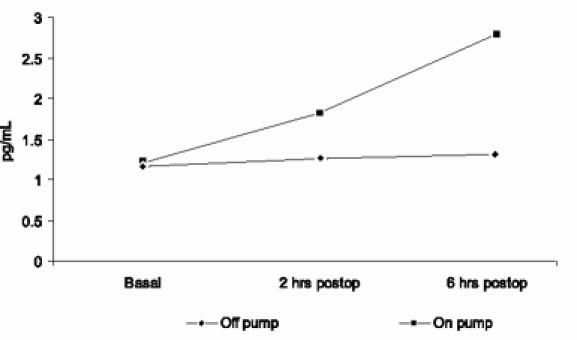
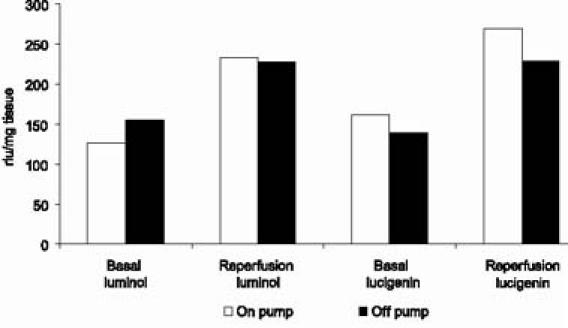
In this study, we attempted to determine the role of off-pump coronary artery bypass grafting (CABG) in the myocardial and systemic inflammatory responses. Twenty patients who underwent elective CABG were enrolled in this study. Ten patients underwent on-pump CABG, and 10 patients underwent off-pump CABG. There were no differences between patients in preoperative clinical variables. We took systemic venous blood samples for the measurement of tumor necrosis factor-alpha, the MB isoenzyme of creatine kinase (CK-MB), and cardiac troponin I, and we took myocardial biopsies from the interventricular septum for chemiluminescence assay of reactive oxygen species (hydroxyl, hydrogen peroxide, hypochlorite, and superoxide). There was no significant difference in the myocardial tissue release of hydrogen peroxide, hydroxyl, hypochlorite, and superoxide between the 2 groups (P > 0.05). The systemic tumor necrosis factor-alpha levels in the off-pump group were significantly lower than in the on-pump group (P <0.01). The cardiac troponin I and creatine kinase-MB levels at 6, 12, and 24 postoperative hours were not statistically different between the 2 groups (P >0.05). We conclude that off-pump CABG appears to reduce systemic inflammation, without reducing myocardial oxidative stress and inflammation.
Figures
Similar articles
-
Myocardial injury in coronary artery bypass grafting: on-pump versus off-pump comparison by measuring high-sensitivity C-reactive protein, cardiac troponin I, heart-type fatty acid-binding protein, creatine kinase-MB, and myoglobin release.J Thorac Cardiovasc Surg. 2008 May;135(5):1110-9, 1119.e1-10. doi: 10.1016/j.jtcvs.2007.12.029. J Thorac Cardiovasc Surg. 2008. PMID: 18455592 Clinical Trial.
-
Impact of intraoperative myocardial cellular damage on early hemodynamics after off-pump versus on-pump coronary artery bypass surgery.Eur J Med Res. 2005 May 20;10(5):218-26. Eur J Med Res. 2005. PMID: 15946923 Clinical Trial.
-
Myocardial revascularization with miniaturized extracorporeal circulation versus off pump: Evaluation of systemic and myocardial inflammatory response in a prospective randomized study.J Thorac Cardiovasc Surg. 2009 May;137(5):1206-12. doi: 10.1016/j.jtcvs.2008.09.074. Epub 2009 Feb 23. J Thorac Cardiovasc Surg. 2009. PMID: 19379993 Clinical Trial.
-
Does off-pump coronary artery bypass graft surgery have a beneficial effect on long-term mortality and morbidity compared with on-pump coronary artery bypass graft surgery?Interact Cardiovasc Thorac Surg. 2014 Jul;19(1):149-59. doi: 10.1093/icvts/ivu075. Epub 2014 Mar 21. Interact Cardiovasc Thorac Surg. 2014. PMID: 24659552 Review.
-
L-arginine impact on inflammatory and cardiac markers in patients undergoing coronary artery bypass graft: a systematic review and meta-analysis of randomized controlled trials.BMC Cardiovasc Disord. 2024 Nov 13;24(1):641. doi: 10.1186/s12872-024-04318-8. BMC Cardiovasc Disord. 2024. PMID: 39538180 Free PMC article.
Cited by
-
Post-operative atrial fibrillation: a maze of mechanisms.Europace. 2012 Feb;14(2):159-74. doi: 10.1093/europace/eur208. Epub 2011 Aug 6. Europace. 2012. PMID: 21821851 Free PMC article. Review.
-
Genomics: risk and outcomes in cardiac surgery.Anesthesiol Clin. 2008 Sep;26(3):399-417. doi: 10.1016/j.anclin.2008.04.002. Anesthesiol Clin. 2008. PMID: 18765214 Free PMC article.
-
Oxidant-antioxidant balance during on-pump coronary artery bypass grafting.ScientificWorldJournal. 2014;2014:263058. doi: 10.1155/2014/263058. Epub 2014 Aug 18. ScientificWorldJournal. 2014. PMID: 25302318 Free PMC article.
-
Auto-reactive myocarditis after percutaneous closure of an atrial septal defect.Intensive Care Med. 2008 Nov;34(11):2121-2. doi: 10.1007/s00134-008-1203-8. Epub 2008 Jul 4. Intensive Care Med. 2008. PMID: 18600312 No abstract available.
-
Change in Free Radical and Antioxidant Enzyme Levels in the Patients Undergoing Open Heart Surgery with Cardiopulmonary Bypass.Oxid Med Cell Longev. 2016;2016:1783728. doi: 10.1155/2016/1783728. Epub 2016 Dec 22. Oxid Med Cell Longev. 2016. PMID: 28101295 Free PMC article.
References
-
- Penttila HJ, Lepojarvi MV, Kiviluoma KT, Kuakoranta PK, Hassinen IE, Peuhkurinen KF. Myocardial preservation during coronary surgery with and without cardiopulmonary bypass. Ann Thorac Surg 2001;71:565–71. - PubMed
-
- Gundry SR, Romano MA, Shattuck OH, Razzouk AJ, Bailey LL. Seven-year follow-up of coronary artery bypasses performed with and without cardiopulmonary bypass. J Thorac Cardiovasc Surg 1998;115:1273–8. - PubMed
-
- Matata BM, Sosnowski AW, Galinanes M. Off-pump bypass graft operation significantly reduces oxidative stress and inflammation. Ann Thorac Surg 2000;69:785–91. - PubMed
-
- Alwan K, Falcoz PE, Alwan J, Mouawad W, Oujaimi G, Chocron S, Etievent JP. Beating versus arrested heart coronary revascularization: evaluation by cardiac troponin I release. Ann Thorac Surg 2004;77:2051–5. - PubMed
-
- Misoph M, Babin-Ebell J. Interindividual variations in cytokine levels following cardiopulmonary bypass. Heart Vessels 1997;12:119–27. - PubMed
Publication types
MeSH terms
Substances
LinkOut - more resources
Full Text Sources
Medical
Research Materials
Miscellaneous