


doi: 10.1901/jaba.2007.119-05.
Further analysis of the matching law to describe two- and three-point shot allocation by professional basketball players
Affiliations
- PMID: 17624070
- PMCID: PMC1885414
- DOI: 10.1901/jaba.2007.119-05
Item in Clipboard
Further analysis of the matching law to describe two- and three-point shot allocation by professional basketball players
J Appl Behav Anal.
2007 Summer.
Abstract
The matching law was used to analyze whether the proportion of shots taken from two- or three-point range would match the proportional reinforcement rates produced by those shots when the reinforcement rate of three-point shooting was changed. Rule changes in 1994 and 1997 altered the distance of the three-point line in the National Basketball Association, which created a quasiexperimental reversal design, thereby naturally changing three-point reinforcement rates. The present data partially confirmed predictions made by the matching law, in that increases in the relative rate of three-point shots attempted corresponded to increases in the relative rate of three-point shots made.
Figures
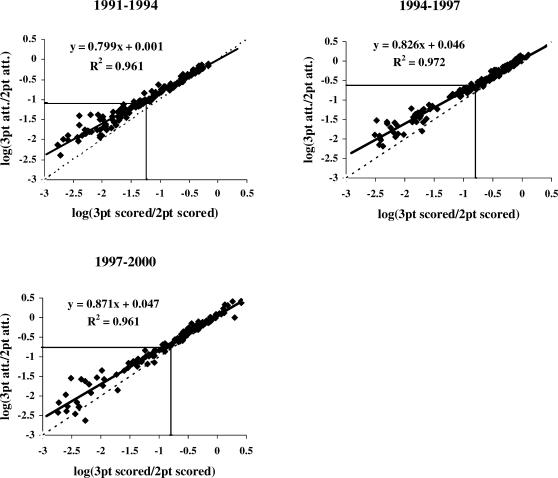
Log response ratios plotted against log reinforcer ratios for the three different conditions of the study. Data from 57 players who made at least one three-point basket for each 3-year period are included. Each point represents data from one player for one 3-year period. The dashed horizontal lines represent the log of the mean response ratio for all players during each 3-year period. The solid diagonal line is a best fit line for all points. The equation describes the best fit line and displays sensitivity (slope) and bias (y intercept), and the dashed diagonal line represents perfect matching.
References
-
- Hubbard J, editor. The official NBA encyclopedia (3rd ed.) New York: Doubleday; 2000.
MeSH terms
LinkOut - more resources
Full Text Sources
