


Familial breast/ovarian cancer and BRCA1/2 genetic screening: the role of immunohistochemistry as an additional method in the selection of patients
- PMID: 17625228
- PMCID: PMC3957528
- DOI: 10.1369/jhc.7A7209.2007
Familial breast/ovarian cancer and BRCA1/2 genetic screening: the role of immunohistochemistry as an additional method in the selection of patients
Abstract
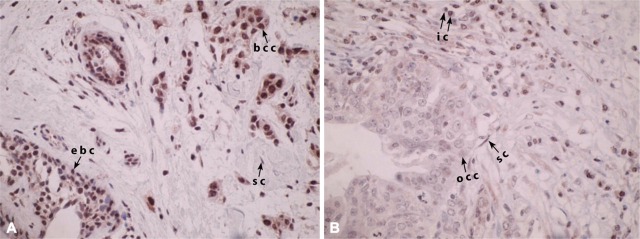
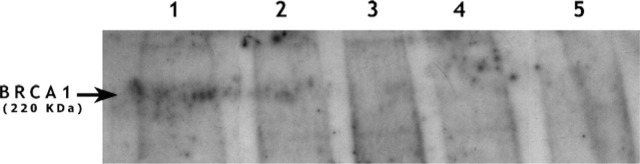
Only 20-25% of families screened for BRCA1/2 mutations are found positive. Because only a positive result is informative, we studied the role of BRCA1/2 immunohistochemistry as an additional method for patient selection. From 53 high-risk-affected probands, 18 (34%) had available paraffin blocks of their tumors and were selected for this study. Mutation screening was done by conformation-sensitive gel electrophoresis and multiplex ligation-dependent probe amplification. For immunohistochemistry, 21 neoplastic specimens (15 breast carcinomas, 5 ovary neoplasms, and 1 rectal adenocarcinoma) were analyzed with BRCA1 (monoclonal antibody, Ab-1, oncogene) and BRCA2 (polyclonal antibody, Ab-2, oncogene) antibodies. Absence of the BRCA1 protein was confirmed in negative tumors by Western blotting. Seven patients were positive for BRCA1/2 mutations: 5 for BRCA1 and 2 for BRCA2. Four out of five positive patients had tumors negative for BRCA1 immunostaining, and the remaining 13 BRCA1-negative patients had positive BRCA1 immunostaining in all tumor samples. Sensitivity to predict for BRCA1 mutation carriers was 80%, and specificity was 100%, with a positive predictive value of 100% and a negative predictive value of 93%. This correlation was statistically significant (p=0.001). No correlation was observed for BRCA2. If larger studies confirm these results, high-risk patients with BRCA1-negative tumors should be screened first for this gene.
Figures
Similar articles
-
BRCA1 and BRCA2 mutations in males with familial breast and ovarian cancer syndrome. Results of a Spanish multicenter study.Fam Cancer. 2015 Dec;14(4):505-13. doi: 10.1007/s10689-015-9814-z. Fam Cancer. 2015. PMID: 26026974
-
Screening for genomic rearrangements in BRCA1 and BRCA2 genes in Czech high-risk breast/ovarian cancer patients: high proportion of population specific alterations in BRCA1 gene.Breast Cancer Res Treat. 2010 Nov;124(2):337-47. doi: 10.1007/s10549-010-0745-y. Epub 2010 Feb 5. Breast Cancer Res Treat. 2010. PMID: 20135348
-
Ovarian cancer risk in Ashkenazi Jewish carriers of BRCA1 and BRCA2 mutations.Clin Cancer Res. 2002 Dec;8(12):3776-81. Clin Cancer Res. 2002. PMID: 12473589
-
The molecular pathology of hereditary breast cancer: genetic testing and therapeutic implications.Mod Pathol. 2005 Oct;18(10):1305-20. doi: 10.1038/modpathol.3800453. Mod Pathol. 2005. PMID: 15933754 Review.
-
[Breast cancer in BRCA1/2 mutation carriers].Cesk Patol. 2016 Fall;52(4):206-209. Cesk Patol. 2016. PMID: 27869445 Review. Czech.
Cited by
-
The performance of BRCA1 immunohistochemistry for detecting germline, somatic, and epigenetic BRCA1 loss in high-grade serous ovarian cancer.Ann Oncol. 2014 Dec;25(12):2372-2378. doi: 10.1093/annonc/mdu461. Epub 2014 Oct 3. Ann Oncol. 2014. PMID: 25281711 Free PMC article.
-
Clinicopathological study of male breast carcinoma: 24 years of experience.Ann Saudi Med. 2009 Jul-Aug;29(4):288-93. doi: 10.4103/0256-4947.55314. Ann Saudi Med. 2009. PMID: 19584580 Free PMC article.
-
Prognostic Relevance of BRCA1 Expression in Survival of Patients With Cervical Cancer.Front Oncol. 2021 Nov 8;11:770103. doi: 10.3389/fonc.2021.770103. eCollection 2021. Front Oncol. 2021. PMID: 34820332 Free PMC article.
-
BRCA immunohistochemistry for screening of BRCA mutation in epithelial ovarian cancer patients.Gynecol Oncol Rep. 2020 May 27;33:100582. doi: 10.1016/j.gore.2020.100582. eCollection 2020 Aug. Gynecol Oncol Rep. 2020. PMID: 32529018 Free PMC article.
-
Surface Plasmon Resonance (SPR) Sensor for Cancer Biomarker Detection.Biosensors (Basel). 2023 Mar 17;13(3):396. doi: 10.3390/bios13030396. Biosensors (Basel). 2023. PMID: 36979608 Free PMC article. Review.
References
-
- Al-Mulla F, Abdulrahman M, Varadharaj G, Akhter N, Anim JT. (2005) BRCA1 gene expression in breast cancer: a correlative study between real-time RT-PCR and immunohistochemistry. J Histochem Cytochem 53: 621–629 - PubMed
-
- American Society of Clinical Oncology (2003) American Society of Clinical Oncology policy statement update: genetic testing for cancer susceptibility. J Clin Oncol 21: 2397–2406 - PubMed
-
- Bradford MM. (1976) A rapid and sensitive method for the quantitation of microgram quantities of protein utilizing the principle of protein-dye binding. Anal Biochem 72: 248–254 - PubMed
-
- Breast Cancer Linkage Consortium (1999) Cancer risks in BRCA2 mutation carriers. J Natl Cancer Inst 91: 1310–1316 - PubMed
-
- Brose MS, Rebbeck TR, Calzone KA, Stopfer JE, Nathanson KL, Weber BL. (2002) Cancer risk estimates for BRCA1 mutation carriers identified in a risk evaluation program. J Natl Cancer Inst 94: 1365–1372 - PubMed
Publication types
MeSH terms
Substances
LinkOut - more resources
Full Text Sources
Medical
Miscellaneous
