


Direct contact in inviting high-risk members of hereditary colon cancer families to genetic counselling and DNA testing
- PMID: 17630403
- PMCID: PMC2752175
- DOI: 10.1136/jmg.2007.051581
Direct contact in inviting high-risk members of hereditary colon cancer families to genetic counselling and DNA testing
Abstract
Background: Identification of hereditary predisposition to cancer has limited significance if not followed by efficient cancer prevention in the family. Probands are traditionally left to inform their relatives about the increased risk, but distant relatives may remain uninformed. An approach to contacting directly at-risk persons assumed to be unaware of their increased cancer risk was taken. With cancer prevention as the ultimate goal, the study was aimed at investigating attitudes towards and psychosocial consequences of this novel strategy.
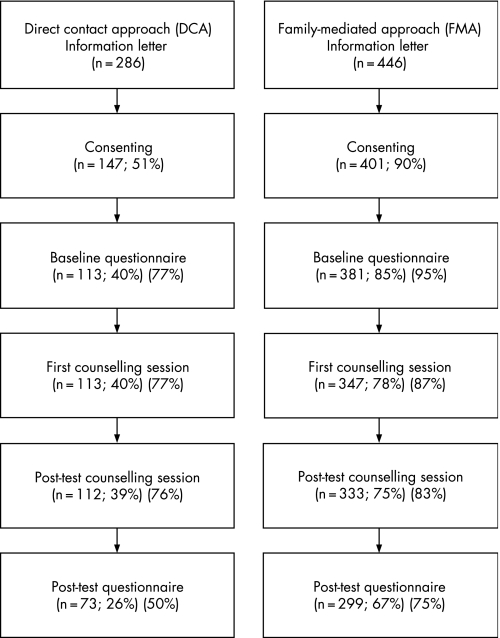
Methods: In families with hereditary non-polyposis colorectal cancer (Lynch syndrome), 286 healthy adult relatives with a 50% risk of a predisposing mutation were contacted by letter. Of these, 112 participated in counselling and predictive testing. Baseline information and information obtained 1 month after the test for 73 respondents were compared with 299 corresponding subjects, approached via the proband (family-mediated approach in our previous study) in these families.
Results: After the contact letter, 51% consented to the study. Of these, 92% approved of the direct contact and 33% had tried to seek information. In 34% of the mutation carriers, neoplasia was identified in the first post-test colonoscopy. Although post-test fear of cancer increased among the mutation carriers and decreased among noncarriers, almost all participants were satisfied with their decision to participate, independently of their test results, parallel to the family-mediated approach.
Conclusion: In this large-scale study, relatives in cancer families were actively contacted to inform them of the condition and genetic counselling. Their attitudes were encouraging, and the psychosocial consequences were similar to the family-mediated approach. Our results suggest the appropriateness of direct contact as an alternative method of contact in cases of life-threatening treatable disease.
References
-
- Claes E, Evers‐Kiebooms G, Boogaerts A, Decruyenaere M, Denayer L, Legius E. Communication with close and distant relatives in the context of genetic testing for hereditary breast and ovarian cancer in cancer patients. Am J Med Genet 2003116A11–19. - PubMed
-
- Hallowell N, Ardern‐Jones A, Eeles R, Foster C, Lucassen A, Moynihan C, Watson M. Communication about genetic testing in families of male BRCA1/2 carriers and non‐carriers: Patterns, priorities and problems. Clin Genet 200567492–502. - PubMed
-
- Hughes C, Lerman C, Schwartz M, Peshkin B, Wenzel L, Narod S, Corio C, Tercyak K P, Hanna D, Isaacs C, Main D. All in the family: evaluation of the process and content of sisters' communication about BRCA1 and BRCA2 genetic test results. Am J Med Genet 2002107143–150. - PubMed
-
- Kenen R, Arden‐Jones A, Eeles R. We are talking, but are they listening? Communication patterns in families with a history of breast/ovarian cancer (HBOC). Psychooncology 200413335–345. - PubMed
-
- Mesters I, Ausems M, Eichhorn S, Vasen H. Informing one's family about genetic testing for hereditary non‐polyposis colorectal cancer (HNPCC): A retrospective exploratory study. Fam Cancer 20054163–167. - PubMed
Publication types
MeSH terms
LinkOut - more resources
Full Text Sources
Medical
