


Predictive factors of neck metastases in laryngeal squamous cell carcinoma. Towards an integrated clinico-molecular classification
- PMID: 17633151
- PMCID: PMC2639989
Predictive factors of neck metastases in laryngeal squamous cell carcinoma. Towards an integrated clinico-molecular classification
Abstract
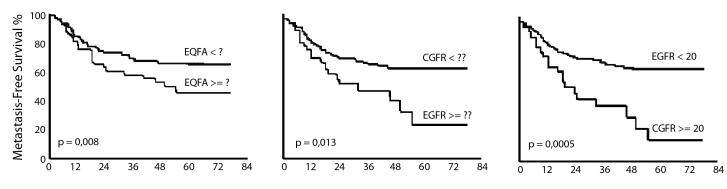
Our group has 25 years' experience in the use of molecular predictive markers in head and neck cancer, on a large patient population, enrolled from a single institution, with a long follow-up, and, most of all, homogeneous regarding histology (squamous cell carcinoma) and site (larynx). Among the most frequent malignancies in the US, cancers of the larynx and uterine corpus are the only types not showing an increase in 5-year Survival Rates over the last 30 years. As far as concerns laryngeal squamous cell carcinoma, we can identify several potential reasons for this failure, the most relevant probably lies in the neck. For this reason, a key issue in laryngeal oncology is to assess metastatic potential of squamous cell carcinoma at diagnosis. Nevertheless, the combination of clinical and histological parameters is not sufficiently reliable in the prediction of lymph node metastases. Molecular characterization, by the study of molecular predictive factors, is a clinical approach aimed to define homogeneous subgroups for clinical metastatic behaviour. Defining invasiveness by means of studies on selected molecular markers (among which the most reliable is probably Epidermal Growth Factor Receptor (EGFR)) may be useful in the choice of the most appropriate treatment on both T and on N.
Viene discussa l’esperienza monocentrica dell’uso di fattori predittivi molecolari su una casistica numerosa ed omogenea di pazienti con carcinomi laringei. Questi carcinomi non hanno avuto un miglioramento prognostico significativo negli ultimi trent’anni. La causa è verosimilmente riferibile alle ricadute sul collo. Per questo risulta indispensabile caratterizzare la aggressività biologica della neoplasia integrando informazioni desunte dallo studio di marcatori predittivi clinici e molecolari. Fra questi il più affidabile è probabilmente il fattore EGFR.
Figures
References
-
- Almadori G, Cadoni G, Galli J, Ferrandina G, Scambia G, Exarchakos G, et al. Epidermal growth factor receptor expression in primary laryngeal cancer: an independent prognostic factor of neck node relapse. Int J Cancer 1999;84:188-91. - PubMed
-
- Scambia G, Panici PB, Battaglia F, Ferrandina G, Almadori G, Paludetti G, et al. Receptors for epidermal growth factor and steroid hormones in primary laryngeal tumours. Cancer 1991;67:1347-51. - PubMed
-
- Maurizi M, Scambia G, Benedetti PP, Ferrandina G, Almadori G, Paludetti G, et al. EGF receptor expression in primary laryngeal cancer: correlation with clinico-pathological features and prognostic significance. Int J Cancer 1992;52:862-6. - PubMed
-
- Bellacosa A, Almadori G, Cavallo S, Cadoni G, Galli J, Ferrandina G, et al. Cyclin D1 gene amplification in human laryngeal squamous cell carcinomas: prognostic significance and clinical implications. Clin Cancer Res 1996;2:175-80. - PubMed
Publication types
MeSH terms
LinkOut - more resources
Full Text Sources
Medical
Research Materials
Miscellaneous