


Association of cysteine-rich secretory protein 3 and beta-microseminoprotein with outcome after radical prostatectomy
- PMID: 17634540
- PMCID: PMC2660867
- DOI: 10.1158/1078-0432.CCR-06-3031
Association of cysteine-rich secretory protein 3 and beta-microseminoprotein with outcome after radical prostatectomy
Abstract
Purpose: It has been suggested that cysteine-rich secretory protein 3 (CRISP-3) and beta-microseminoprotein (MSP) are associated with outcome in prostate cancer. We investigated whether these markers are related to biochemical recurrence and whether addition of the markers improves prediction of recurring disease.
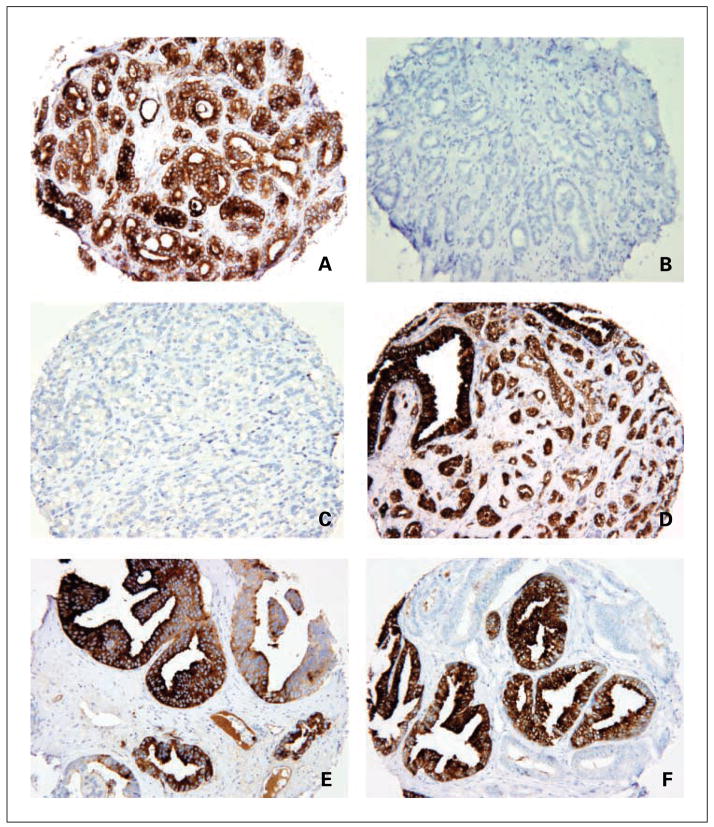
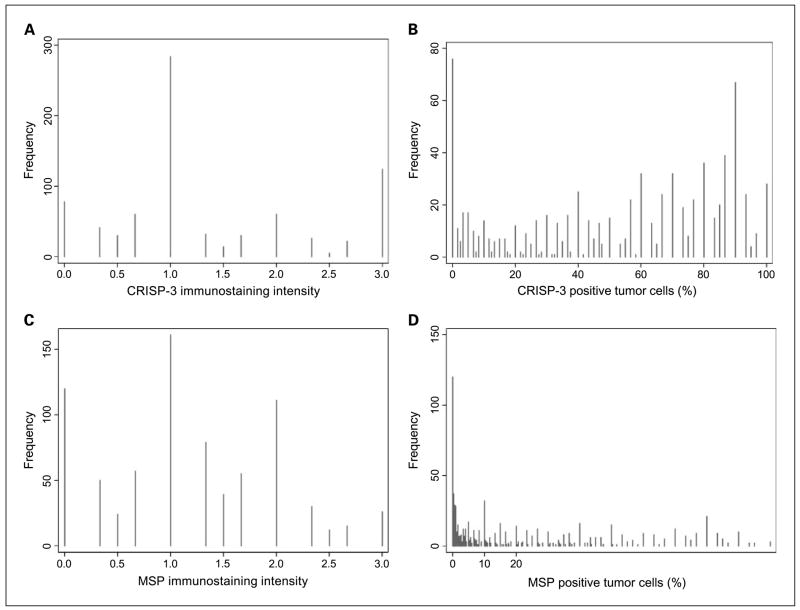
Experimental design: Tissue microarrays of radical prostatectomy specimens were analyzed for CRISP-3 and MSP by immunohistochemistry. Associations between marker positivity and postprostatectomy biochemical recurrence [prostate-specific antigen (PSA) >0.2 ng/mL with a confirmatory level] were evaluated by univariate and multivariable Cox proportional hazards regression. Multivariable analyses controlled for preoperative PSA and pathologic stage and grade.
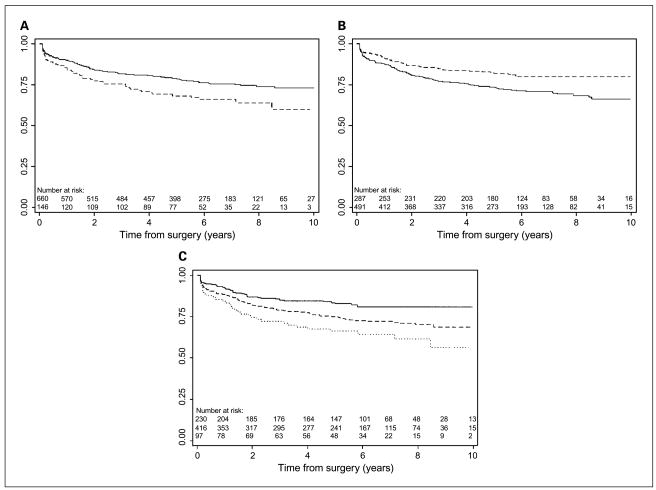
Results: Among 945 patients, 224 had recurrence. Median follow-up for survivors was 6.0 years. Patients positive for CRISP-3 had smaller recurrence-free probabilities, whereas MSP-positive patients had larger recurrence-free probabilities. On univariate analysis, the hazard ratio for patients positive versus negative for CRISP-3 was 1.53 (P=0.010) and for MSP was 0.63 (P=0.004). On multivariable analysis, both CRISP-3 (P=0.007) and MSP (P=0.002) were associated with recurrence. The hazard ratio among CRISP-3-positive/MSP-negative patients compared with CRISP-3-negative/MSP-positive patients was 2.38. Adding CRISP-3 to a base model that included PSA and pathologic stage and grade did not enhance the prediction of recurrence, but adding MSP increased the concordance index minimally from 0.778 to 0.781.
Conclusion: We report evidence that CRISP-3 and MSP are independent predictors of recurrence after radical prostatectomy for localized prostate cancer. However, addition of the markers does not importantly improve the performance of existing predictive models. Further research should aim to elucidate the functions of CRISP-3 and MSP in prostate cancer cells.
Figures
References
-
- Jemal A, Siegel R, Ward E, et al. Cancer statistics, 2006. CA Cancer J Clin. 2006;56:106–30. - PubMed
-
- Kattan MW, Scardino PT, Eastham JA, Stapleton AM, Wheeler TM. A preoperative nomogram for disease recurrence following radical prostatectomy for prostate cancer. J Natl Cancer Inst. 1998;90:766–71. - PubMed
-
- Kattan MW, Wheeler TM, Scardino PT. Postoperative nomogram for disease recurrence after radical prostatectomy for prostate cancer. J Clin Oncol. 1999;17:1499–507. - PubMed
-
- Graefen M, Karakiewicz PI, Cagiannos I, et al. Validation study of the accuracy of a postoperative nomogram for recurrence after radical prostatectomy for localized prostate cancer. J Clin Oncol. 2002;20:951–6. - PubMed
-
- Graefen M, Karakiewicz PI, Cagiannos I, et al. International validation of a preoperative nomogram for prostate cancer recurrence after radical prostatectomy. J Clin Oncol. 2002;20:3206–12. - PubMed
Publication types
MeSH terms
Substances
Grants and funding
LinkOut - more resources
Full Text Sources
Other Literature Sources
Medical
Research Materials
Miscellaneous
