


Different effects of ribosome biogenesis inhibition on cell proliferation in retinoblastoma protein- and p53-deficient and proficient human osteosarcoma cell lines
- PMID: 17635520
- PMCID: PMC6495848
- DOI: 10.1111/j.1365-2184.2007.00448.x
Different effects of ribosome biogenesis inhibition on cell proliferation in retinoblastoma protein- and p53-deficient and proficient human osteosarcoma cell lines
Abstract
Objectives: To evaluate the effects of rRNA synthesis inhibition on cell cycle progression and cell population growth according to the RB and p53 status.
Material and methods: RB- and p53-proficient U2OS cells and the RB- and p53-deficient SAOS-2 cells were used, rRNA transcription hindered by actinomycin D, and cell cycle analysed by flow cytometry.
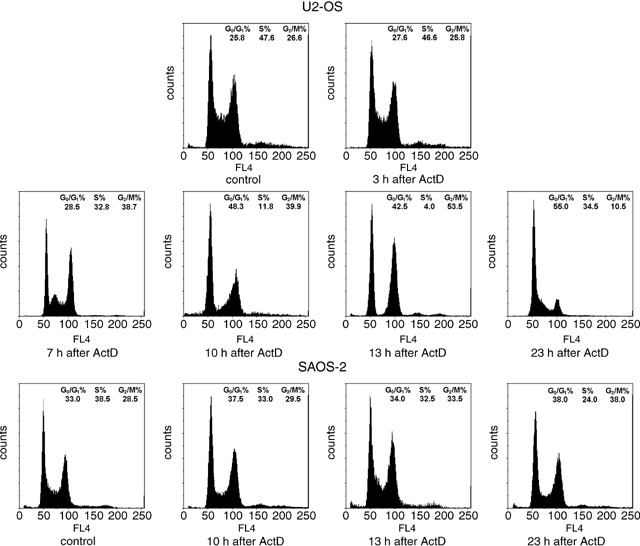
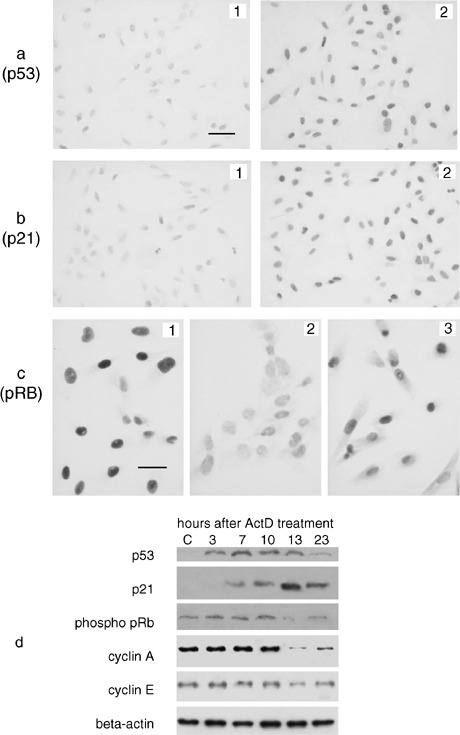
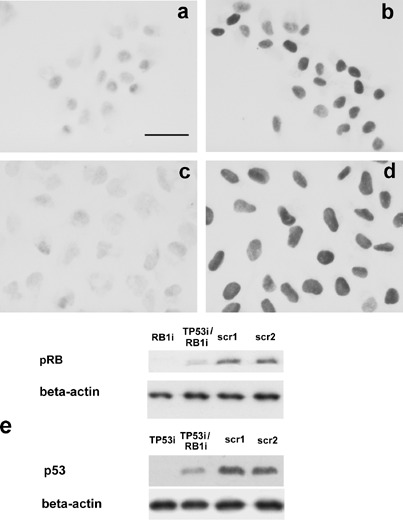
Results: One hour of actinomycin D treatment induced in U2OS cells a block at the cell cycle checkpoints G(1)-S and G(2)-M, which was removed only after rRNA synthesis was resumed. rRNA synthesis inhibition did not influence cell cycle progression in SAOS-2 cells. No effect on cell cycle progression after actinomycin D-induced rRNA inhibition was also found in U2OS cells silenced for RB and p53 expression. A mild perturbation of cell cycle progression was observed in U2OS cells silenced for the expression of either RB or p53 alone. We also treated U2OS and SAOS-2 cells with actinomycin D for 1 h/day for 5 days. This treatment lightly reduced growth rate of the U2OS cell population, whereas cell population growth of SAOS-2 cells was completely inhibited. A marked reduction of ribosome content occurred in SAOS-2 cells after the long-term actinomycin D treatment, whereas no modification was observed in U2OS cells.
Conclusions: These results demonstrate that inhibition of ribosome biogenesis does not hinder cell cycle progression in RB- and p53-deficient cells. A daily-repeated transitory inhibition of ribosome biogenesis leads to a progressive reduction of ribosome content with the consequent extinction of cancer cell population lacking RB and p53.
Figures


References
-
- Budde A, Grummt I (1999) p53 represses ribosomal gene transcription. Oncogene 18, 1119–1124. - PubMed
-
- Bunz F, Dutriaux A, Lengauer C, Waldman T, Zhou S, Brown JP, Sedivy JM, Kinzler KW, Vogelstein B (1998) Requirement for p53 and p21 to sustain G2 arrest after DNA damage. Science 282, 1497–1501. - PubMed
-
- Classon M, Harlow E (2002) The retinoblastoma tumour suppressor in development and cancer. Nat. Rev. Cancer 2, 910–917. - PubMed
Publication types
MeSH terms
Substances
LinkOut - more resources
Full Text Sources
Research Materials
Miscellaneous
