


Antibiotics for whooping cough (pertussis)
- PMID: 17636756
- PMCID: PMC11322855
- DOI: 10.1002/14651858.CD004404.pub3
Antibiotics for whooping cough (pertussis)
Abstract
Background: Whooping cough is a highly contagious disease. Infants are at highest risk of severe disease and death. Erythromycin for 14 days is currently recommended for treatment and contact prophylaxis, but is of uncertain benefit.
Objectives: To study the benefits and risks of antibiotic treatment of and contact prophylaxis against whooping cough.
Search strategy: We searched the Cochrane Central Register of Controlled Trials (CENTRAL), the Database of Abstracts of Reviews of Effects (DARE) (The Cochrane Library Issue 1, 2007); MEDLINE (January 1966 to March 2007); EMBASE (January 1974 to March 2007).
Selection criteria: All randomised and quasi-randomised controlled trials of antibiotics for treatment of, and contact prophylaxis against, whooping cough.
Data collection and analysis: Three to four review authors independently extracted data and assessed the quality of each trial.
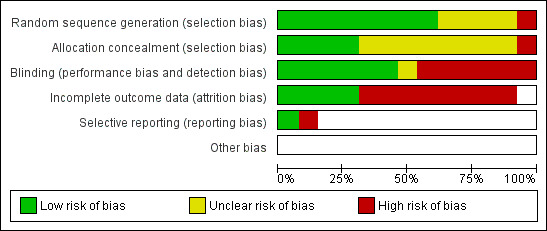
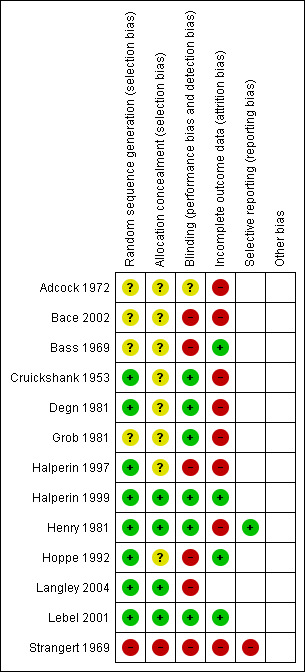
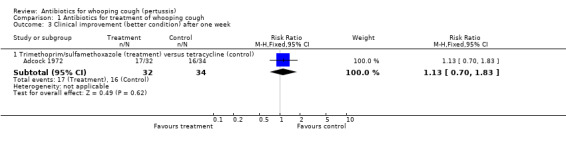
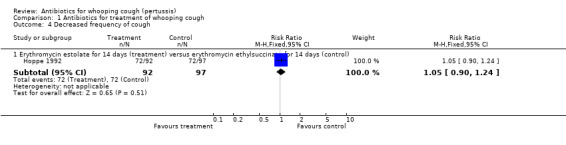
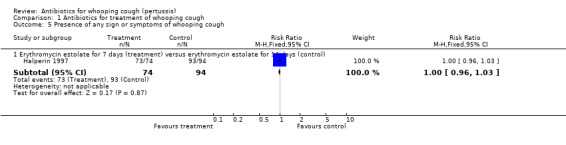
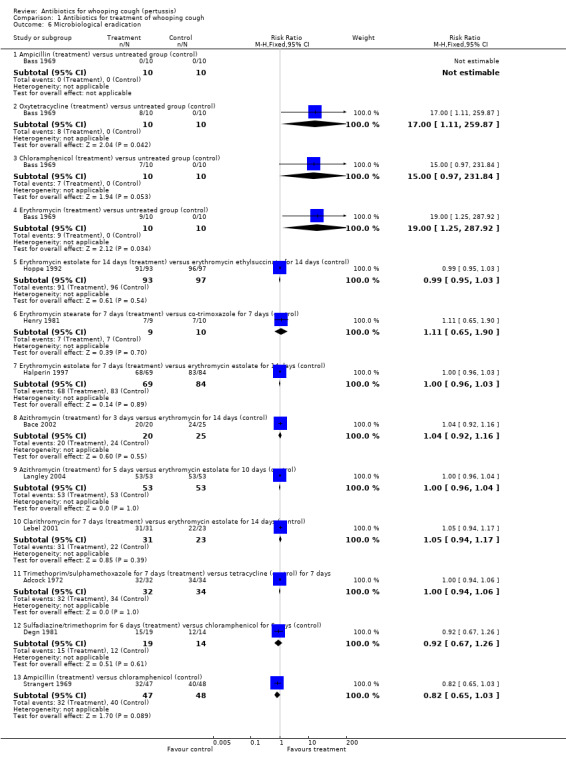
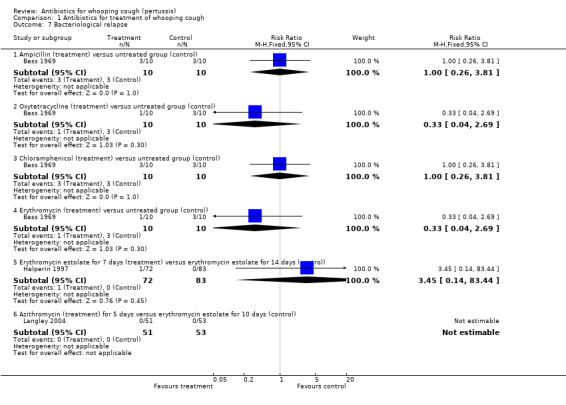
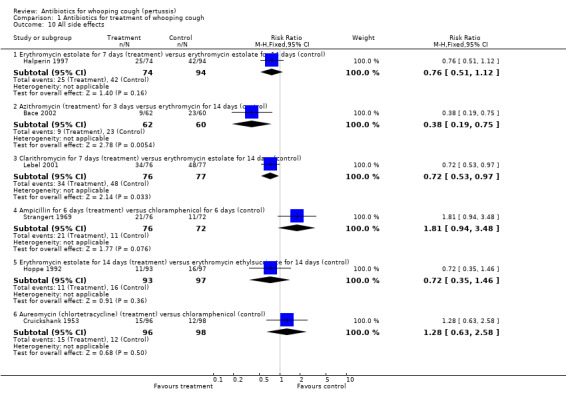
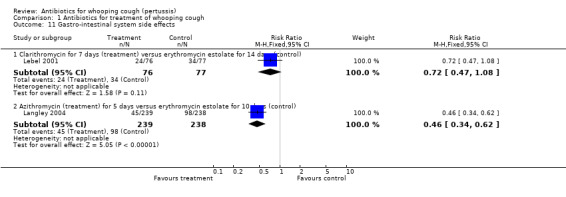
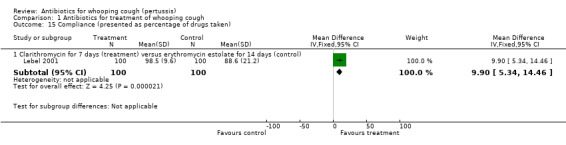
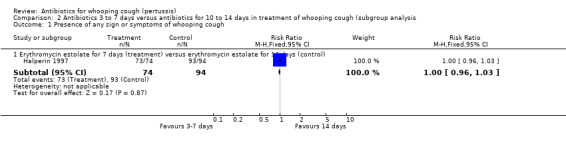
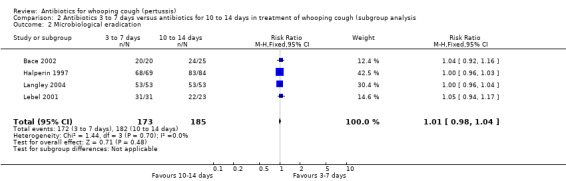
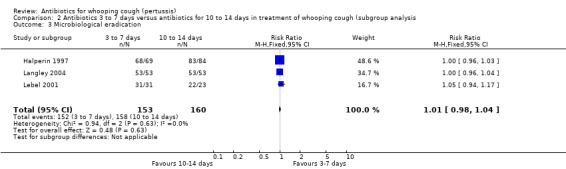
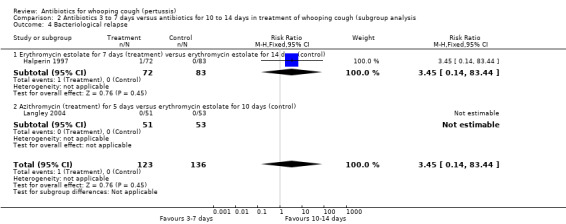
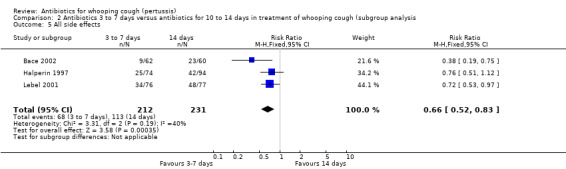
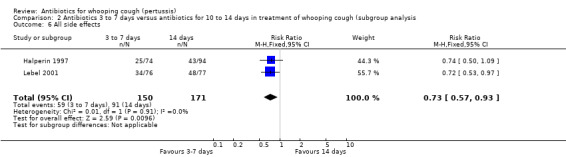
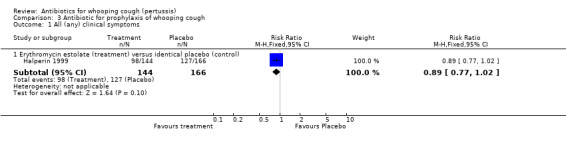
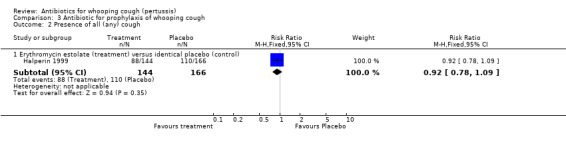
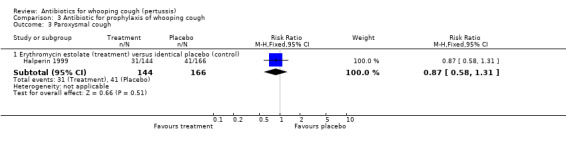
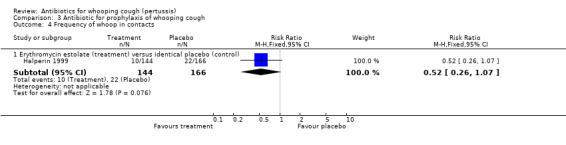
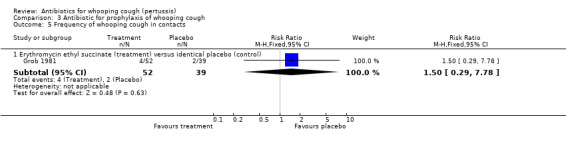
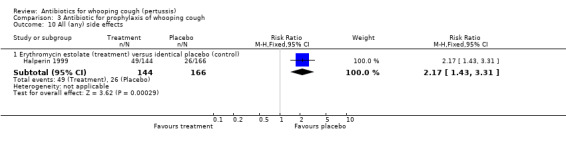
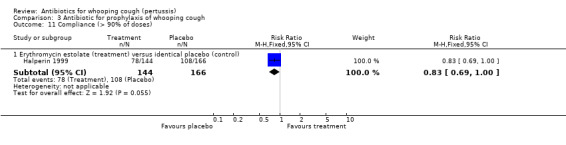
Main results: Thirteen trials with 2197 participants met the inclusion criteria: 11 trials investigated treatment regimens; 2 investigated prophylaxis regimens. The quality of the trials was variable.Short-term antibiotics (azithromycin for three to five days, or clarithromycin or erythromycin for seven days) were as effective as long-term (erythromycin for 10 to 14 days) in eradicating Bordetella pertussis (B. pertussis) from the nasopharynx (relative risk (RR) 1.02, 95% confidence interval (CI) 0.98 to 1.05), but had fewer side effects (RR 0.66, 95% CI 0.52 to 0.83). Trimethoprim/sulfamethoxazole for seven days was also effective. Nor were there differences in clinical outcomes or microbiological relapse between short and long-term antibiotics. Contact prophylaxis of contacts older than six months of age with antibiotics did not significantly improve clinical symptoms or the number of cases developing culture-positive B. pertussis.
Authors' conclusions: Although antibiotics were effective in eliminating B. pertussis, they did not alter the subsequent clinical course of the illness. There is insufficient evidence to determine the benefit of prophylactic treatment of pertussis contacts.
Conflict of interest statement
None known.
Figures
Update of
-
Antibiotics for whooping cough (pertussis).Cochrane Database Syst Rev. 2005 Jan 25;(1):CD004404. doi: 10.1002/14651858.CD004404.pub2. Cochrane Database Syst Rev. 2005. Update in: Cochrane Database Syst Rev. 2007 Jul 18;(3):CD004404. doi: 10.1002/14651858.CD004404.pub3. PMID: 15674946 Updated.
References
References to studies included in this review
Adcock 1972 {published data only}
Bace 2002 {published data only}
-
- Bace A, Kuzmanovic N, Novak D, Anic‐Milic T, Radosevic S, Welle A, et al. The efficacy and safety of 3‐day azithromycin vs 14‐day erythromycin in the treatment of pertussis in infants and young children. Abstract presented in ICMASKO 6 in Bologna, Italy. January 23‐25 2002.
Bass 1969 {published data only}
-
- Bass JW, Klenk EL, Kotheimer JB, Linnemann CC, Smith MH. Antimicrobial treatment of pertussis. Journal of Pediatrics 1969;75(5):768‐81. - PubMed
Cruickshank 1953 {published data only}
-
- Cruickshank R, Anderson T, Benn EC, Bradford H, Christie AB, Joe A, et al. Treatment of whooping‐cough with antibiotics. Lancet 1953;1:1109‐12. [MEDLINE: ; CN‐00341118]
Degn 1981 {published data only}
-
- Degn H, Jacobsen AT, Gjerris A, Rasmussen SN, Helin P, Sorensen SF. Treatment of whooping cough in newborn infants with chloramphenicol and sulfadiazine/trimethoprim. Ugeskrift for Laeger 1981;143(3):107‐9. - PubMed
Grob 1981 {published data only}
-
- Grob PR. Prophylactic erythromycin for whooping‐cough contacts. Lancet 1981;1(8223):772. - PubMed
Halperin 1997 {published data only}
-
- Halperin SA, Bortolussi R, Langley JM, Miller B, Eastwood BJ. Seven days of erythromycin estolate is as effective as fourteen days for the treatment of Bordetella pertussis infections. Pediatrics 1997;100(1):65‐71. - PubMed
Halperin 1999 {published data only}
-
- Halperin SA, Bortolussi R, Langley JM, Eastwood BJ, Serres G. A randomized, placebo‐controlled trial of erythromycin estolate chemoprophylaxis for household contacts of children with culture‐positive Bordetella pertussis infection. Pediatrics 1999;104(4):e42. - PubMed
Henry 1981 {published data only}
-
- Henry RL, Dorman DC, Skinner JA, Mellis CM. Antimicrobial therapy in whooping cough. Medical Journal of Australia 1981;2(1):27‐8. - PubMed
Hoppe 1992 {published data only}
-
- Hoppe JE. Comparison of erythromycin estolate and erythromycin ethylsuccinate for treatment of pertussis. The Erythromycin Study Group. Pediatric Infectious Disease Journal 1992;11(3):189‐93. - PubMed
Langley 2004 {published data only}
-
- Langley JM, Halperin SA, Boucher FD, Smith B. Azithromycin is as effective as and better tolerated than erythromycin estolate for the treatment of pertussis. Pediatrics 2004;114(1):96‐101. - PubMed
Lebel 2001 {published data only}
-
- Lebel MH, Mehra S. Efficacy and safety of clarithromycin versus erythromycin for the treatment of pertussis: a prospective, randomized, single blind trial. Pediatric Infectious Disease Journal 2001;20(12):1149‐54. - PubMed
Strangert 1969 {published data only}
-
- Strangert K. Comparison between the effect of chloramphenicol and ampicillin in whooping‐cough. Scandinavian Journal of Infectious Diseases 1969;1(1):67‐70. - PubMed
References to studies excluded from this review
Aoyama 1996 {published data only}
-
- Aoyama T, Sunakawa K, Iwata S, Takeuchi Y, Fujii R. Efficacy of short‐term treatment of pertussis with clarithromycin and azithromycin. Journal of Pediatrics 1996;129(5):761‐4. - PubMed
Bergquist 1987 {published data only}
-
- Bergquist SO, Bernander S, Dahnsjo H, Sundelof B. Erythromycin in the treatment of pertussis: a study of bacteriologic and clinical effects. Pediatric Infectious Disease Journal 1987;6(5):458‐61. - PubMed
Di Nola 1974 {published data only}
-
- Nola F, Soranzo ML. Comparative trial of cephacetrile versus cephaloridine in the treatment of secondary respiratory infections in childhood pertussis. Arzneimittel‐Forschung 1974;24(9b):1510‐2. - PubMed
LaBoccetta 1952 {published data only}
-
- LaBoccetta AC, Dawson KE. Pertussis: treatment with aureomycin; clinical study of eighty‐five patients and seventy‐four controls. American Journal of Diseases of Children 1952;84:184‐90. [Cochrane ARI handsearch] - PubMed
Spencely 1981 {published data only}
-
- Spencely M, Lambert HP. Prophylactic erythromycin for whooping‐cough contacts. Lancet 1981;1(8223):772‐3. - PubMed
Torre 1984 {published data only}
-
- Torre D, Maggiolo F, Sampietro C. Comparative clinical study of josamycin and erythromycin in pertussis. Chemioterapia 1984;3(4):255‐7. - PubMed
Trollfors 1978 {published data only}
-
- Trollfors B. Effect of erythromycin and amoxycillin on Bordetella pertussis in the nasopharynx. Infection 1978;6(5):228‐30. - PubMed
Additional references
AAP 1975
-
- Anonymous. American Academy of Pediatrics. Committee on drugs. Requiem for tetracyclines. Pediatrics 1975;55(1):142‐3. - PubMed
Atkinson 1996
-
- Atkinson W. Centers for Disease Control and Prevention. 3rd Edition. Atlanta: Dept of Health and Human Services. Epidemiology and prevention of vaccine‐preventable diseases, 1996.
Bass 1985
-
- Bass JW. Erythromycin for pertussis: probable reasons for past failure. Lancet 1985;2:147. - PubMed
Bettiol 2010
Broomhall 1984
CDC 1991
-
- Centers for Disease Control and Prevention. Diphtheria, tetanus, and pertussis: recommendations for vaccine use and other preventive measures: recommendations of the Advisory Committee on immunization practices (ACIP). Morbidity and Mortality Weekly Report 1991;40(RR‐10):1‐28. - PubMed
CDC 1995
-
- Centers for Disease Control and Prevention. Pertussis ‐ United States, January 1992 ‐ June 1995. JAMA 1995;274(6):450‐1. - PubMed
CDC 2000
-
- Centers for Disease Control and Prevention. Guidelines for the control of pertussis outbreak. Available at http://www.cdc.gov/nip/publications/pertussis/guide.htm 2000 (accessed February 2002).
CDC 2002
-
- Centers for Disease Control and Prevention. Pertussis deaths ‐ United States, 2000. Morbidity and Mortality Weekly Report 2002;51(4):73‐6. - PubMed
CDC 2005
-
- Centers for Disease Control and Prevention. Pertussis ‐ United States, 2001 ‐ 2003. Morbidity and Mortality Weekly Report 2005;54(50):1283‐6 (available at http://www.cdc.gov/mmwr/preview/mmwrhtml/mm5450a3.htm). - PubMed
CDI 1997
-
- Anonymous. Technical report series guidelines for the control of pertussis in Australia. Communicable Diseases Intelligent (CDI) 1997;1:30.
Chalmers 1983
-
- Chalmers TC, Celano P, Sacks HS, Smith H. Bias in treatment assignment in controlled clinical trials. New England Journal of Medicine 1983;309:1358‐61. - PubMed
Cherry 1984
-
- Cherry JD. The epidemiology of pertussis and pertussis immunization in the United States: a comparative study. Current Problems in Pediatrics 1984;14(2):1‐78. - PubMed
Cherry 1988
-
- Cherry JD, Brunell PA, Golden GS, Karazon DT. Report of the task force on pertussis and pertussis immunization. Pediatrics 1988;81:939‐84.
De Serres 1995
-
- Serres G, Boulianne N, Duval B. Field effectiveness of erythromycin prophylaxis to prevent pertussis within families. Pediatric Infectious Disease Journal 1995;14(11):969‐75. - PubMed
Ginsburg 1986
-
- Ginsburg CM. Pharmacology of erythromycin in infants and children. Pediatric Infectious Disease Journal 1986;5:124‐9. - PubMed
Halsey 1980
-
- Halsey NA, Welling MA, Lehman RM. Nosocomial pertussis: a failure of erythromycin treatment and prophylaxis. American Journal of Diseases of Children 1980;134(5):521‐2. - PubMed
Heininger 1994
-
- Heininger U, Stehr K, Schmitt‐Grohe S, Lorenz C, Rost R, Christenson PD, et al. Clinical characteristics of illness caused by Bordetella parapertussis compared with illness caused by Bordetella pertussis. Pediatric Infectious Disease Journal 1994;13(4):306‐9. - PubMed
Heininger 1998
-
- Heininger U, Cherry JD, Stehr K, Schmitt‐Grohé S, Uberall M, Laussucq S, et al. Comparative efficacy of the Lederle/Takeda acellular pertussis component DTP (DTaP) vaccine and Lederle whole‐cell component DTP vaccine in German children after household exposure. Pediatrics 1998;102(3):546‐53. - PubMed
Higgins 2011
-
- Higgins JPT, Green S, editors. Cochrane Handbook for Systematic Reviews of Interventions Version 5.1.0 [updated March 2011]. The Cochrane Collaboration. http://www.cochrane‐handbook.org. 2011.
Honein 1999
-
- Honein MA, Paulozzi LJ, Himelright IM, Lee B, Cragan JD, Patterson L, et al. Infantile hypertrophic pyloric stenosis after pertussis prophylaxis with erythromycin: a case review and cohort study. Lancet 1999;354(9196):2101‐5. - PubMed
Hoppe 1988
-
- Hoppe JE, Haug A. Treatment and prevention of pertussis by antimicrobial agents (Part II). Infection 1988;16(3):148‐52. - PubMed
Hoppe 2000
-
- Hoppe JE. Neonatal pertussis. Pediatric Infectious Disease Journal 2000;19(3):244‐7. - PubMed
Isacson 1993
-
- Isacson J, Trollfors B, Taranger J, Zackrisson G, Lagergard T. How common is whooping cough in a nonvaccinating country?. Pediatric Infectious Disease Journal 1993;12(4):284‐8. - PubMed
Islur 1975
-
- Islur J, Anglin CS, Middleton PJ. The whooping cough syndrome: a continuing problem. Clinical Pediatrics 1975;14(2):171‐6. - PubMed
Krugman 1992
-
- Krugman S, Katz SL, Greshon AA, Wilfert CM. Pertussis (whooping cough). Infectious Diseases of Children. 9th Edition. St. Louis: Mosby Year Book, 1992:299‐313.
Kucers 1997
-
- Kucers A, Crowe SM, Grayson ML, Hoy JF. The use of antibiotics: a clinical view of antibacterial, antifungal, and antiviral drugs. 5th Edition. Oxford: Butterworth‐Heinemann, 1997:637‐42.
Leach 1997
-
- Leach AJ, Shelby‐James TM, Mayo M, Gratten M, Laming AC, Currie BJ, et al. A prospective study of the impact of community‐based azithromycin treatment of trachoma on carriage and resistance of Streptococcus pneumoniae. Clinical Infectious Diseases 1997;24(3):356‐62. - PubMed
Lefebvre 2009
-
- Lefebvre C, Manheimer E, Glanville J. Chapter 6: Searching for studies. Cochrane Handbook for Systematic Reviews of Interventions. Chichester, UK: Wiley‐Blackwell, 2009.
Long 1997
-
- Long SS, Pickering LK, Prober CG. Bordetella pertussis (pertussis) and other species. Principles and Practice of Pediatric Infectious Diseases. Saunders WB Co, 1997:977‐86.
Ray 1977
-
- Ray WA, Federspiel CF, Schaffner W. Prescribing of tetracycline to children less than 8 years old. A two‐year epidemiologic study among ambulatory Tennessee medicaid recipients. JAMA 1977;237(19):2069‐74. - PubMed
RevMan 2011 [Computer program]
-
- The Nordic Cochrane Centre. The Cochrane Collaboration. Review Manager (RevMan). Version 5.1. Copenhagen: The Nordic Cochrane Centre. The Cochrane Collaboration, 2011.
Schulz 1995
-
- Schulz KF, Chalmers I, Hayes RJ, Altman D. Empirical evidence of bias. JAMA 1995;273:408‐12. - PubMed
Shu 1987
-
- Shu XO, Gao YT, Linet MS, Brinton LA, Gao RN, Jin F, et al. Chloramphenicol use and childhood leukaemia in Shanghai. Lancet 1987;2(8565):934‐7. - PubMed
Smilack 1999
-
- Smilack JD. The tetracyclines. Mayo Clinic Proceedings 1999;74(7):727‐9. - PubMed
Stang 1986
-
- Stang H. Pyloric stenosis associated with erythromycin ingested through breastmilk. Minnesota Medicine 1986;69(11):669‐70, 682. - PubMed
Thomas 2002
-
- Thomas J. Australian Prescription Products Guide. 1st Edition. Australian Pharmaceutical Publishing Company, 2002:1844.
Wallerstein 1969
-
- Wallerstein RO, Condit PK, Kasper CK, Brown JW, Morrison FR. Statewide study of chloramphenicol therapy and fatal aplastic anemia. JAMA 1969;208(11):2045‐50. - PubMed
Weiss 1960
-
- Weiss CF, Glazko AJ, Weston JK. Chloramphenicol in the newborn infant: a physiologic explanation of its toxicity when given in excess doses. New England Journal of Medicine 1960;262:787‐94. - PubMed
WHO 1999
-
- WHO. WHO position paper. Pertussis Vaccine. Weekly Epidemiological Record 1999; Vol. 74, issue 18:137‐42.
References to other published versions of this review
Altunaiji 2005
Publication types
MeSH terms
Substances
LinkOut - more resources
Full Text Sources
Medical
Miscellaneous
