


Mice lacking the immediate early gene Egr3 respond to the anti-aggressive effects of clozapine yet are relatively resistant to its sedating effects
- PMID: 17637609
- PMCID: PMC4621766
- DOI: 10.1038/sj.npp.1301505
Mice lacking the immediate early gene Egr3 respond to the anti-aggressive effects of clozapine yet are relatively resistant to its sedating effects
Abstract
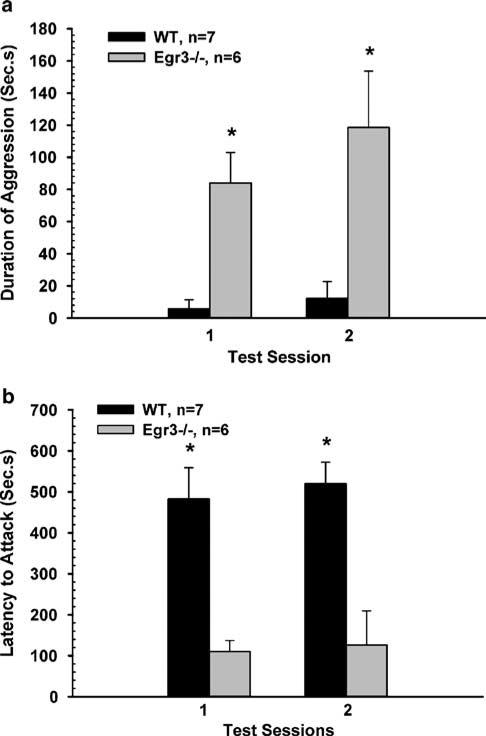
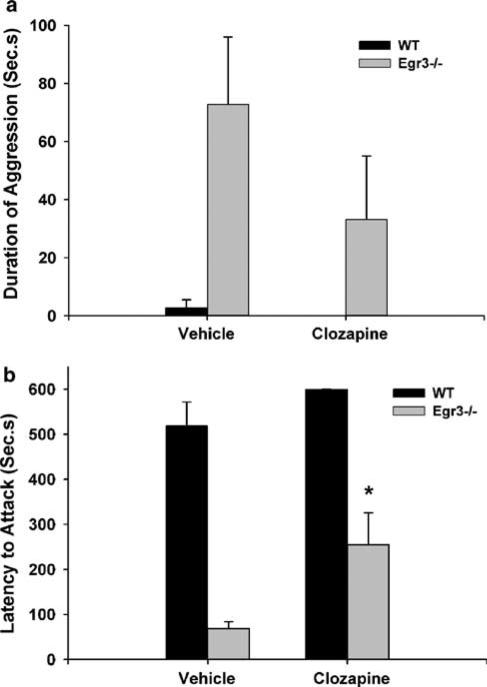
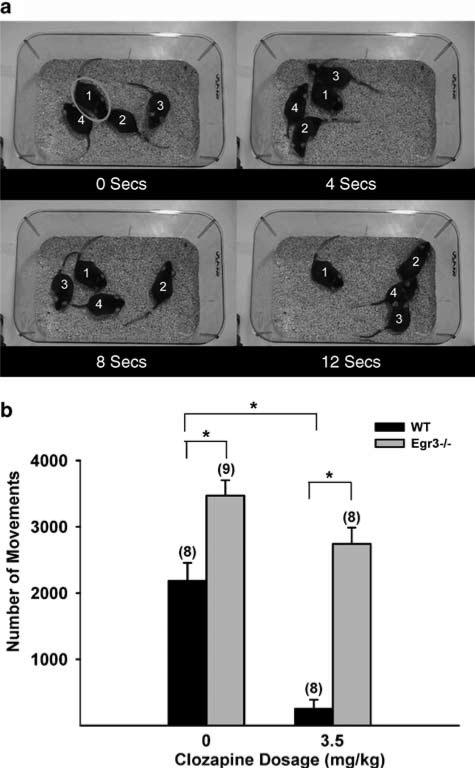
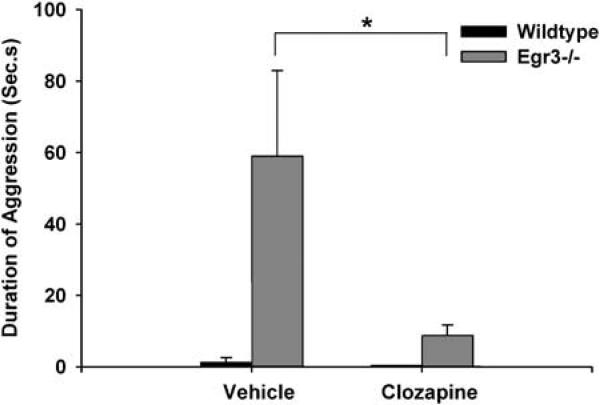
Immediate early genes (IEGs) of the early growth response gene (Egr) family are activated in the brain in response to stress, social stimuli, and administration of psycho-active medications. However, little is known about the role of these genes in the biological or behavioral response to these stimuli. Here we show that mice lacking the IEG transcription factor Egr3 (Egr3-/- mice) display increased aggression, and a decreased latency to attack, in response to the stressful social stimulus of a foreign intruder. Together with our findings of persistent and intrusive olfactory-mediated social investigation of conspecifics, these results suggest increased impulsivity in Egr3-/- mice. We also show that the aggression of Egr3-/- mice is significantly inhibited with chronic administration of the antipsychotic medication clozapine. Despite their sensitivity to this therapeutic effect of clozapine, Egr3-/- mice display a marked resistance to the sedating effects of acute clozapine compared with WT littermate controls. This indicates that the therapeutic, anti-aggressive action of clozapine is separable from its sedating activity, and that the biological abnormality resulting from loss of Egr3 distinguishes these different mechanisms. Thus Egr3-/- mice may provide an important tool for elucidating the mechanism of action of clozapine, as well as for understanding the biology underlying aggressive behavior. Notably, schizophrenia patients display a similar decreased susceptibility to the side effects of antipsychotic medications compared to non-psychiatric controls, despite the medications producing a therapeutic response. This suggests the possibility that Egr3-/- mice may provide insight into the neurobiological abnormalities underlying schizophrenia.
Figures
References
-
- Artola A, von Frijtag JC, Fermont PC, Gispen WH, Schrama LH, Kamal A, et al. Long-lasting modulation of the induction of LTD and LTP in rat hippocampal CA1 by behavioural stress and environmental enrichment. Eur J Neurosci. 2006;23:261–272. - PubMed
-
- Blouin JL, Dombroski BA, Nath SK, Lasseter VK, Wolyniec PS, Nestadt G, et al. Schizophrenia susceptibility loci on chromosomes 13q32 and 8p21. Nat Genet. 1998;20:70–73. - PubMed
-
- Bouwknecht JA, Hijzen TH, van der Gugten J, Maes RA, Hen R, Olivier B. Absence of 5-HT(1B) receptors is associated with impaired impulse control in male 5-HT(1B) knockout mice. Biol Psychiatry. 2001;49:557–568. - PubMed
-
- Bozon B, Davis S, Laroche S. Regulated transcription of the immediate-early gene Zif268: mechanisms and gene dosage-dependent function in synaptic plasticity and memory formation. Hippocampus. 2002;12:570–577. - PubMed
-
- Bozon B, Davis S, Laroche S. A requirement for the immediate early gene zif268 in reconsolidation of recognition memory after retrieval. Neuron. 2003;40:695–701. - PubMed
Publication types
MeSH terms
Substances
Grants and funding
LinkOut - more resources
Full Text Sources
Other Literature Sources
Medical
