


Impact of dual infections on chemotherapeutic efficacy in BALB/c mice infected with major genotypes of Trypanosoma cruzi
- PMID: 17638698
- PMCID: PMC2043214
- DOI: 10.1128/AAC.01590-06
Impact of dual infections on chemotherapeutic efficacy in BALB/c mice infected with major genotypes of Trypanosoma cruzi
Abstract
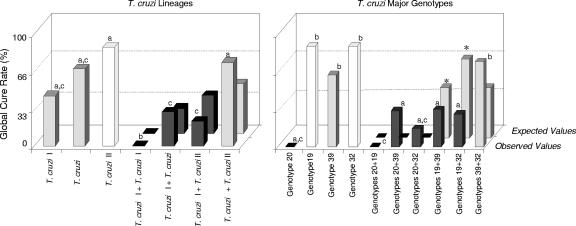
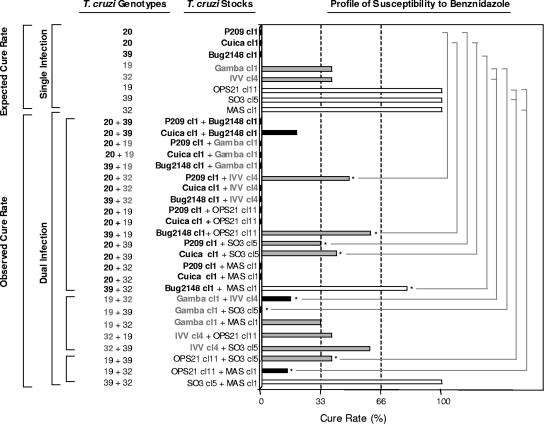
The aim of this work was to investigate the impact of dual infections with stocks of Trypanosoma cruzi major genotypes on benznidazole (BZ) treatment efficacy. For this purpose, T. cruzi stocks representative of the genetic T. cruzi lineages, displaying different susceptibilities to BZ, belonging to the major T. cruzi genotypes broadly dispersed in North and South America and important in Chagas' disease epidemiology were used. Therapeutic efficacy was observed in 27.8% of the animals treated. Following BZ susceptibility classification, significant differences were observed in dual infections on the major genotype level, demonstrating that combinations of genotypes 19+39 and genotypes 19+32 led to a shift in the expected BZ susceptibility profile toward the resistance pattern. Analysis on the T. cruzi stock level demonstrated that 9 out of 24 dual infections shifted the expected BZ susceptibility profile compared with the respective single infections, including shifts toward lower and higher BZ susceptibilities. Microsatellite identification was able to identify a mixture of T. cruzi stocks in 7.7% of the T. cruzi isolates from infected and untreated mice (6.9%) and infected and treated but not cured mice (9.0%), revealing in some mixtures of BZ-susceptible and -resistant stocks that the T. cruzi stock identified after BZ treatment was previously susceptible in single infections. Considering the clonal structure and evolution of T. cruzi, an unexpected result was the identification of parasite subpopulations with distinct microsatellite alleles in relation to the original stocks observed in 12.2% of the isolates. Taken together, the data suggest that mixed infections, already verified in nature, may have an important impact on the efficacy of chemotherapy.
Figures
References
-
- Alves, A. B. M., D. F. Almeida, and W. M. A. von Kruger. 1996. Genome variation in Trypanosoma cruzi clonal cultures. Parasitol. Res. 82:410-415. - PubMed
-
- Alves, A. B. M., A. Tanuri, D. F. Almeida, and W. M. A. von Kruger. 1993. Reversible changes in the isoenzyme electrophoretic mobility pattern and infectivity in clones of Trypanosoma cruzi. Exp. Parasitol. 77:246-253. - PubMed
-
- Andrade, S. G., and J. B. Magalhães. 1996. Biodemes and zymodemes of Trypanosoma cruzi strains: correlations with clinical data and experimental pathology. Rev. Soc. Bras. Med. Trop. 30:27-35. - PubMed
-
- Andrade, S. G., A. Rassi, J. B. Magalhães, F. F. Ferriolli, and A. O. Luquetti. 1992. Specific chemotherapy of Chagas disease: a comparison between the response in patients and experimental animals inoculated with the same strains. Trans. R. Soc. Trop. Med. Hyg. 86:624-626. - PubMed
-
- Andrade, S. G., S. Stocker-Guerret, A. S. Pimentel, and J. A. Grimaud. 1991. Reversibility of cardiac fibrosis in mice chronically infected with Trypanosoma cruzi, under specific chemotherapy. Mem. Inst. Oswaldo Cruz 86:187-200. - PubMed
Publication types
MeSH terms
Substances
LinkOut - more resources
Full Text Sources
Medical
