doi: 10.1101/gad.1550707.
The secretory peptide gene EPF1 enforces the stomatal one-cell-spacing rule
Affiliations
- PMID: 17639078
- PMCID: PMC1920166
- DOI: 10.1101/gad.1550707
Item in Clipboard
The secretory peptide gene EPF1 enforces the stomatal one-cell-spacing rule
Genes Dev.
.
Abstract
Stomata are innovations of land plants that allow regulated gas exchange. Stomatal precursor cells are produced by asymmetric cell division, and once formed, signal their neighbors to inhibit the formation of stomatal precursors in direct contact. We report a gene of Arabidopsis thaliana, EPIDERMAL PATTERNING FACTOR 1 (EPF1) that encodes a small secretory peptide expressed in stomatal cells and precursors and that controls stomatal patterning through regulation of asymmetric cell division. EPF1 activity is dependent on the TOO MANY MOUTHS receptor-like protein and ERECTA family receptor kinases, suggesting that EPF1 may provide a positional cue interpreted by these receptors.
Figures
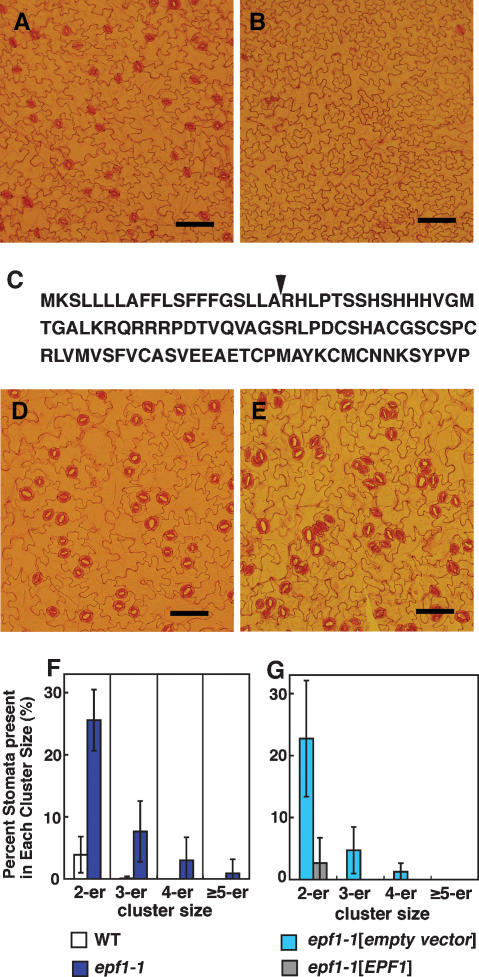
The EPF1 gene, encoding a secretory protein, regulates stomatal patterning. (A,B) Overexpression of EPF1 results in decreased number of stomata. An abaxial side of a cotyledon of Arabidopsis transformed with the pTK016 vector (A) and Promoter2x35S-Ω-EPF1 (B) are shown. After 7 d selection on BASTA (phosphinotricin) plate, resistant plants were further grown on nutrient plates for 7 d. (C) Deduced amino acid sequence of EPF1 product. The predicted cleavage site flanking the N-terminal signal sequence is shown with an arrowhead. (D,E) epf1-1 has clustered stomata. Abaxial sides of 20-d-old wild-type (D) and epf1-1 (E) cotyledons are shown. (F,G) Percent stomata (mean ± SD) present in stomatal clusters. (F) White column shows wild type and blue column shows epf1-1. (G) Light-blue column shows epf1-1 transformed with the control vector, and gray column shows epf1-1 transformed with the EPF1 gene. Bars, 100 μm.

Expression of EPF1. (A) RT–PCR analysis for EPF1 using RNA from roots (R), rosette leaves (RL), cauline leaves (CL), stems (St), and floral buds (FB). 18S rRNA was used as a control target. (B) RNA gel blot analysis using RNA from cotyledons (Co), rosette leaves of different developmental stages (1–12), and shoot apex of 16-d-old wild-type plants. EPF1, TMM, SDD1, and 18S rRNA were used as probes. (C–E) In situ hybridization for abaxial side of rosette leaves, probed with antisense EPF1 (C), sense EPF1 (D), and antisense SDD1 (E). Arrows indicate mature stomata and arrowheads indicate hybridization signal. (F) GUS expression in 14-d-old Arabidopsis transformed with PromoterEPF1-GUS. (G) Expression of PromoterEPF1∷GFP (green) in abaxial rosette leaf. To highlight the outline of cells, leaves were stained with FM4-64, which accumulates in membranes (red color). The arrow and arrowhead indicate a meristemoid and a GMC, respectively. Bars: B,F, 5 mm; C–E,G, 50 μm.

Effect of EPF1 overexpression on stomatal density in different genetic backgrounds. Spots represent stomatal densities of independent T1 plants that had been transformed with the control vector (open spots) and Promoter2x35S-Ω-EPF1 (closed spots). (Top) Abaxial side of cotyledons of 15-d-old plants. (Bottom) Abaxial side of primary leaves of 20-d-old plants.

Size distribution of stomatal clusters. (A) epf1, tmm, and epf1;tmm. (B) epf1, sdd1, and epf1;sdd1. Single stomata are not shown.
References
-
- Baldauf S.L. The deep roots of eukaryotes. Science. 2003;300:1703–1706. - PubMed
-
- Becker D., Kemper E., Schell J., Masterson R., Kemper E., Schell J., Masterson R., Schell J., Masterson R., Masterson R. New plant binary vectors with selectable markers located proximal to the left T-DNA border. Plant Mol. Biol. 1992;20:1195–1197. - PubMed
-
- Bergmann D.C. Integrating signals in stomatal development. Curr. Opin. Plant Biol. 2003;7:26–32. - PubMed
-
- Bergmann D.C., Lukowitz W., Somerville C.R., Lukowitz W., Somerville C.R., Somerville C.R. Stomatal development and pattern controlled by a MAPKK kinase. Science. 2004;304:1494–1497. - PubMed
Publication types
MeSH terms
Substances
LinkOut - more resources
Full Text Sources
Other Literature Sources
Molecular Biology Databases