


Comparison of two signal detection methods in a coroner-based system for near real-time mortality surveillance
- PMID: 17639656
- PMCID: PMC1888503
- DOI: 10.1177/003335490712200414
Comparison of two signal detection methods in a coroner-based system for near real-time mortality surveillance
Abstract
Objectives: This article describes and compares the performance characteristics of two approaches to outbreak detection in the context of a coroner-based mortality surveillance system using controlled feature set simulation.
Methods: The comparative capabilities of the outbreak detection methods--the Epidemic Threshold and Cusum methods--were assessed by introducing a series of simulated signals, configured as nonoverlapping, three-day outbreaks, into historic surveillance data and assessing their respective performances. Treating each calendar day as a separate observation, sensitivity, predictive value positive, and predictive value negative were calculated for both signal detection methods at various outbreak magnitudes. Their relative performances were also assessed in terms of the overall percentage of outbreaks detected.
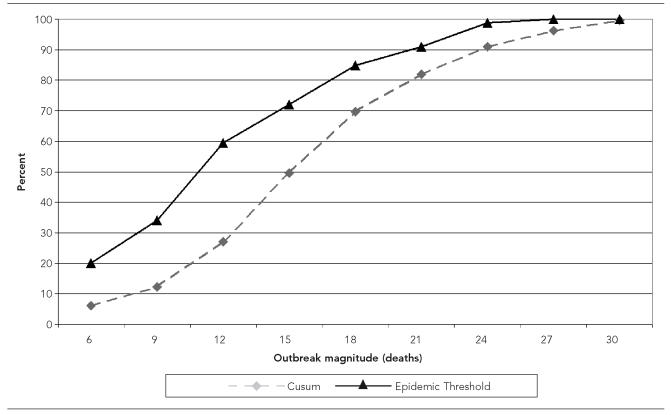
Results: Both methods exhibited low sensitivity for small outbreaks and low to moderate sensitivity for larger ones. In terms of overall outbreak detection, large outbreaks were detected with moderate to high levels of reliability, while smaller ones were detected with low to moderate reliability for both methods. The Epidemic Threshold method performed significantly better than the Cusum method for overall outbreak detection.
Conclusions: The use of coroner data for mortality surveillance has both advantages and disadvantages, the chief advantage being the rapid availability of coroner data compared to vital statistics data, making near real-time mortality surveillance possible. Given the lack of sensitivity and limited outbreak detection reliability of the methods studied, the use of mortality surveillance for early outbreak detection appears to have limited usefulness. If it is used, it should be as an adjuvant in conjunction with other surveillance systems.
Figures
References
-
- Denver A. Epidemiology in health service management. Fredrick (MD): Aspen; 1984.
-
- Buehler JW, Hopkins RS, Overhage JM, Sosin DM, Tong V. Framework for evaluating public health surveillance systems for early detection of outbreaks; recommendations from the CDC Working Group. MMWR Recomm Rep. 2004;53(RR-5):1–11. - PubMed
-
- Durth JS, Bailey LA, Stoto MA, editors. Improving health in the community: a role for performance monitoring. Washington: National Academies Press; 1997. - PubMed
-
- Thacker SB, Berkelman RL. Public health surveillance in the United States. Epidemiol Rev. 1988;10:164–90. - PubMed
Publication types
MeSH terms
LinkOut - more resources
Full Text Sources
