


Expression of thymidine phosphorylase in peripheral blood cells of breast cancer patients is not increased by paclitaxel
- PMID: 17640356
- PMCID: PMC1939983
- DOI: 10.1186/1472-6904-7-7
Expression of thymidine phosphorylase in peripheral blood cells of breast cancer patients is not increased by paclitaxel
Abstract
Background: A synergistic cytotoxic effect has been hypothesized for taxanes and capecitabine, a prodrug of 5-fluorouracil. Based on preclinical studies, this synergism has been attributed to an up-regulation of the enzyme thymidine phosphorylase (TP). Beside tumour tissue, TP is highly expressed in white blood cells, possibly causing increased hematotoxicity, when taxanes are combined with capecitabine. So far, this hypothesis has not been investigated in humans.
Methods: A total of 128 consecutive blood samples were collected from eight patients with advanced breast cancer receiving paclitaxel weekly at a dose of 80 mg/m2. To assess the expression of TP in blood cells, samples were collected prior to first therapy, at the end of infusion, and up to 15 days thereafter. This procedure was repeated during the sixth application of paclitaxel. After isolation of the peripheral mononuclear blood cells, the expression of TP was assessed by ELISA. In parallel, paclitaxel level in plasma was evaluated at three selected time points as pharmacokinetic control parameter.
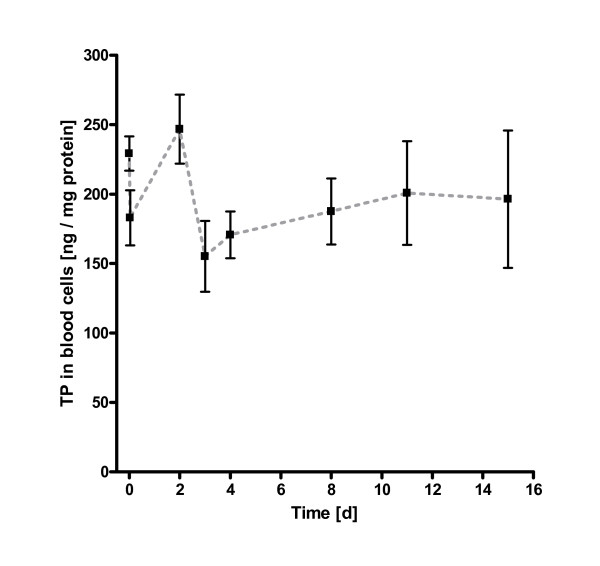
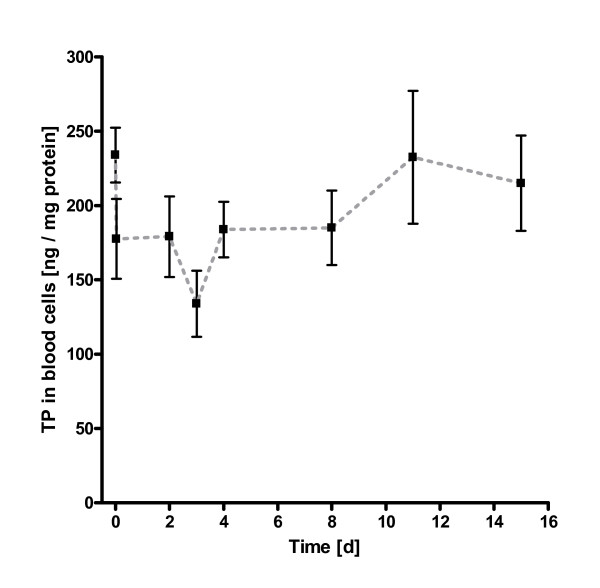
Results: Paclitaxel concentrations at the end of infusion did not change significantly from week 1 to week 6. The expression of TP in peripheral mononuclear blood cells decreased significantly after infusion below pretherapeutic values (p = 0.023; n = 8). After the nadir on day 3, the expression of TP increased moderately returning to baseline levels within one week. The overall picture in week 6 was similar to week 1. Using a trend analysis, neither a short-term nor a long-term induction of TP was observed.
Conclusion: TP in peripheral mononuclear blood cells was hardly regulated under therapy with paclitaxel. Therefore, no increased haematotoxicity due to TP upregulation is expected from the combination of taxanes and capecitabine.
Figures
References
-
- Miwa M, Ura M, Nishida M, Sawada N, Ishikawa T, Mori K, Shimma N, Umeda I, Ishitsuka H. Design of a novel oral fluoropyrimidine carbamate, capecitabine, which generates 5-fluorouracil selectively in tumours by enzymes concentrated in human liver and cancer tissue. Eur J Cancer. 1998;34:1274–1281. doi: 10.1016/S0959-8049(98)00058-6. - DOI - PubMed
-
- Yoshimura A, Kuwazuru Y, Furukawa T, Yoshida H, Yamada K, Akiyama S. Purification and tissue distribution of human thymidine phosphorylase; high expression in lymphozytes, reticulocytes and tumors. Biochem Biophys Acta. 1990;1034:107–112. - PubMed
-
- Sawada N, Ishikawa T, Sekiguchi F, Tanaka Y, Ihitsuka H. X-ray irradiation induces thymidine phosphorylase and enhances the efficacy of capecitabine (xeloda) in human cancer xenografts. Clin Cancer Res. 1999;5:2948–2953. - PubMed
-
- Maher JF, Villalona-Calero MA. Taxanes and capecitabine in combination: rationale and clinical results. Clin Breast Cancer. 2002;2:287–293. - PubMed
Publication types
MeSH terms
Substances
LinkOut - more resources
Full Text Sources
Medical
