


Simulating hemispatial neglect with virtual reality
- PMID: 17640377
- PMCID: PMC1965467
- DOI: 10.1186/1743-0003-4-27
Simulating hemispatial neglect with virtual reality
Abstract
Background: Hemispatial neglect is a cognitive disorder defined as a lack of attention for stimuli contra-lateral to the brain lesion. The assessment is traditionally done with basic pencil and paper tests and the rehabilitation programs are generally not well adapted. We propose a virtual reality system featuring an eye-tracking device for a better characterization of the neglect that will lead to new rehabilitation techniques.
Methods: This paper presents a comparison of eye-gaze patterns of healthy subjects, patients and healthy simulated patients on a virtual line bisection test. The task was also executed with a reduced visual field condition hoping that fewer stimuli would limit the neglect.
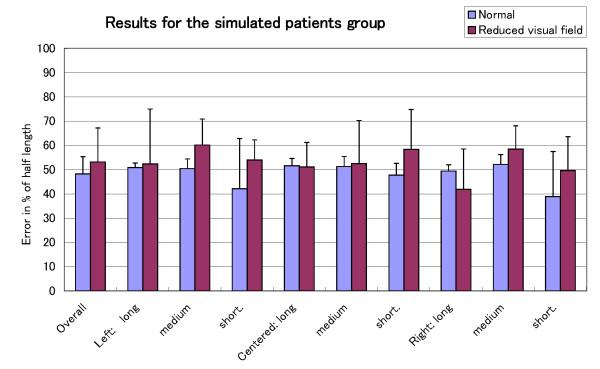
Results: We found that patients and healthy simulated patients had similar eye-gaze patterns. However, while the reduced visual field condition had no effect on the healthy simulated patients, it actually had a negative impact on the patients. We discuss the reasons for these differences and how they relate to the limitations of the neglect simulation.
Conclusion: We argue that with some improvements the technique could be used to determine the potential of new rehabilitation techniques and also help the rehabilitation staff or the patient's relatives to better understand the neglect condition.
Figures



References
-
- Heilman KM, Watson RT, Valenstein E. Neglect and related disorders Clinical neuropsychology. Oxford University Press; 1985. pp. 243–250.
-
- Albert ML. A simple test of visual neglect. Neurology. 1973;23:658–664. - PubMed
-
- Binder J, Marshall R, Lazar R, Benjamin J, Mohr JP. Distinct Syndrome of Hemineglect. Archives of Neurology. 1992;49:1187–1194. - PubMed
-
- Bisiach E, Capitani E, Colombo A, Spinnler H. Halving a horizontal segment : a study on hemisphere-damaged patients with cerebral focal lesions. Archives Suisses de Neurologie, Neurochirurgie et de Psychiatrie. 1976;118:199–206. - PubMed
Publication types
MeSH terms
LinkOut - more resources
Full Text Sources
