


doi: 10.1016/j.neurobiolaging.2007.05.025.
Epub 2007 Jul 20.
Protection against beta-amyloid induced abnormal synaptic function and cell death by Ginkgolide J
Affiliations
- PMID: 17640772
- PMCID: PMC2646106
- DOI: 10.1016/j.neurobiolaging.2007.05.025
Item in Clipboard
Protection against beta-amyloid induced abnormal synaptic function and cell death by Ginkgolide J
Neurobiol Aging.
2009 Feb.
Abstract
A new Ginkgo biloba extract P8A (TTL), 70% enriched with terpene trilactones, prevents A beta(1-42) induced inhibition of long-term potentiation in the CA1 region of mouse hippocampal slices. This neuroprotective effect is attributed in large part to ginkgolide J that completely replicates the effect of the extract. Ginkgolide J is also capable of inhibiting cell death of rodent hippocampal neurons caused by A beta(1-42). This beneficial and multi-faceted mode of action of the ginkgolide makes it a new and promising lead in designing therapies against Alzheimer's disease.
Figures
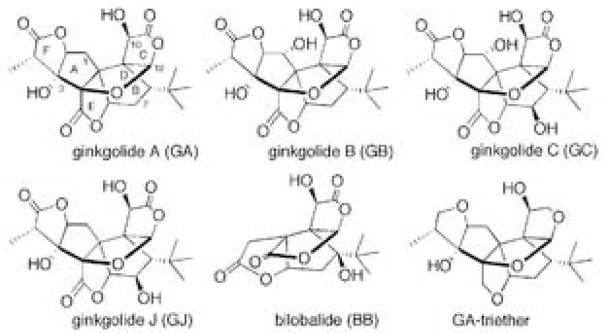
Structures of native terpene trilactones from Ginkgo biloba extract and a reduced derivative, GA-triether.
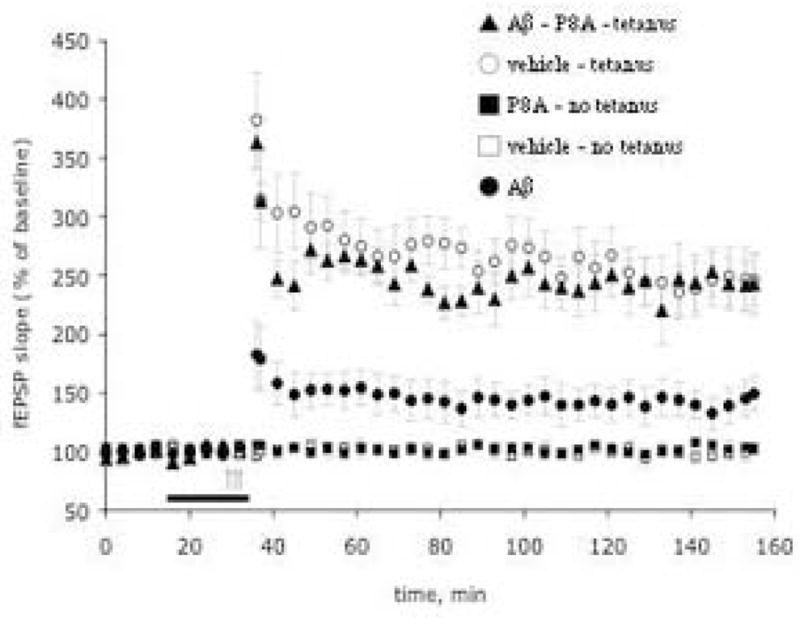
P8A reverses Aβ-induced LTP impairment in the CA1 region of hippocampal slices (n = 8 slices from 8 mice for P8A, 6 slices from 6 mice for Aβ, and 6 slices from 6 mice for vehicle). Both Aβ and P8A did not affect baseline transmission in experiments where no tetanus was applied (n = 3 slices from 3 mice both for P8A, Aβ and vehicle). The horizontal bar indicates the period during which Aβ (200 nM) and P8A (200 μg/ml) were added to the bath solution. The arrows indicate the time at which the theta-burst stimulation was applied in this and the following figures. Every fourth recording point is shown for clarity in this and the following figures. Values represent mean ± SEM (Two-way ANOVA F(1, 12)=10.64, P<0.01 for P8A + Aβ vs. Aβ alone).
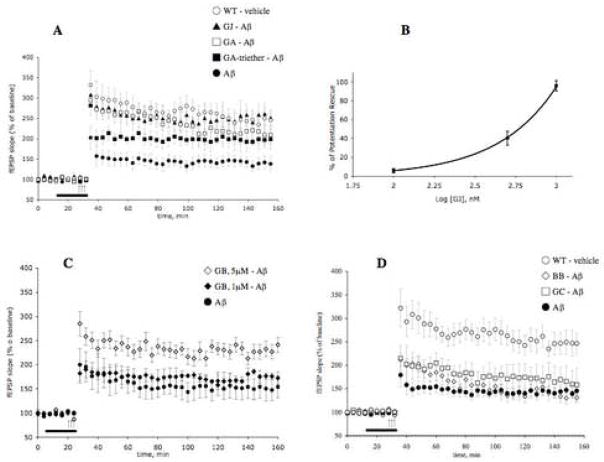
A) Summary graph showing that 20 min treatment with 1 μM GJ, GA and GA-triether rescues LTP impairment in slices treated with 200 nM Aβ1-42 for 20 min prior to LTP induction (n = 9 slices from 8 mice for GJ + Aβ, 8 slices from 8 mice for GA + Aβ and 8 slices from 7 mice for GA-triether + Aβ, 6 slices from 6 mice for Aβ alone). Similar concentrations of GJ, GA and GA-triether did not affect baseline transmission in experiments where no tetanus was applied (n = 4 slices from 4 mice for each group; data not shown). Two way ANOVA: F(1, 13)=12.08, P<0.01 for GJ + Aβ vs. Aβ alone; F(1, 12)=10.02, P<0.01 for GA + Aβ vs. Aβalone; F(1, 12) = 5.83, P<0.05 for GA-triether + Aβ vs. Aβ alone). B) A dose-response curve for GJ effect on Aβ-induced LTP impairment indicates that GJ has its maximal beneficial effect at 1 μM (n = 12 slices from 12 mice for each point). Nonlinear regression analysis was used to fit curves for different concentrations using GraphPad Prism software (GraphPad Software Inc., San Diego, CA). C) Summary graph showing that 20 min treatment with 5 μM (but not 1 μM) GB re-establishes normal LTP in slices treated with 200 nM Aβ1-42 for 20 min prior to LTP induction (n = 12 slices from 10 mice for 5 μM and 8 slices from 8 mice for 1 μM). Both 5 and 1 μM concentrations GB did not affect baseline transmission in experiments where no tetanus was applied (n = 4 slices from 4 mice for each group; data not shown). Two way ANOVA: F(1, 16)=9.47, P<0.01 for 5 μM GB + Aβ vs. Aβ alone; and F(1, 12)=1.85, P>0.05 for 1 μM GB + Aβ vs. Aβ. Alone. D) Summary graph showing that 20 min treatment with the ginkgolides GC as well as the bilobalide BB does not rescue LTP impairment in slices treated with 200 nM Aβ for 20 min prior to LTP induction (n = 9 slices from 7 mice for GC, and 7 slices from 7 mice for BB). Both GC and BB did not affect baseline transmission in experiments where no tetanus was applied (n = 4 for each group; data not shown). The horizontal bar indicates the period during which these drugs were added to the bath solution. Experiments were interleaved with each other. Two way ANOVA: F(1, 13)=0.98, P>0.05 for GC + Aβ vs. Aβ alone and F(1, 11)=0.78, P>0.05 for BB + Aβ vs. Aβ alone. Every fourth recording point is shown for clarity.
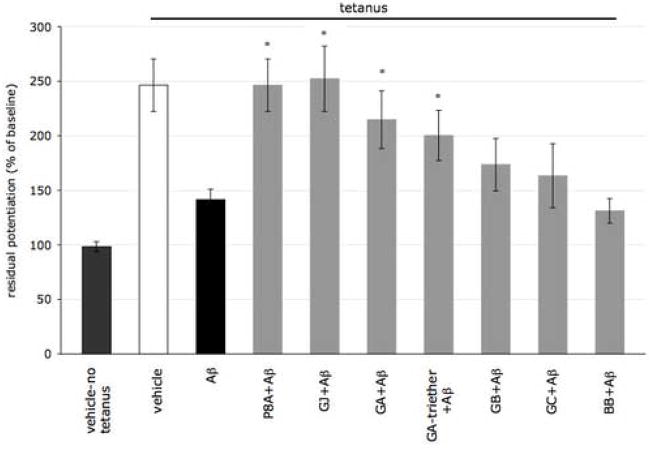
Residual levels of potentiation were averaged during the last 10 min of LTP. P8A, GJ, GA and GA-triether rescued the LTP impairment (Student-Newman-Keuls multiple comparison test, p<0.05 for Aβ vs P8A + Aβ, Aβ vs GJ + Aβ, Aβ vs GA + Aβ, and Aβ vs GA-triether + Aβ, *). Vehicle-no tetanus = 100.0% ± 4.69. Tetanus + vehicle = 246.32 ± 24.0. Tetanus + Aβ = 148.85% ± 9.5. Tetanus + P8A = 246.33% ± 24.1. Tetanus + GJ = 252.25% ± 29.9. Tetanus + GA = 214.72% ± 26.4. Tetanus + GA-triether = 200.23% ± 22.9. Tetanus + GB = 173.45% ± 24.0. Tetanus + GC = 163.31% ± 29.3. Tetanus + BB = 131.09% ± 11.3.
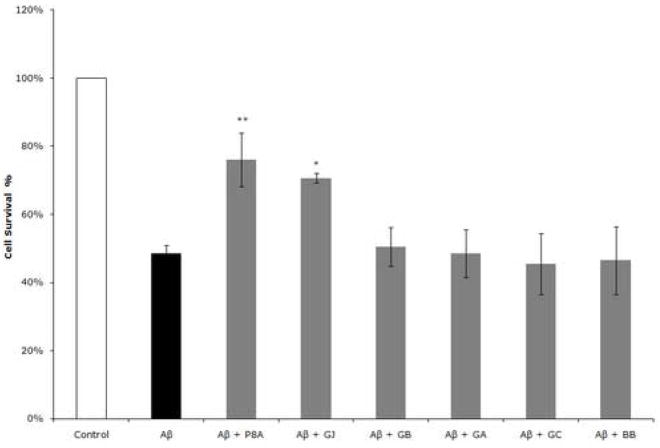
Hippocampal cultures were treated by adding 10 μM Aβ1-42 in its oligomeric form with or without P8A at 50 μg/ml, or alternatively each one of the ginkgolides (GA, GJ) at a concentration of 1 μM. After 24 hrs the number of viable cells was assessed using cell nuclei counting. Aβ induced death of ~50% of the cell population. Both the P8A and GJ, but no GA or any of the other ginkgolides were consistently able to prevent cell death (Student-Newman-Keuls multiple comparison test, p<0.01 for Aβ vs P8A + Aβ, **; p<0.05 for Aβ vs GJ + Aβ, *). CTRL = Control, 100%. Aβ = 48.5% ± 2.4. P8A + Aβ = 76.0 ± 7.9. GJ + Aβ = 70.7 ± 1.4. GA + Aβ = 50.5 ± 5.7. GB ± Aβ = 48.5 ± 7.0. GC ± Aβ = 45.5 ± 9.0. BB ± Aβ = 46.5 ± 10.0. Values represent mean ± SEM of three consecutive experiments. Each experiment was performed in triplicate.
References
-
- Aksenov M, Aksenova M, Butterfield DA, Markesbery WR. Oxidative modification of creatine kinase BB in Alzheimer’s disease brain. Journal of neurochemistry. 2000;74(6):2520–7. - PubMed
-
- Andrieu S, Gillette S, Amouyal K, Nourhashemi F, Reynish E, Ousset PJ, Albarede JL, Vellas B, Grandjean H. Association of Alzheimer’s disease onset with ginkgo biloba and other symptomatic cognitive treatments in a population of women aged 75 years and older from the EPIDOS study. The journals of gerontology. 2003;58(4):372–7. - PubMed
-
- Bartlett H, Eperjesi F. An ideal ocular nutritional supplement? Ophthalmic Physiol Opt. 2004;24(4):339–49. - PubMed
-
- Bastianetto S, Zheng WH, Quirion R. The Ginkgo biloba extract (EGb 761) protects and rescues hippocampal cells against nitric oxide-induced toxicity: involvement of its flavonoid constituents and protein kinase C. Journal of neurochemistry. 2000;74(6):2268–77. - PubMed
Publication types
MeSH terms
Substances
Grants and funding
LinkOut - more resources
Full Text Sources
Other Literature Sources
Miscellaneous
