. 2007 Jul 31;104(31):12784-9.
doi: 10.1073/pnas.0705499104. Epub 2007 Jul 18.

Protein 4.1B suppresses prostate cancer progression and metastasis

Affiliations

Protein 4.1B suppresses prostate cancer progression and metastasis

Sunny Y Wong et al. Proc Natl Acad Sci U S A. .

Abstract

Protein 4.1B is a 4.1/ezrin/radixin/moesin domain-containing protein whose expression is frequently lost in a variety of human tumors, including meningiomas, non-small-cell lung cancers, and breast carcinomas. However, its potential tumor-suppressive function under in vivo conditions remains to be validated. In a screen for genes involved with prostate cancer metastasis, we found that 4.1B expression is reduced in highly metastatic tumors. Down-regulation of 4.1B increased the metastatic propensity of poorly metastatic cells in an orthotopic model of prostate cancer. Furthermore, 4.1B-deficient mice displayed increased susceptibility for developing aggressive, spontaneous prostate carcinomas. In both cases, enhanced tumor malignancy was associated with reduced apoptosis. Because expression of Protein 4.1B is frequently down-regulated in human clinical prostate cancer, as well as in a spectrum of other tumor types, these results suggest a more general role for Protein 4.1B as a negative regulator of cancer progression to metastatic disease.


Conflict of interest statement

The authors declare no conflict of interest.

Figures
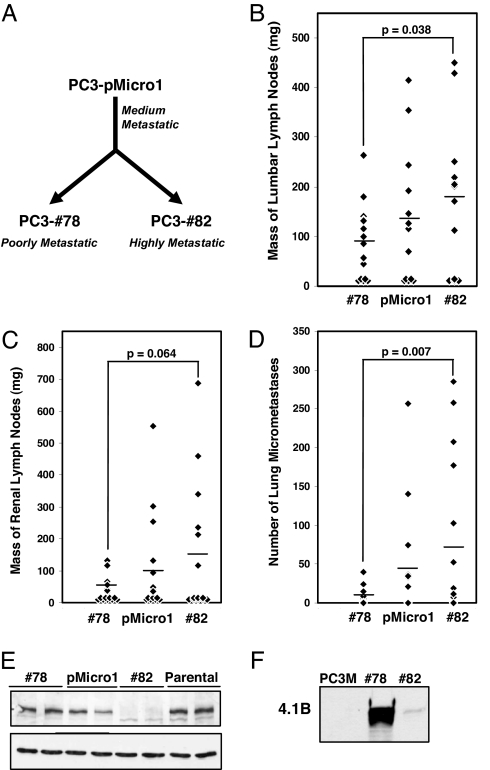
Fig. 1.
Fig. 1.
Derivation of metastatic variant prostate cancer cell lines and identification of 4.1B as a protein that is down-regulated in highly metastatic cells. (A) Highly metastatic #82 cells and poorly metastatic #78 cells were isolated after repeated in vivo passaging of PC-3 cells by using surgical orthotopic implantation. (B–D) #82 cells formed orthotopic primary tumors that exhibited an increased propensity to metastasize to paraaortic/lumbar lymph nodes (B), pararenal lymph nodes (C), and lung (D) relative to tumors from #78 cells (horizontal bar, mean). (E) Western blotting for 4.1B (Upper) or GAPDH loading control (Lower) confirmed gene expression analyses indicating that 4.1B was specifically down-regulated in highly metastatic #82 and PC-3M cells (F).
Fig. 2.
Fig. 2.
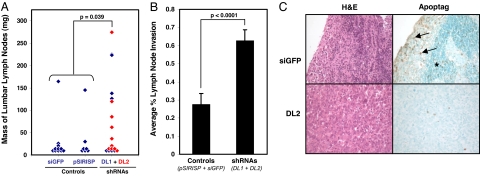
Down-regulation of 4.1B increases the metastatic potential of poorly metastatic #78 cells. (A and B) The average mass of the draining paraaortic/lumbar lymph nodes (A), and the percentage node area that had been infiltrated by tumor cells (B) were both significantly increased in mice bearing #78 orthotopic tumors expressing DL1 and DL2 shRNAs against 4.1B relative to those bearing #78 control tumors. (C) Paraaortic/lumbar lymph nodes from mice bearing #78 tumors expressing DL1 and DL2 were often completely infiltrated by tumor cells, with few apoptotic cells present (Lower). In contrast, nodes from mice bearing control #78 tumors (Upper) more commonly possessed areas of subcapsular invasion, where apoptotic cells were frequently observed (arrows). In most cases, the interior regions of these nodes were relatively uninvaded (*). Representative serial lymph node sections stained either by H&E (Left) or for apoptosis (Right) are shown at ×20 magnification.
Fig. 3.
Fig. 3.
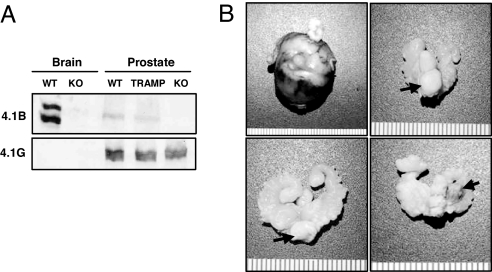
4.1B−/− mice develop aggressive adenocarcinomas in a spontaneous tumor model of prostate cancer. (A) Western blotting for 4.1B (Upper) or 4.1G (Lower) in brain or prostate tissues shows that 4.1B is specifically lost in knockout animals. (B) 4.1B−/−;TRAMP mice more commonly developed a variety of palpable, high-grade carcinomas in the prostate (arrows), including (starting from Upper Left and proceeding clockwise) compound, multilobed carcinomas; ventral-lobed carcinomas; anterior-lobed carcinomas; and dorsal-lobed carcinomas. These results are tabulated in Table 1.
Fig. 4.
Fig. 4.
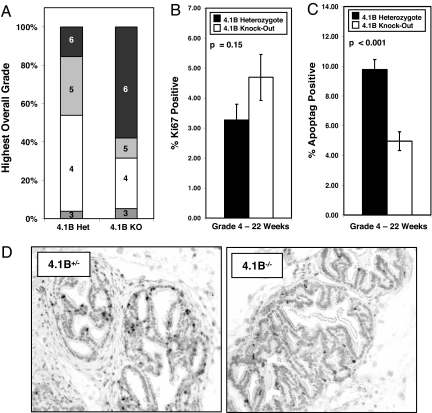
Higher grade and less differentiated 4.1B−/−;TRAMP prostate carcinomas likely arise from tumorigenic lesions that exhibit less apoptosis than those of heterozygous lesions. (A) Each entire prostate was assigned a single highest grade identical to the highest grade assigned to any one constituent lobe. Please refer to SI Fig. 14 for additional histologic scoring results organized by prostate lobe. (B) Proliferation rates were similar regardless of 4.1B status in 22-week-old, grade 4 TRAMP ventral prostates, but 4.1B−/− TRAMP ventral prostates were significantly less apoptotic relative to grade- and age-matched 4.1B+/− TRAMP prostates (C). (D) Representative sections stained for apoptotic cells.
Fig. 5.
Fig. 5.
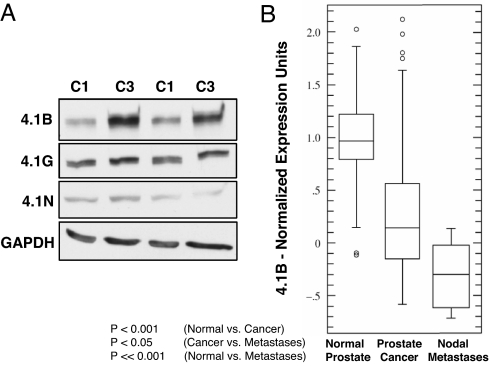
4.1B is down-regulated in aggressive TRAMP tumor cell lines and in human clinical prostate cancer. (A) 4.1B protein levels are reduced in malignant TRAMP-C1 cells (C1) relative to nonmalignant TRAMP-C3 cells (C3); independent replicate samples are shown. (B) 4.1B expression is significantly down-regulated during human clinical prostate cancer progression, from normal prostate tissue, to prostate cancer, and finally to prostate cancer lymph node metastases [data obtained by Lapointe et al. (22) and processed by Oncomine 3.0]. Three additional human clinical prostate cancer studies displaying down-regulation of 4.1B can be found in SI Fig. 17.

References

    1. Bretscher A, Edwards K, Fehon RG. Nat Rev Mol Cell Biol. 2002;3:586–599. - PubMed
    1. Sun CX, Robb VA, Gutmann DH. J Cell Sci. 2002;115:3991–4000. - PubMed
    1. Gutmann DH, Giordano MJ, Fishback AS, Guha A. Neurology. 1997;49:267–270. - PubMed
    1. McClatchey AI, Giovannini M. Genes Dev. 2005;19:2265–2277. - PubMed
    1. McClatchey AI, Saotome I, Mercer K, Crowley D, Gusella JF, Bronson RT, Jacks T. Genes Dev. 1998;12:1121–1133. - PMC - PubMed

Publication types

MeSH terms

Associated data