Meta-analysis of cannabinoid ligand binding affinity and receptor distribution: interspecies differences
- PMID: 17641667
- PMCID: PMC2190026
- DOI: 10.1038/sj.bjp.0707399
Meta-analysis of cannabinoid ligand binding affinity and receptor distribution: interspecies differences
Abstract
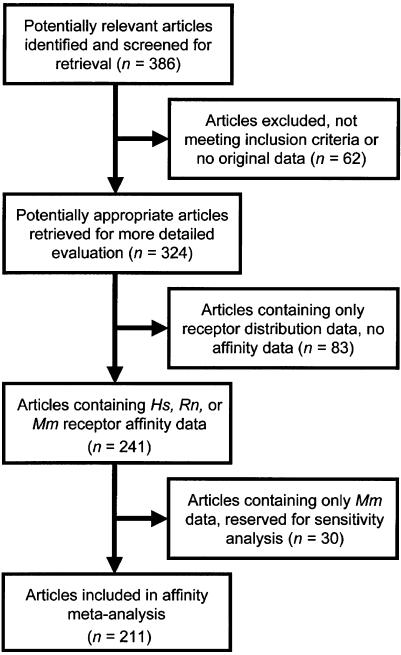
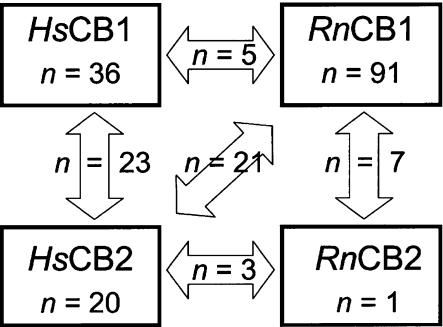
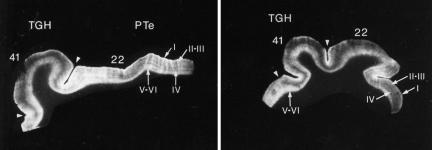
A meta-analysis, unlike a literature review, synthesizes previous studies into new results. Pooled data from 211 studies measured ligand binding affinities at human (Hs) or rat (Rn) cannabinoid receptors CB1 and CB2. Cochrane methods were modified for this non-clinical analysis. Meta-regression detected data heterogeneity arising from methodological factors: use of sectioned tissues, lack of PMSF and choice of radioligand. Native brain tissues exhibited greater affinity (lower nM) than transfected cells, but the trend fell short of significance, as did the trend between centrifugation and filtration methods. Correcting for heterogeneity, mean Ki values for delta 9-tetrahydrocannabinol differed significantly between HsCB1 and RnCB1 (25.1 and 42.6 nM, respectively) but not between HsCB1 and HsCB2 (25.1 and 35.2). Mean Kd values for HsCB1, RnCB1 and HsCB2 of CP55,940 (2.5, 0.98, 0.92) and WIN55,212-2 (16.7, 2.4, 3.7) differed between HsCB1 and RnCB1 and between HsCB1 and HsCB2. SR141716A differed between HsCB1 and RnCB1 (2.9 and 1.0 nM). Anandamide at HsCB1, RnCB1 and HsCB2 (239.2, 87.7, 439.5) fell short of statistical differences due to heterogeneity. We consider these Kd and Ki values to be the most valid estimates in the literature. Sensitivity analyses did not support the numerical validity of cannabidiol, cannabinol, 2-arachidonoyl glycerol and all ligands at RnCB2. Aggregate rank order analysis of CB(1) distribution in the brain (pooled from 119 autoradiographic, immunohistochemical and in situ hybridization studies) showed denser HsCB1 expression in cognitive regions (cerebral cortex) compared to RnCB1, which was relatively richer in movement-associated areas (cerebellum, caudate-putamen). Implications of interspecies differences are discussed.
Figures
References
-
- Andersson H, D'Antona AM, Kendall DA, Von Heijne G, Chin CN. Membrane assembly of the cannabinoid receptor 1: impact of a long N-terminal tail. Mol Pharmacol. 2003;64:570–577. - PubMed
-
- Arnold JC, Topple AN, Mallet PE, Hunt GE, McGregor IS. The distribution of cannabinoid-induced Fos expression in rat brain: differences between the Lewis and Wistar strain. Brain Res. 2001;921:240–255. - PubMed
-
- Astolfi M, Patacchini R, Maggi M, Manzini S. Improved discriminatory properties between human and murine tachykinin NK1 receptors of MEN 10930: a new potent and competitive antagonist. Neuropeptides. 1997;31:373–379. - PubMed
-
- Baker D, Pryce G, Davies WL, Hiley CR. In silico patent searching reveals a new cannabinoid receptor. Trends Pharmacol Sci. 2006;27:1–4. - PubMed
Publication types
MeSH terms
Substances
LinkOut - more resources
Full Text Sources
Other Literature Sources
Molecular Biology Databases