. 2007 Oct;155(2):84-93.
doi: 10.1016/j.molbiopara.2007.06.002. Epub 2007 Jun 19.

Proteomic analysis of Schistosoma mansoni egg secretions

Affiliations

Proteomic analysis of Schistosoma mansoni egg secretions

Cynthia L Cass et al. Mol Biochem Parasitol. 2007 Oct.

Abstract

Schistosomiasis remains a largely neglected, global health problem. The morbid pathology of the disease stems from the host's inflammatory response to parasite eggs trapped in host tissues. Long term host/parasite survival is dependent upon the successful modulation of the acute pathological response, which is induced by egg antigens. In this study, using Multidimensional Protein Identification Technology, we identified the Schistosoma mansoni egg secretome consisting of 188 proteins. Notably we identified proteins involved in redox balance, molecular chaperoning and protein folding, development and signaling, scavenging and metabolic pathways, immune response modulation, and 32 novel, previously uncharacterized schistosome proteins. We localized a subset of previously characterized schistosome proteins identified in egg secretions in this study, to the surface of live S. mansoni eggs using the circumoval precipitin reaction. The identification of proteins actively secreted by live schistosome eggs provides important new information for understanding immune modulation and the pathology of schistosomiasis.


Figures
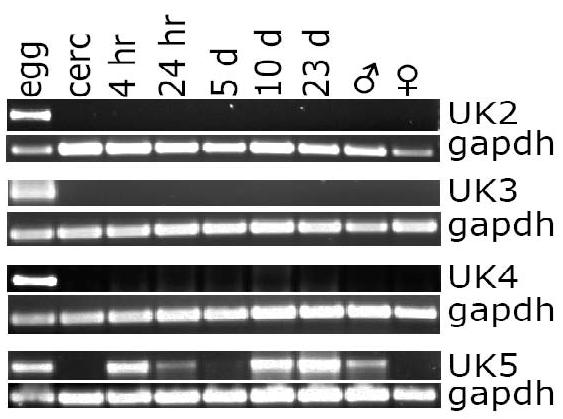
Figure 1
Figure 1. RT-PCR analysis of unknown egg secreted protein mRNA expression across Schistosoma mansoni life cycle stages
RT-PCR, using primer pairs specific for unknown ESP proteins 2-5 (UK 2-5), was used to visualize the expression of unknown egg protein expression throughout the S. mansoni life cycle. In each lane, 0.5 μl cDNA from one of nine developmental stages (egg (egg); cercariae (cerc); schistosomula cultured for either 4 hours (4 hr), 24 hours (24 hr), 5 days (5d), or 10 days (10d); 23 day larvae (23d); adult males (♂); adult females (♀)) was probed by RT-PCR using the primers and conditions listed in Supplemental Table 2.
Figure 2
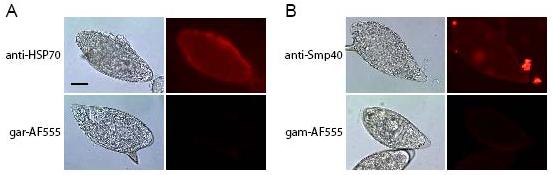
Figure 2. Egg secreted proteins can be visualized in circumoval precipitin reactions
Panel (A) shows eggs cultured with rabbit polyclonal antibodies against HSP70 visualized with anti-rabbit IgG-Alexa Fluor 555-labeled secondary antibody, or with secondary antibody alone (goat anti rabbit-AF555). Panel (B) shows eggs cultured with either a mixture of equal amounts of several purified monoclonal antibodies against Sm-p40 visualized by anti-mouse IgG-Alexa Fluor 555-labeled secondary antibody, and the secondary antibody alone (goat anti mouse-AF555). Exposure times are: bright field (1/30 sec), immunofluorescence (1 sec). Bar equals 30 μm.
Figure 3
Figure 3
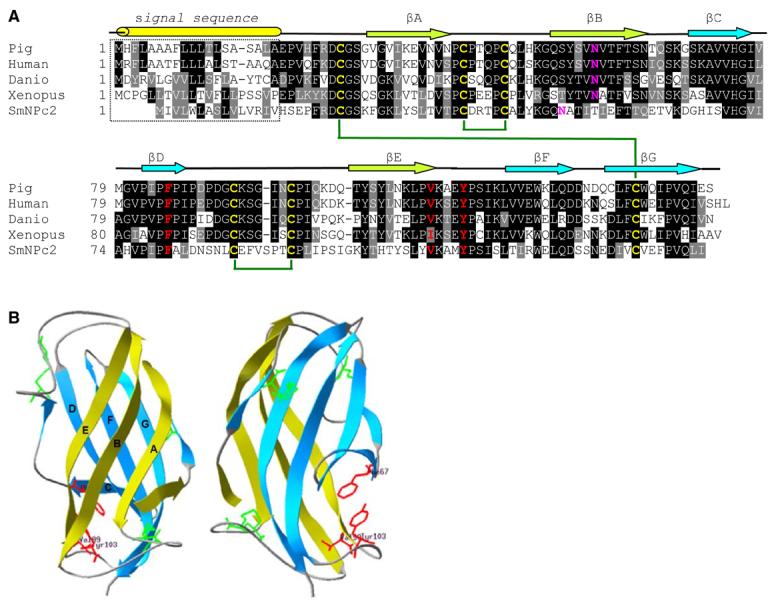
Panel A. Primary sequence alignment of S. mansoni and vertebrate NPC2 proteins. NPC2 proteins from pig (O97763), human (P61916), Danio rerio (Q9DGJ3), and Xenopus tropicalis (CAJ83028) were aligned with the S. mansoni NPC2 protein using ClustalW [57]. Identical residues are shown in reverse font and functionally conserved residues are shown with gray background. The predicted secondary structure elements [58] of S. mansoni NPC2 are shown above the sequence alignment. Predicted β-sheets (arrows) and leader peptide (tube) are indicated. Residues determined to be essential for cholesterol binding in human NPC2 are shown in red, conserved Cys residues are shown in yellow and potential disulfides are indicated by green lines, and potential N-glycosylation sites are shown in pink. Panel B. Structural model of S. mansoni NPC2. Ribbon diagrams of S. mansoni NPC2 with views related by a 90° rotation. One β-sheet is shown in lime and the other in turquoise. The side chains of cysteine residues that form three disulfide bonds are shown in green. Residues that have been found to be essential for cholesterol binding, Phe-66, Val-96, and Tyr-100, are shown in red. This figure was generated using Swiss-Model and DeepView/Swiss-PDB Viewer [59].

References

    1. Hotez PJ, Molyneux DH, Fenwick A, Ottesen E, Ehrlich Sachs S, et al. Incorporating a rapid-impact package for neglected tropical diseases with programs for HIV/AIDS, tuberculosis, and malaria. PLoS Med. 2006;3:e102. - PMC - PubMed
    1. King CH, Dickman K, Tisch DJ. Reassessment of the cost of chronic helminthic infection: a meta-analysis of disability-related outcomes in endemic schistosomiasis. Lancet. 2005;365:1561–9. - PubMed
    1. Abath FGC, Morais CNL, Montenegro CEL, Wynn TA, Montenegro SML. Immunopathogenic mechanisms in schistosomiasis: what can be learnt from human studies? Trends Parasitol. 2006;22:86–91. - PubMed
    1. Hernandez HJ, Wang Y, Tzellas N, Stadecker MJ. Expression of class II, but not class I, major histocompatibility complex molecules is required for granuloma formation in infection with Schistosoma mansoni. Eur J Immunol. 1997;27:1170–6. - PubMed
    1. Pearce EJ, MacDonald AS. The immunobiology of schistosomiasis. Nat Rev Immunol. 2002;2:499–511. - PubMed

Publication types

LinkOut - more resources