


Inflammatory biomarkers, disease activity and spinal disease measures in patients with ankylosing spondylitis after treatment with infliximab
- PMID: 17644552
- PMCID: PMC2564765
- DOI: 10.1136/ard.2007.071605
Inflammatory biomarkers, disease activity and spinal disease measures in patients with ankylosing spondylitis after treatment with infliximab
Abstract
Objective: To evaluate the relationship between biomarker levels and disease activity and the spinal inflammation detected by magnetic resonance imaging (MRI) in patients with ankylosing spondylitis (AS).
Methods: Patients with AS were randomly assigned in a 3:8 ratio to receive infusions of placebo or 5 mg/kg infliximab at weeks 0, 2, 6, 12 and 18. Sera were collected for biomarker analysis at weeks 0, 2 and 24 and were analysed for levels of interleukin-6 (IL-6), vascular endothelial growth factor (VEGF) and C-reactive protein (CRP). Bath Ankylosing Spondylitis Disease Activity Index (BASDAI) scores and pre- and post-gadolinium T1 and short tau inversion recovery MRIs were collected at baseline and week 24.
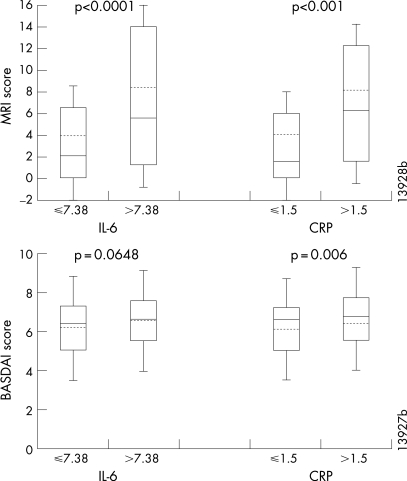
Results: Significantly greater reductions in IL-6, VEGF and CRP were observed at weeks 2 and 24 in the infliximab group compared with the placebo group (all p<0.001). Baseline IL-6 levels >7.38 pg/ml and CRP levels >1.5 mg/dl were associated with increased rates of clinical response after 24 weeks. Multiple regression analyses showed that reductions from baseline to week 2 in IL-6, but not CRP or VEGF, were significantly associated with reductions in MRI activity and BASDAI scores from baseline to week 24 in the infliximab group (p<0.001).
Conclusions: Significant reductions in IL-6, VEGF and CRP were observed with infliximab compared with placebo. High levels of baseline IL-6 and CRP were associated with clinical response after infliximab treatment. Early reductions in IL-6 were significantly associated with improvements in disease activity and the spinal inflammation detected by MRI.
Conflict of interest statement
Figures


References
-
- Braun J, Bollow M, Neure L, Seipelt E, Seyrekbasan F, Herbst H, et al. Use of immunohistologic and in situ hybridization techniques in the examination of sacroiliac joint biopsy specimens from patients with ankylosing spondylitis. Arthritis Rheum 1995;38:499–505 - PubMed
-
- Francois RJ, Neure L, Sieper J, Braun J. Immunohistological examination of open sacroiliac biopsies of patients with ankylosing spondylitis: detection of tumour necrosis factor alpha in two patients with early disease and transforming growth factor beta in three more advanced cases. Ann Rheum Dis 2006;65:713–20 - PMC - PubMed
-
- Lange U, Teichmann J, Stracke H. Correlation between plasma TNF-alpha, IGF-1, biochemical markers of bone metabolism, markers of inflammation/disease activity, and clinical manifestations in ankylosing spondylitis. Eur J Med Res 2000;5:507–11 - PubMed
-
- Seo JS, Lee SS, Kim SI, Ryu WH, Sa KH, Kim SU, et al. Influence of VEGF gene polymorphisms on the severity of ankylosing spondylitis. Rheumatology (Oxford) 2005;44:1299–302 - PubMed
Publication types
MeSH terms
Substances
LinkOut - more resources
Full Text Sources
Other Literature Sources
Medical
Research Materials
Miscellaneous
