. 2007 Oct 15;110(8):2889-98.
doi: 10.1182/blood-2007-01-066316. Epub 2007 Jul 20.

Cited2 is required for normal hematopoiesis in the murine fetal liver

Affiliations

Cited2 is required for normal hematopoiesis in the murine fetal liver

Yu Chen et al. Blood. .

Abstract

Cited2 (cAMP-responsive elementbinding protein [CBP]/p300-interacting transactivators with glutamic acid [E] and aspartic acid [D]-rich tail 2) is a newly identified transcriptional modulator. Knockout of the Cited2 gene results in embryonic lethality with embryos manifesting heart and neural tube defects. Cited2-/- fetal liver displayed significant reduction in the numbers of Lin(-)c-Kit+Sca-1+ cells, Lin(-)c-Kit+ cells, and progenitor cells of different lineages. Fetal liver cells from Cited2-/- embryos gave rise to markedly reduced number of colonies in the colony-forming unit assay. Primary and secondary transplantation studies showed significantly compromised reconstitution of T-lymphoid, B-lymphoid, and myeloid lineages in mice that received a transplant of Cited2-/- fetal liver cells. Competitive reconstitution experiments further showed that fetal liver hematopoietic stem cell (HSC) function is severely impaired due to Cited2 deficiency. Microarray analysis showed decreased expression of Wnt5a and a panel of myeloid molecular markers such as PRTN3, MPO, Neutrophil elastase, Cathepsin G, and Eosinophil peroxidase in Cited2-/- fetal livers. Decreased expression of Bmi-1, Notch1, LEF-1, Mcl-1, and GATA2 was also observed in Cited2-/- Lin(-)c-Kit+ cells. The present study uncovers for the first time a novel role of Cited2 in the maintenance of hematopoietic homeostasis during embryogenesis and thus provides new insights into the molecular regulation of hematopoietic development.


Figures

Figure 1
Figure 1
Cited2 is expressed in Linc-Kit+, Linc-Kit+Sca-1+ (LSK) fetal liver cells. Fetal liver cells from 14.5 dpc were sorted for Linc-Kit+ and LSK subpopulations. Sorted cells were processed for mRNA expression of Cited2 by RT-PCR, and the expression was further quantified by real-time PCR with 18S as the internal control for verifying the presence of cDNA after reverse transcription and for quantification purposes. (A) Cited2 expression was detected in Linc-Kit+ and LSK cells. (B) Cited2 expression in LSK cells was approximately 3-fold higher than that in Linc-Kit+ cells. Two sets of independently sorted cells were performed in parallel for Cited2 mRNA expression analysis.
Figure 2
Figure 2
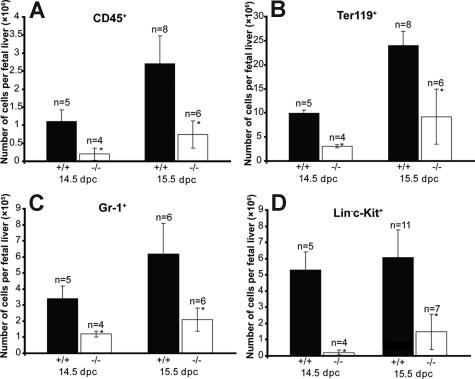
Reduction of hematopoietic cells in Cited2−/− fetal liver at 14.5 dpc and 15.5 dpc. Fetal livers from 14.5 dpc and 15.5 dpc were harvested and single cell suspensions were prepared by passing them through a 1-mL pipette and filtering through a 100-μm cell strainer. Cell number was counted using a hemocytometer. Fetal liver cells (5 × 10⁵) were used for the FACS analysis. The absolute number of CD45+ (A), Ter119+ (B), Gr-1+ (C), and Linc-Kit+ (D) cells from Cited2−/− and Cited2+/+ controls at 14.5 dpc and 15.5 dpc is presented (*P < .05; average ± SEM).
Figure 3
Figure 3
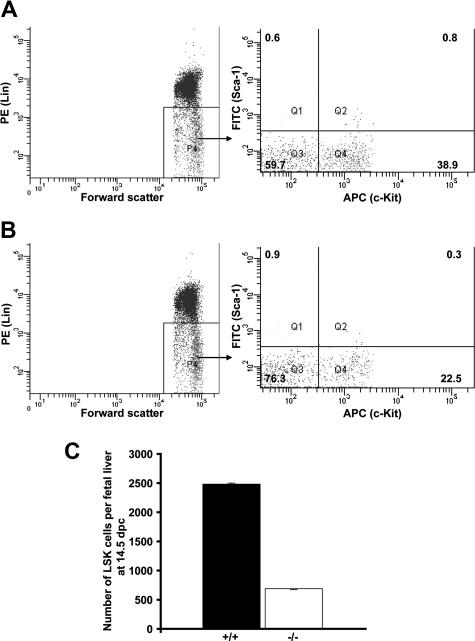
Reduced number of LSK cells in Cited2−/− fetal liver. Fetal liver cells from (A) Cited2+/+ littermate control (n = 5) and (B) Cited2−/− (n = 4) at 14.5 dpc were sorted as shown by the representative lineage and sorting gates (LSK cells were collected from Q2). Ten thousand counts were presented in panels A,B. The numbers within the quadrants represent the percentage of cells. The yield of LSK cells sorted from Q2 was too low to be reanalyzed. (C) The cumulative counts of LSK cells obtained by flow cytometer during the sorting procedure, which was compared between Cited2−/− and Cited2+/+ littermate control and revealed significant reduction in Cited2−/− fetal liver (P < .01; average ± SEM).
Figure 4
Figure 4
Number and proliferation of hematopoietic progenitor cells were compromised due to Cited2 deficiency. Fetal liver cells were prepared and 2 × 10⁴ fetal liver cells from each sample were plated in triplicate cultures of methylcellulose-based medium supplemented with 3 units/mL Epo, 10 ng/mL mouse recombinant IL-3, 10 ng/mL human recombinant IL-6, and 50 ng/mL mouse recombinant stem cell factor. The frequency of BFU-Es, CFU-GMs, and CFU-GEMMs was determined after 7 to 12 days of culture. Total number of BFU-Es, CFU-GMs, and CFU-GEMMs per fetal liver was obtained by multiplying the frequency of BFU-Es, CFU-GMs, and CFU-GEMMs per 2 × 10⁴ cells by the total fetal liver cell number. The data were expressed as average (± SD). (A) At 13.5 dpc, the number of BFU-Es, CFU-GMs, and CFU-GEMMs was reduced in Cited2−/− fetal liver (n = 5) compared with the wild-type littermate control (n = 5). Cited2+/− fetal liver (n = 4) had fewer numbers of BFU-Es, CFU-GMs, and CFU-GEMMs as well. (B) At 14.5 dpc, decreased number of BFU-Es, CFU-GMs, and CFU-GEMMs was observed in Cited2−/− fetal liver (n = 4) compared with the wild-type littermate control (n = 3). Cited2+/− fetal liver (n = 5) showed decreased number of BFU-Es and CFU-GMs. (C) Decreased number of BFU-Es, CFU-GMs, and CFU-GEMMs was observed in Cited2−/− fetal liver (n = 4) compared with the wild-type littermate control (n = 6) at 15.5 dpc. Cited2+/− fetal liver (n = 4) showed decreased number of BFU-Es, CFU-GMs, and CFU-GEMMs. All comparisons were relative to wild-type controls (# indicates P < .05, *P < .01).
Figure 5
Figure 5
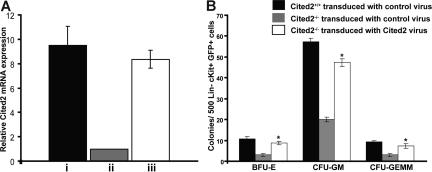
Retrovirus-mediated Cited2 expression rescues the defective hematopoietic colony-forming activity in Lin c-Kit+ Cited2−/− fetal liver cells. MSCV-Cited2-IRES-GFP plasmid– or MSCV-IRES-GFP control plasmid–mediated retrovirus transduction was performed on Cited2−/− and Cited2+/+ 13.5 dpc fetal liver cells. Briefly, after coculture with retrovirus producer cells, GFP+Linc-Kit+ fetal liver cells were sorted for GFP expression followed by analysis of Cited2 mRNA expression via real-time PCR. Meanwhile, 500 cells of the analyzed cell population were plated in triplicate in methylcellulose-based medium (M3434; StemCell Technologies) for colony-forming unit (CFU) assay. Colonies were counted 12 days after plating. (A) Cited2 was expressed in GFP+Linc-Kit+ Cited2−/− fetal liver after transduction with Cited2-expressing retrovirus. (B) Retrovirus-mediated Cited2 expression in GFP+Linc-Kit+ Cited2−/− fetal liver cells at 13.5 dpc significantly increased the frequency of BFU-Es, CFU-GMs, and CFU-GEMMs (n = 3) compared with the vector control (n = 3; *P < .01; average ± SD). (Cited2+/+ fetal liver cells transduced with control virus [■]; Cited2−/− fetal liver cells transduced with control virus [■]; Cited2−/− fetal liver cells transduced with Cited2-expressing virus [□].)
Figure 6
Figure 6
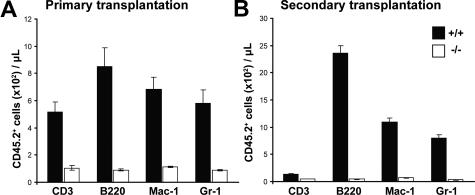
Cited2 deficiency results in impaired reconstitution of multiple lineages in primary and secondary transplantations. (A) Fetal liver cells (106) from each of Cited2−/− (n = 3) and Cited2+/+ (n = 3) embryos were injected via tail vein into lethally irradiated congenic recipient mice, and the peripheral blood reconstitution of T-lymphoid, B-lymphoid, and myeloid cells was analyzed 8 months after transplantation. The long-term reconstitution of T-lymphoid, B-lymphoid, and myeloid lineages was impaired as shown by significantly decreased absolute number of donor-derived cells of each lineage (P < .01) in Cited2−/− mice that underwent transplantation. Donor chimerism was determined as: [%CD45.2+CD3+/%CD3+] × 100, [%CD45.2+B220+/%B220+] × 100, [%CD45.2+Mac-1+/%Mac-1+] × 100, [%CD45.2+Gr-1+/%Gr-1+] × 100. (B) Secondary transplantation was performed 8 months after the primary transplantation. Bone marrow cells (107) were harvested from primary transplants and transplanted into recipient mice after irradiation (9 Gy). Significantly decreased numbers of donor-derived T-lymphoid, B-lymphoid, and myeloid cells were observed in Cited2−/− mice that underwent transplantation (P < .01).
Figure 7
Figure 7
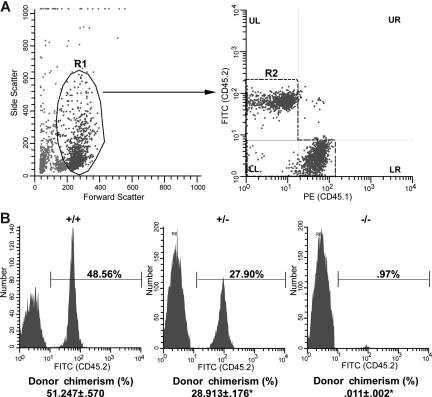
Impaired HSC activity due to Cited2 deficiency. Competitive reconstitution was performed by transplanting 106 fetal liver cells from the recipient strain as competitor cells (CD45.1+) and 106 fetal liver cells from Cited2−/− (n = 3), Cited2+/− (n = 3), and Cited2+/+ littermate control (n = 3) at 14.5 dpc (CD45.2+). Percentage of CD45.2+ and CD45.1+ cells in the peripheral blood was analyzed and donor chimerism was determined as [%CD45.2+/(%CD45.1+ + %CD45.2+)] × 100. The chimerism data were expressed as average plus or minus SD (below “Donor chimerism”). (A) The gating was performed in 2 steps to exclude the CD45.1 and CD45.2 double-positive cells and artifacts in the analysis. First, viable nucleated cells (R1) according to forward and side scatter characteristics were gated to gain CD45.1 and CD45.2 positivity. Then, CD45.1 and CD45.2 double-positive cells (ranging from 0.95% to 4.5%) were gated out and the R2 was retained for further analysis, which includes UL, LL, and LR quadrants. (B) Representative histograms plotted after gating on R1 and R2. Compared with Cited2+/+ littermate controls, Cited2−/− fetal liver cells exhibited severely impaired reconstitution ability reflected by significantly decreased donor chimerism (*P < .01). Cited2+/− fetal liver cells showed significant reduced reconstitution as well (*P < .01). The percentages above the brackets represent the CD45.2+ cells.

References

    1. Johnson GR, Moore MAS. Role of stem cell migration in initiation of mouse foetal liver haemopoiesis. Nature. 1975;258:726–728. - PubMed
    1. Sun HB, Zhu YX, Yin T, Sledge G, Yang YC. MRG1, the product of a melanocyte-specific gene related gene, is a cytokine-inducible transcription factor with transformation activity. Proc Natl Acad Sci U S A. 1998;95:13555–13560. - PMC - PubMed
    1. Shioda T, Fenner MH, Isselbacher KJ. MSG1 and its related protein MRG1 share a transcription activating domain. Gene. 1997;19(204):235–241. - PubMed
    1. Leung MK, Jones T, Michels CL, Livingston DM, Bhattacharya S. Molecular cloning and chromosomal localization of the human CITED2 gene encoding p35srj/Mrg1. Genomics. 1999;61:307–313. - PubMed
    1. Dunwoodie SL, Rodriguez TA, Beddington RS. Msg1 and Mrg1, founding members of a gene family, show distinct patterns of gene expression during mouse embryogenesis. Mech Dev. 1998;72:27–40. - PubMed

Publication types

MeSH terms