


EasyGO: Gene Ontology-based annotation and functional enrichment analysis tool for agronomical species
- PMID: 17645808
- PMCID: PMC1940007
- DOI: 10.1186/1471-2164-8-246
EasyGO: Gene Ontology-based annotation and functional enrichment analysis tool for agronomical species
Abstract
Background: It is always difficult to interpret microarray results. Recently, a handful of tools have been developed to meet this need, but almost none of them were designed to support agronomical species.
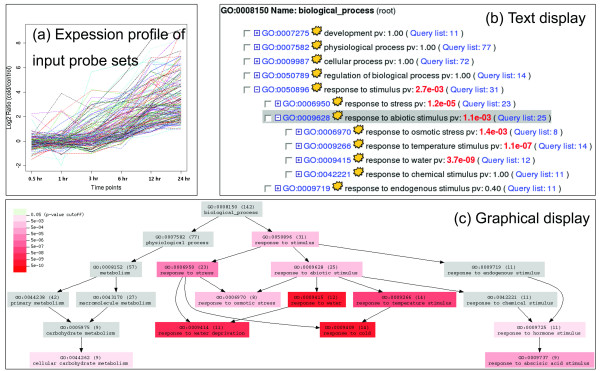
Description: This paper presents EasyGO, a web server to perform Gene Ontology based functional interpretation on groups of genes or GeneChip probe sets. EasyGO makes a special contribution to the agronomical research community by supporting Affymetrix GeneChips of both crops and farm animals and by providing stronger capabilities for results visualization and user interaction. Currently it supports 11 agronomical plants, 3 farm animals, and the model plant Arabidopsis. The authors demonstrated EasyGO's ability to uncover hidden knowledge by analyzing a group of probe sets with similar expression profiles.
Conclusion: EasyGO is a good tool for helping biologists and agricultural scientists to discover enriched biological knowledge that can provide solutions or suggestions for original problems. It is freely available to all users at http://bioinformatics.cau.edu.cn/easygo/.
Figures
References
Publication types
MeSH terms
Substances
LinkOut - more resources
Full Text Sources
Medical
