


Review
doi: 10.1016/j.ijpara.2007.05.015.
Epub 2007 Jun 23.
Comparative genomics: from genotype to disease phenotype in the leishmaniases
Affiliations
- PMID: 17645880
- PMCID: PMC2696322
- DOI: 10.1016/j.ijpara.2007.05.015
Item in Clipboard
Review
Comparative genomics: from genotype to disease phenotype in the leishmaniases
Int J Parasitol.
2007 Sep.
Abstract
Recent progress in sequencing the genomes of several Leishmania species, causative agents of cutaneous, mucocutaneous and visceral leishmaniasis, is revealing unusual features of potential relevance to parasite virulence and pathogenesis in the host. While the genomes of Leishmania major, Leishmania braziliensis and Leishmania infantum are highly similar in content and organisation, species-specific genes and mechanisms distinguish one from another. In particular, the presence of retrotransposons and the components of a putative RNA interference machinery in L. braziliensis suggest the potential for both greater diversity and more tractable experimentation in this Leishmania Viannia species.
Figures
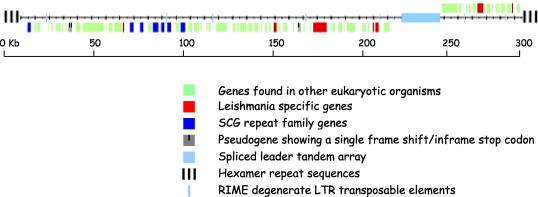
The structure of a typical Leishmania chromosome: chromosome 2 of Leishmania major. The location and coding strands of the 74 protein-coding genes are shown as coloured boxes, coded according to the categories indicated below. The majority are genes conserved with other eukaryotes; distribution of the Leishmania-specific and scβ-galactosyltransferase (SCG) repeat family genes are also shown, together with three pseudogenes. Other chromosomal features include the telomeric hexamer repeats, the spliced leader tandem array and the ribosomal mobile element (RIME) degenerate LTR transposons.
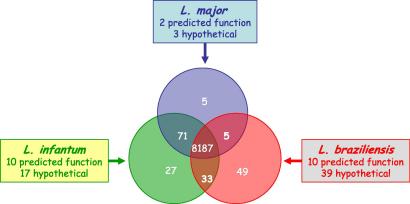
Leishmania species-specific genes. The Venn diagram shows how many of the 8,187 protein-coding genes are species-specific or shared between two of the three sequenced Leishmania species. These genes are subdivided into those that have a predicted function (mostly through sequence identity) and those that are of unknown function at the time of publication (the “hypotheticals”).
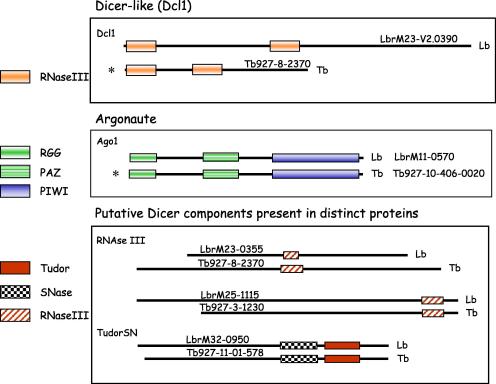
RNAi machinery: Leishmania braziliensis versus Trypanosoma brucei. Schematic representation of the main components of the RNAi pathways identified by sequence similarity and/or functional evaluation in T. brucei (Tb) and L. braziliensis (Lb). Comparisons of the gene products and their domains in each species are accompanied by their GeneDB gene IDs; Tb927, T. brucei genes; LbrM, L. braziliensis genes. Domain IDs are depicted on the left. RGG indicates a domain containing arginine-glycine-glycine repeats; SNase indicates the Staphylococcal nuclease domain present in TudorSN proteins. ∗Indicates genes confirmed to be functionally active in the T. brucei RNAi pathway.
References
-
- Awandare G.A., Ouma C., Keller C.C., Were T., Otieno R., Ouma Y., Davenport G.C., Hittner J.B., Ong’echa J.M., Ferrell R., Perkins D.J. A macrophage migration inhibitory factor promoter polymorphism is associated with high-density parasitemia in children with malaria. Genes Immun. 2006;7:568–575. - PubMed
-
- Barral A., Pedral-Sampaio D., Grimaldi Junior G., Momen H., McMahon-Pratt D., Ribeiro de Jesus A., Almeida R., Badaro R., Barral-Netto M., Carvalho E.M. Leishmaniasis in Bahia, Brazil: evidence that Leishmania amazonensis produces a wide spectrum of clinical disease. Am. J. Trop Med. Hyg. 1991;44:536–546. - PubMed
-
- Barry J.D., McCulloch R. Antigenic variation in trypanosomes: enhanced phenotypic variation in a eukaryotic parasite. Adv. Parasitol. 2001;49:1–70. - PubMed
Publication types
MeSH terms
Substances
Grants and funding
LinkOut - more resources
Full Text Sources
Medical
