


Reflex responsiveness of a human hand muscle when controlling isometric force and joint position
- PMID: 17646129
- PMCID: PMC2020450
- DOI: 10.1016/j.clinph.2007.06.009
Reflex responsiveness of a human hand muscle when controlling isometric force and joint position
Abstract
Objective: This study compared reflex responsiveness of the first dorsal interosseus muscle during two tasks that employ different strategies to stabilize the finger while exerting the same net muscle torque.
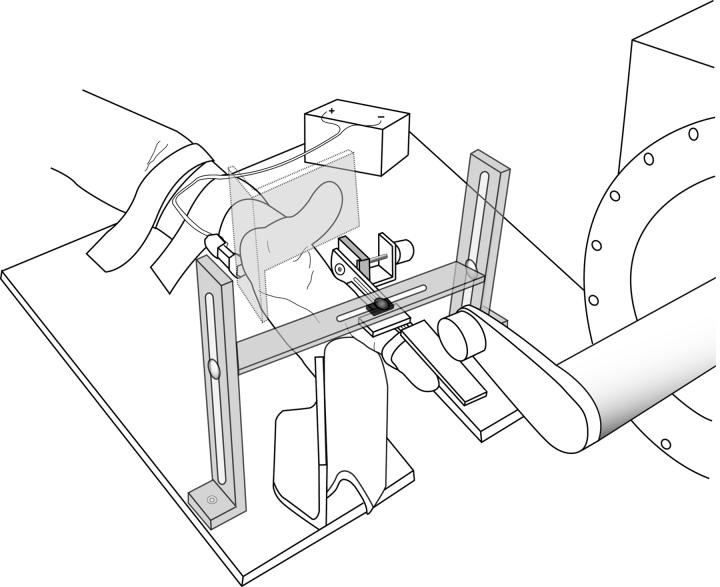
Methods: Healthy human subjects performed two motor tasks that involved either pushing up against a rigid restraint to exert a constant isometric force equal to 20% of maximum or maintaining a constant angle at the metacarpophalangeal joint while supporting an equivalent inertial load. Each task consisted of six 40-s contractions during which electrical and mechanical stimuli were delivered.
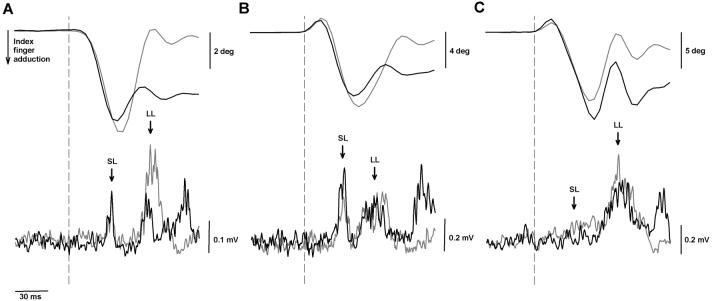
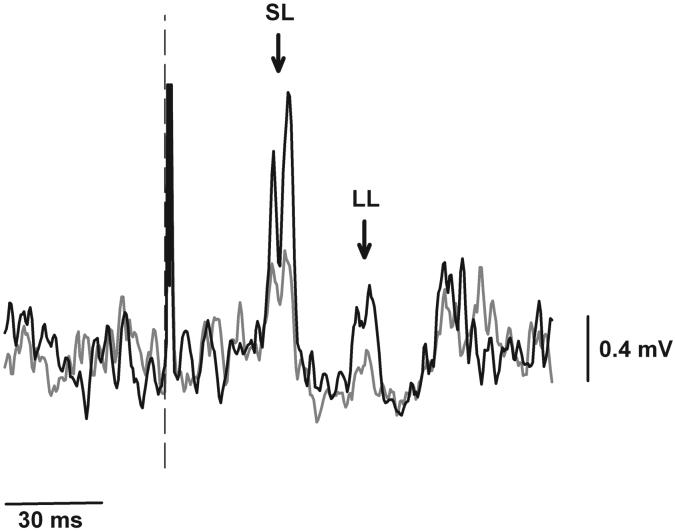
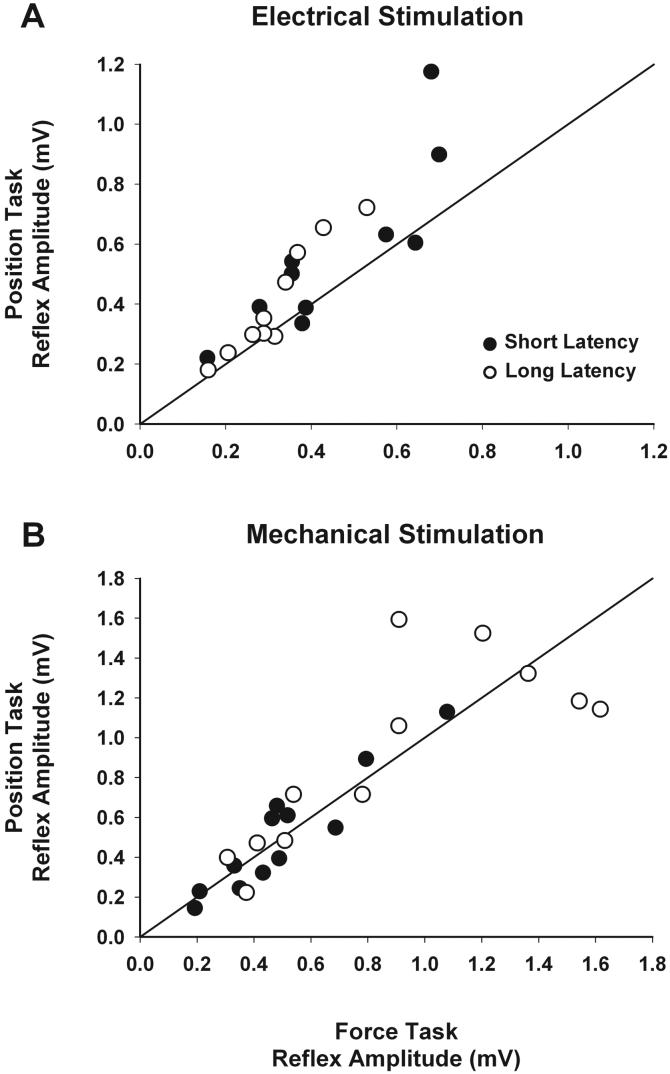
Results: The amplitude of short and long latency reflex responses to mechanical stretch did not differ significantly between tasks. In contrast, reflexes evoked by electrical stimulation were significantly greater when supporting the inertial load.
Conclusions: Agonist motor neurons exhibited heightened reflex responsiveness to synaptic input from heteronymous afferents when controlling the position of an inertial load. Task differences in the reflex response to electrical stimulation were not reflected in the response to mechanical perturbation, indicating a difference in the efficacy of the pathways that mediate these effects.
Significance: Results from this study suggest that modulation of spinal reflex pathways may contribute to differences in the control of force and position during isometric contractions of the first dorsal interosseus muscle.
Figures
References
-
- Aimonetti JM, Schmied A, Vedel JP, Pagni S. Ia presynaptic inhibition in human wrist extensor muscles: effects of motor task and cutaneous afferent activity. J Physiol Paris. 1999;93(4):395–401. - PubMed
-
- Akazawa K, Milner TE, Stein RB. Modulation of reflex EMG and stiffness in response to stretch of human finger muscle. J Neurophysiol. 1983;49(1):16–27. - PubMed
-
- Balestra C, Duchateau J, Hainaut K. Effects of fatigue on the stretch reflex in a human muscle. Electroencephalogr Clin Neurophysiol. 1992;85(1):46–52. - PubMed
-
- Basmajian JV, Blusmenstein R. In: Electrode placement in electromyographic biofeedback. Biofeedback. Principles and practice for clinicians. Basmajian JV, editor. Williams & Wilkins; Baltimore: 1983. pp. 363–378.
Publication types
MeSH terms
Grants and funding
LinkOut - more resources
Full Text Sources
