


Friendship moderates prospective associations between social isolation and adjustment problems in young children
- PMID: 17650145
- PMCID: PMC2754761
- DOI: 10.1111/j.1467-8624.2007.01072.x
Friendship moderates prospective associations between social isolation and adjustment problems in young children
Abstract
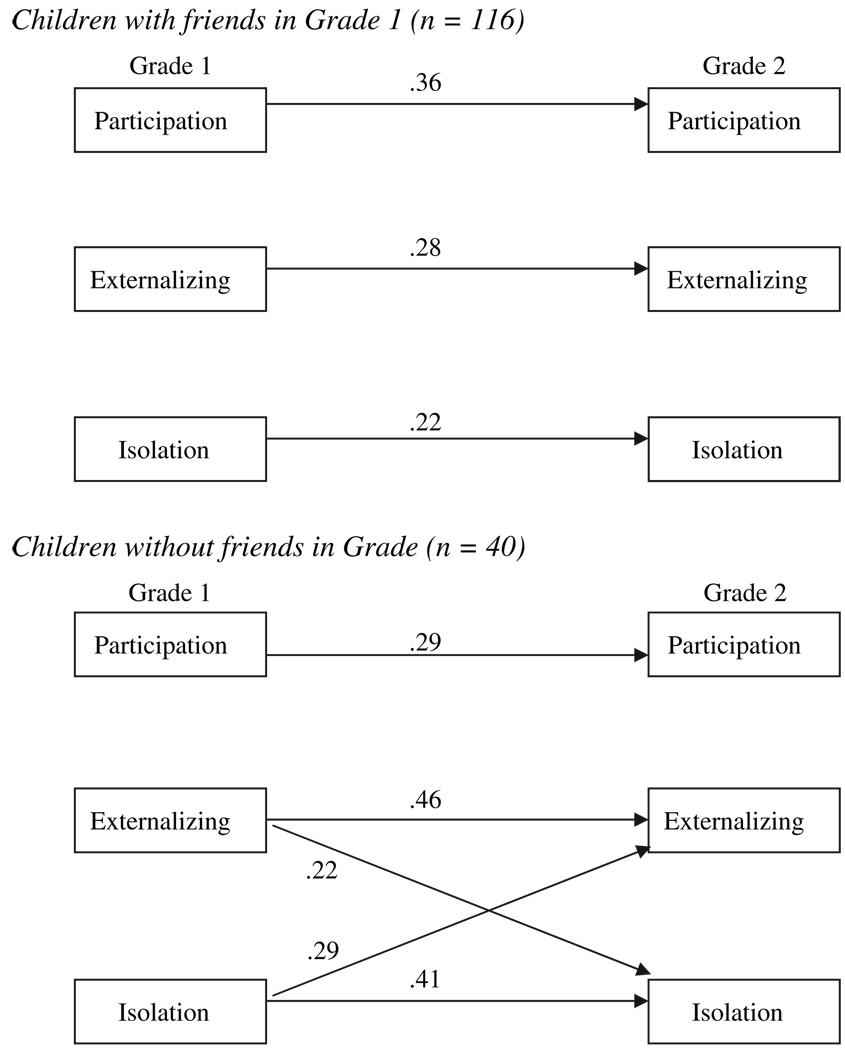
This longitudinal study investigated prospective links between social isolation and adjustment problems among 166 (77 girls, 89 boys) Finnish children ages 7 to 9. Peer nominations for social engagement and self-reports of internalizing and externalizing problems were collected in the spring of the 1st and 2nd grade. Friendship moderated prospective associations between peer and adjustment variables. Among friended children, there were no prospective associations between social isolation and either internalizing or externalizing problems. Among unfriended children, initial social isolation was positively linked to subsequent increases in internalizing and externalizing problems, and initial internalizing and externalizing problems predicted subsequent increases in social isolation. The findings suggest that friendship buffers against the adverse consequences associated with being isolated and presenting adjustment difficulties.
Figures

References
-
- Aunola K, Nurmi J-E. Maternal affection moderates the impact of psychological control on a child’s mathematical performance. Developmental Psychology. 2004;40:965–978. - PubMed
-
- Aunola K, Nurmi J-E. The role of parenting styles in children’s problem behavior. Child Development. 2005;76:1144–1159. - PubMed
-
- Bentler PM. EQS structural equations program manual. Encino, CA: Multivariate Software; 1995.
-
- Berndt TJ. Children’s friendships: Shifts over a half-century in perspectives on their development and their effects. Merrill-Palmer Quarterly. 2004;50:206–223.
-
- Bierman KL. Peer rejection: Developmental processes and interventions. New York: Guilford; 2003.
Publication types
MeSH terms
Grants and funding
LinkOut - more resources
Full Text Sources
