


Effects of gender and age on motor exam in typically developing children
- PMID: 17650993
- PMCID: PMC2099302
- DOI: 10.1080/87565640701361013
Effects of gender and age on motor exam in typically developing children
Abstract
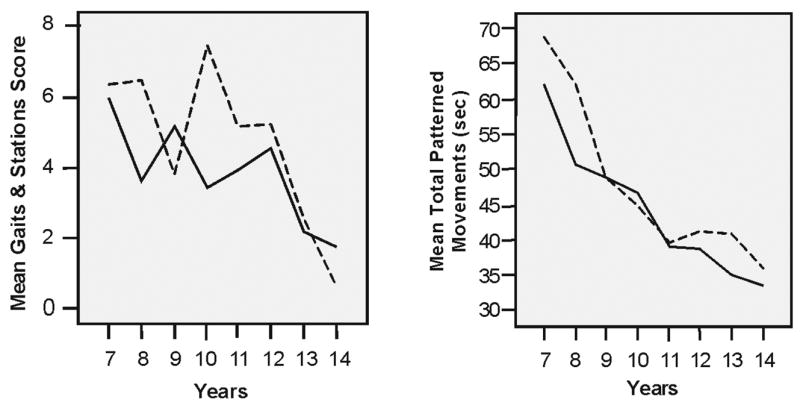
Few studies have contrasted performance of typically developing boys and girls on standardized motor assessment. In the present study, developmental status of the motor system was assessed in 144 typically developing children (72 boys, 72 girls, ages 7-14), using the Physical and Neurological Examination for Subtle Signs (PANESS, Denckla, 1985). Four summary variables were examined: (1) Gaits and Stations, (2) Overflow, (3) Dysrythmia, and (4) Timed Movements. For most variables, gender differences were not significant; however significant gender effects were observed for some subtle signs (involuntary movements), gaits and stations, and timed patterned movements. In all instances, girls showed fewer subtle signs and were faster and more proficient than boys. Significant age-related changes were observed for some subtle signs (dysrythmia and overflow), and for timed movements. In contrast, by age 7, many of the skills assessed by the PANESS have reached "adult" level in typically developing children. Motor development appears to follow a different developmental course in girls than in boys; separate gender and age norms should be used in clinical assessment of motor function in children.
Figures
References
-
- Adams R, Kocsis J, Estes R. Soft neurological signs in learning-disabled children and controls. American Journal of Diseases of Children. 1974;128:614–618. - PubMed
-
- Annett M. The growth of manual preference and speed. British Journal of Psychology. 1970;61:545–558. - PubMed
-
- Barnett AL, Peters J. Motor proficiency assessment batteries. In: Dewey D, Tupper D, editors. Developmental motor disorders: A neuropsychological prospective. New York: The Guilford Press; 2004. pp. 66–83.
-
- Chen R, Gerloff C, Hallett M, Cohen L. Involvement of the ipsilateral motor cortex in finger movements of different complexities. Annals of Neurology. 1997;41:247–254. - PubMed
-
- De Bellis M, Keshavan MS, Beers S, Hall J, Frustaci K, Masalehdan A, et al. Sex differences in brain maturation during childhood and adolescence. Cerebral Cortex. 2001;11:552–557. - PubMed
Publication types
MeSH terms
Grants and funding
- HD-24061/HD/NICHD NIH HHS/United States
- R01 NS047781/NS/NINDS NIH HHS/United States
- MH 52432R29/MH/NIMH NIH HHS/United States
- K08 NS 02039/NS/NINDS NIH HHS/United States
- K02 NS044850/NS/NINDS NIH HHS/United States
- R01 NS043480/NS/NINDS NIH HHS/United States
- M01 RR000052/RR/NCRR NIH HHS/United States
- NS-25806/NS/NINDS NIH HHS/United States
- K01 MH 01824/MH/NIMH NIH HHS/United States
- K08 NS002039/NS/NINDS NIH HHS/United States
- K01 MH001824/MH/NIMH NIH HHS/United States
- P01 HD035468/HD/NICHD NIH HHS/United States
- 2R01 NS047781/NS/NINDS NIH HHS/United States
- R01 MH085328/MH/NIMH NIH HHS/United States
- P30 HD024061/HD/NICHD NIH HHS/United States
- R01 MH078160/MH/NIMH NIH HHS/United States
- K02 NS04485/NS/NINDS NIH HHS/United States
- P01 HD 35468/HD/NICHD NIH HHS/United States
- P50 NS035359/NS/NINDS NIH HHS/United States
LinkOut - more resources
Full Text Sources
Medical
