. 2007 Sep;51(5):931-40.
doi: 10.1111/j.1365-313X.2007.03192.x. Epub 2007 Jul 25.

Quantitative phosphoproteomic analysis of plasma membrane proteins reveals regulatory mechanisms of plant innate immune responses

Affiliations

Quantitative phosphoproteomic analysis of plasma membrane proteins reveals regulatory mechanisms of plant innate immune responses

Thomas S Nühse et al. Plant J. 2007 Sep.

Abstract

Advances in proteomic techniques have allowed the large-scale identification of phosphorylation sites in complex protein samples, but new biological insight requires an understanding of their in vivo dynamics. Here, we demonstrate the use of a stable isotope-based quantitative approach for pathway discovery and structure-function studies in Arabidopsis cells treated with the bacterial elicitor flagellin. The quantitative comparison identifies individual sites on plasma membrane (PM) proteins that undergo rapid phosphorylation or dephosphorylation. The data reveal both divergent dynamics of different sites within one protein and coordinated regulation of homologous sites in related proteins, as found for the PM H(+)-ATPases AHA1, 2 and 3. Strongly elicitor-responsive phosphorylation sites may reflect direct regulation of protein activity. We confirm this prediction for RbohD, an NADPH oxidase that mediates the rapid production of reactive oxygen species (ROS) in response to elicitors and pathogens. Plant NADPH oxidases are structurally distinct from their mammalian homologues, and regulation of the plant enzymes is poorly understood. On RbohD, we found both unchanging and strongly induced phosphorylation sites. By complementing an RbohD mutant plant with non-phosphorylatable forms of RbohD, we show that only those sites that undergo differential regulation are required for activation of the protein. These experiments demonstrate the potential for use of quantitative phosphoproteomics to determine regulatory mechanisms at the molecular level and provide new insights into innate immune responses.


Figures

Figure 1
Figure 1
Schematic work flow for quantitative phosphoproteomics. Steps performed in parallel with control or treated samples are indicated with four individual block arrows in white or grey/black. All procedures after the pooling (indicated with asterisk) of iTRAQ labelled peptides are indicated with a single broad multicoloured arrow. Phosphopeptides were isolated either from labelled and pooled samples (a) or from larger amounts of unlabelled samples, followed by iTRAQ labelling (b). Note that ion-exchange fractionation is required for sample deconvolution, desalting before IMAC and post-iTRAQ labelling sample clean-up, which means that two rounds of ion-exchange fractionation are necessary in (b).
Figure 2
Figure 2
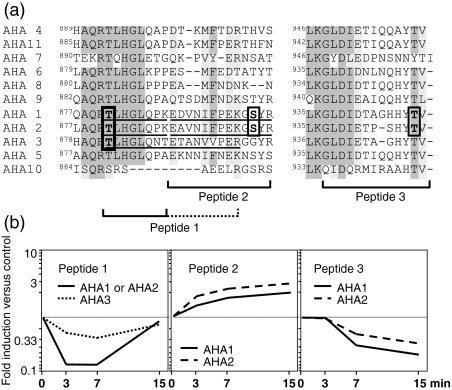
Differential regulation of three distinct phosphorylation sites on H+-ATPases. (a) ClustalW alignment of the C-terminal protein sequences of all Arabidopsis H+-ATPases. Identified phosphopeptides are marked below and their sequences are underlined within the alignment. The dashed line for peptide 1 refers to the peptide from AHA3, which is longer than peptide 1 of AHA1 and AHA2 because of the absence of an additional tryptic cleavage site. Phosphorylated residues are indicated by black frames. (b) Time course of the relative abundance (elicited versus control) of the three phosphopeptides following in vivo elicitation with flg22.
Figure 3
Figure 3
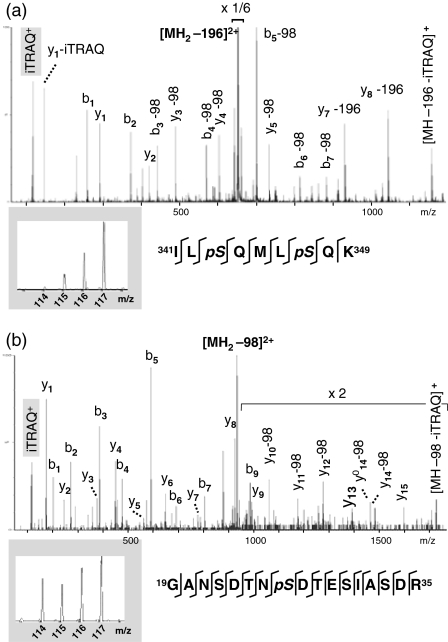
MS/MS spectra of two phosphopeptides from RbohD, covering the phosphorylation sites S343/S347 (a) and S26 (b), respectively. Below are magnifications of the m/z regions that show the iTRAQ signature ions. Peak areas at m/z 114, 115, 116 and 117 reflect the abundance of the peptide in the control, and in the 3, 7 or 15 min elicited samples, respectively.
Figure 4
Figure 4
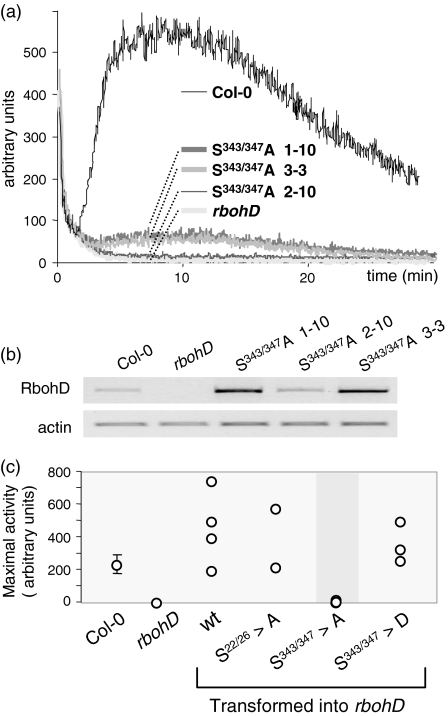
S343/347 are necessary but not sufficient for full activation of RbohD. (a) flg22-triggered oxidative burst measured by chemiluminescence in Col-0 wild-type, rbohD mutant and three independent lines expressing RbohD (S343/347A) in the rbohD background. (b) Expression level of the rbohD gene in wild-type and transformants by RT-PCR. (c) Maximal RbohD activity in Col-0 wild-type and transformants, measured as in (a). Measurements for the S343/347A mutants (three lines as above) are highlighted. Error bars for Col-0 indicate the standard error of the mean for a triplicate measurement using plants of the same age.

References

    1. Asai T. MAP kinase signalling cascade in Arabidopsis innate immunity. Nature. 2002;415:977–983. - PubMed
    1. Benschop JJ. Quantitative phospho-proteomics of early elicitor signalling in Arabidopsis. Mol. Cell Proteomics. 2007 in press. - PubMed
    1. Blagoev B. Temporal analysis of phosphotyrosine-dependent signaling networks by quantitative proteomics. Nat. Biotechnol. 2004;22:1139–1145. - PubMed
    1. Chandra S. Role of phosphorylation in elicitation of the oxidative burst in cultured soybean cells. Proc. Natl Acad. Sci. USA. 1995;92:4120–4123. - PMC - PubMed
    1. Chang A. Maturation of the yeast plasma membrane [H+]ATPase involves phosphorylation during intracellular transport. J. Cell Biol. 1991;115:289–295. - PMC - PubMed

Publication types