


Occasional tobacco use among young adult women: a longitudinal analysis of smoking transitions
- PMID: 17652240
- PMCID: PMC2598537
- DOI: 10.1136/tc.2006.018416
Occasional tobacco use among young adult women: a longitudinal analysis of smoking transitions
Abstract
Objective: To describe prospective transitions in smoking among young adult women who were occasional smokers, and the factors associated with these transitions, by comparing sociodemographic, lifestyle and psychosocial characteristics of those who changed from occasional smoking to daily smoking, non-daily smoking or non-smoking.
Design: Longitudinal study with mailed questionnaires.
Participants/setting: Women aged 18-23 years in 1996 were randomly selected from the Medicare Australia database, which provides the most complete list of people in Australia.
Main outcome measures: Self-reported smoking status at survey 1 (1996), survey 2 (2000) and survey 3 (2003), for 7510 participants who took part in all three surveys and who had complete data on smoking at survey 1.
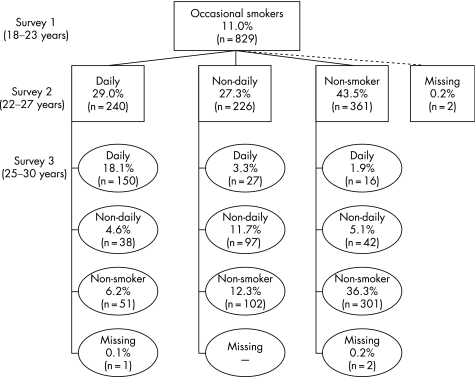
Results: At survey 1, 28% (n = 2120) of all respondents reported smoking. Among the smokers, 39% (n = 829) were occasional smokers. Of these occasional smokers, 18% changed to daily smoking at survey 2 and remained daily smokers at survey 3; 12% reported non-daily smoking at surveys 2 and 3; 36% stopped smoking and remained non-smokers; and 33% moved between daily, non-daily and non-smoking over surveys 2 and 3. Over the whole 7-year period, approximately half stopped smoking, one-quarter changed to daily smoking and the remainder reported non-daily smoking. Multivariate analysis identified that a history of daily smoking for > or = 6 months at baseline predicted reversion to daily smoking at follow-up. Being single and using illicit drugs were also associated with change to daily or non-daily smoking, whereas alcohol consumption was associated with non-daily smoking only. Compared with stopping smoking, the change to daily smoking was significantly associated with having intermediate educational qualifications. No significant associations with depression and perceived stress were observed in the multivariate analysis.
Conclusions: Interventions to reduce the prevalence of smoking among young women need to take account of occasional smokers, who made up 39% of all smokers in this study. Targeted interventions to prevent the escalation to daily smoking and to promote cessation should allow for the social context of smoking with alcohol and other drugs, and social and environmental influences in vocational education and occupational settings.
Conflict of interest statement
Competing interests: None declared.
References
-
- Australian Institute of Health and Welfare 2004 National Drug Strategy Household Survey: first results. AIHW Catalogue number. PHE 57. Canberra, ACT: AIHW, 2005
-
- West P, Sweeting H, Ecob R. Family and friends' influences on the uptake of regular smoking from mid‐adolescence to early adulthood. Addiction 1999941397–1412. - PubMed
Publication types
MeSH terms
LinkOut - more resources
Full Text Sources
Medical
