


Cognitive behaviour therapy for fatigued cancer survivors: long-term follow-up
- PMID: 17653075
- PMCID: PMC2360364
- DOI: 10.1038/sj.bjc.6603899
Cognitive behaviour therapy for fatigued cancer survivors: long-term follow-up
Abstract
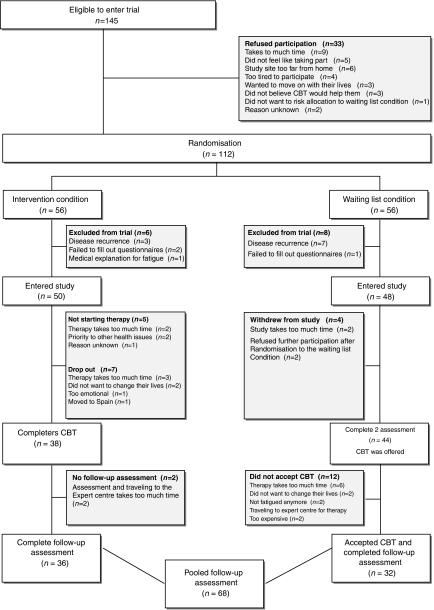
An earlier randomised-controlled trial demonstrated the positive effects of cognitive behaviour therapy (CBT), especially designed for fatigued cancer survivors in reducing fatigue, functional impairments and psychological distress. In the current prospective study, we were able to examine the long-term effect of CBT in patients who completed the therapy. Predictors of fatigue severity at follow-up were exploratory investigated. Sixty-eight patients who completed CBT were assessed at pretreatment, post-treatment and at follow-up (mean follow-up 1.9 years (s.d. 1.0), range: 1-4 years). To analyse possible predictors of treatment outcome a linear regression (enter) was carried out. Improvements on fatigue severity, functional impairment and psychological distress after CBT appeared to remain stable during a follow-up period. Patients who were not fatigued anymore at follow-up were not different from a reference group of non-fatigued cancer survivors. The explorative regression analysis showed that fatigue severity, psychological distress and somatic attributions at pretreatment contributed to persistent fatigue severity at follow-up. Cognitive behaviour therapy, especially designed for post-cancer fatigue, is successful in reducing fatigue and functional impairment in cancer survivors. Moreover, these positive effects were maintained at about 2 years after finishing CBT.
References
-
- Aaronson NK, Ahmedzai S, Bergman B, Bullinger M, Cull M, Duez NJ, Filiberti A, Flechtner H, Fleishman SB, de Haes JC, Kaasa S, Klee M, Osoba D, Razav D, Rofe P, Schraub S, Sneeuw K, Sullivan M, Takeda F (1993) The European organization for research and treatment of cancer QLQ-C30: a quality-of-life instrument for use in international clinical trials in oncology. J Natl Cancer Inst 85: 365–376 - PubMed
-
- Arindell WA, Ettema JHM (1986) SCL-90, Handleiding Bij Een Multidimensionele Psychopathologie-Indicator. Swets & Zwitlinger B.V: Amsterdam
-
- Basen-Engquist K, Carmack Taylor CL, Rosenblum C, Smith MA, Shinn EH, Greisinger A, Gregg X, Massey P, Valero V, Rivera E (2006) Randomized pilot test of lifestyle physical activity intervention for breast cancer survivors. Patient Educ Couns 64: 225–234 - PubMed
-
- Bergner M, Bobbitt RA, Carter WB, Gilson BS (1981) The sickness impact profile. Development and final revision of a health status measure. Med Care 19: 787–805 - PubMed
Publication types
MeSH terms
Associated data
LinkOut - more resources
Full Text Sources
Medical
