


Relationship between post-ERCP pancreatitis and the change of serum amylase level after the procedure
- PMID: 17657841
- PMCID: PMC4611219
- DOI: 10.3748/wjg.v13.i28.3855
Relationship between post-ERCP pancreatitis and the change of serum amylase level after the procedure
Abstract
Aim: To clarify the relationship between the change of serum amylase level and post-ERCP pancreatitis.
Methods: Between January 1999 and December 2002, 1291 ERCP-related procedures were performed. Serum amylase concentrations were measured before the procedure and 3, 6, and 24 h afterward. The frequency and severity of post-ERCP pancreatitis and the relationship between these phenomena and the change in amylase level were estimated.
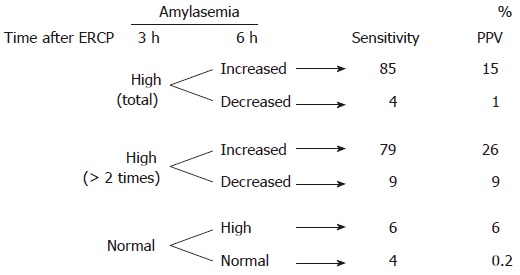
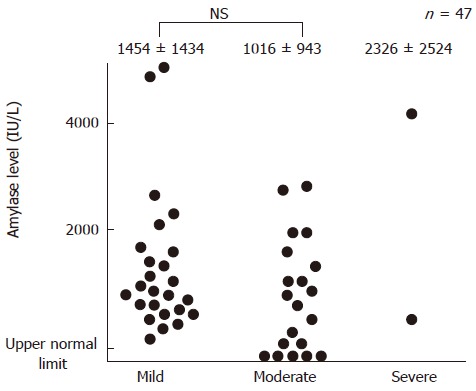
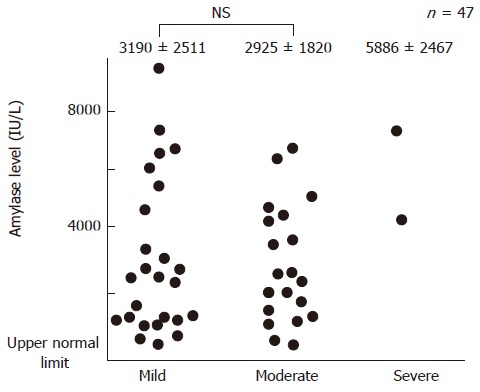
Results: Post-ERCP pancreatitis occurred in 47 patients (3.6%). Pancreatitis occurred in 1% of patients with normal amylase levels 3 h after ERCP, and in 1%, 5%, 20%, 31% and 39% of patients with amylase levels elevated 1-2 times, 2-3 times, 3-5 times, 5-10 times and over 10 times the upper normal limit at 3 h after ERCP, respectively (level < 2 times vs >or= 2 times, P < 0.001). Of the 143 patients with levels higher than the normal limit at 3 h after ERCP followed by elevation at 6 h, pancreatitis occurred in 26%. In contrast, pancreatitis occurred in 9% of 45 patients with a level higher than two times the normal limit at 3 h after ERCP followed by a decrease at 6 h (26% vs 9%, P < 0.05).
Conclusion: Post-ERCP pancreatitis is frequently associated with an increase in serum amylase level greater than twice the normal limit at 3 h after ERCP with an elevation at 6 h. A decrease in amylase level at 6 h after ERCP suggests the unlikelihood of development of post-ERCP pancreatitis.
Figures
References
-
- Masci E, Toti G, Mariani A, Curioni S, Lomazzi A, Dinelli M, Minoli G, Crosta C, Comin U, Fertitta A, et al. Complications of diagnostic and therapeutic ERCP: a prospective multicenter study. Am J Gastroenterol. 2001;96:417–423. - PubMed
-
- Freeman ML, DiSario JA, Nelson DB, Fennerty MB, Lee JG, Bjorkman DJ, Overby CS, Aas J, Ryan ME, Bochna GS, et al. Risk factors for post-ERCP pancreatitis: a prospective, multicenter study. Gastrointest Endosc. 2001;54:425–434. - PubMed
-
- Vandervoort J, Soetikno RM, Tham TC, Wong RC, Ferrari AP, Montes H, Roston AD, Slivka A, Lichtenstein DR, Ruymann FW, et al. Risk factors for complications after performance of ERCP. Gastrointest Endosc. 2002;56:652–656. - PubMed
-
- Cotton PB, Lehman G, Vennes J, Geenen JE, Russell RC, Meyers WC, Liguory C, Nickl N. Endoscopic sphincterotomy complications and their management: an attempt at consensus. Gastrointest Endosc. 1991;37:383–393. - PubMed
-
- Smithline A, Silverman W, Rogers D, Nisi R, Wiersema M, Jamidar P, Hawes R, Lehman G. Effect of prophylactic main pancreatic duct stenting on the incidence of biliary endoscopic sphincterotomy-induced pancreatitis in high-risk patients. Gastrointest Endosc. 1993;39:652–657. - PubMed
MeSH terms
Substances
LinkOut - more resources
Full Text Sources
Medical
