. 2007;35(15):5154-64.
doi: 10.1093/nar/gkm543. Epub 2007 Jul 26.

Combinatorial delivery of small interfering RNAs reduces RNAi efficacy by selective incorporation into RISC

Affiliations

Combinatorial delivery of small interfering RNAs reduces RNAi efficacy by selective incorporation into RISC

Daniela Castanotto et al. Nucleic Acids Res. 2007.

Abstract

Despite the great potential of RNAi, ectopic expression of shRNA or siRNAs holds the inherent risk of competition for critical RNAi components, thus altering the regulatory functions of some cellular microRNAs. In addition, specific siRNA sequences can potentially hinder incorporation of other siRNAs when used in a combinatorial approach. We show that both synthetic siRNAs and expressed shRNAs compete against each other and with the endogenous microRNAs for transport and for incorporation into the RNA induced silencing complex (RISC). The same siRNA sequences do not display competition when expressed from a microRNA backbone. We also show that TAR RNA binding protein (TRBP) is one of the sensors for selection and incorporation of the guide sequence of interfering RNAs. These findings reveal that combinatorial siRNA approaches can be problematic and have important implications for the methodology of expression and use of therapeutic interfering RNAs.


Figures
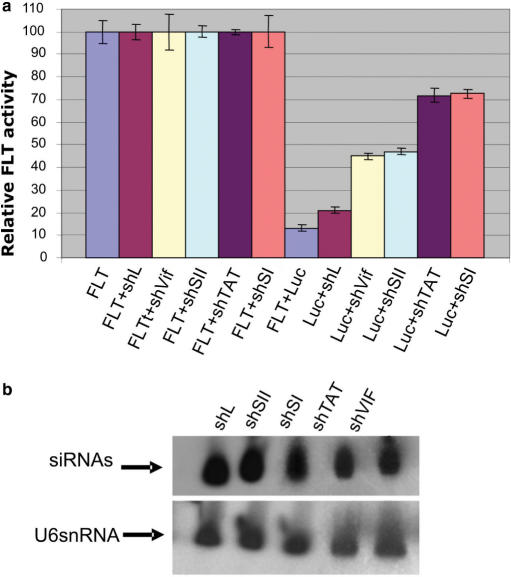
Figure 1.
Figure 1.
Irrelevant shRNA sequences compete with a luciferase-directed shRNA and reduce its ability to down-regulate the target. (a) FLT is a U1 expressed firefly luciferase gene, shL is targeted against the EnvPb1 retrovirus envelope gene, shVif is targeted against the Vif gene, shSII against sequences present in the HIV-Rev, shTAT is designed against the HIV Tat gene and shSI is directed against both TAT and Rev genes. The shRNA Luc is targeted to a sequence present in the coding region of the firefly luciferase gene. The irrelevant shRNAs were transfected with the luciferase target to monitor non-specific effects (constructs 2–6). FLT (construct 1) indicates the luciferase target transfected alone. The Bluescript vector was used to adjust the total amount of DNA transfected to be the same in each sample. Fifty nanogram of the firefly luciferase target and 50 ng of the shRNA constructs were used for these transfection reactions. The luciferase units were calculated by comparing each experimental sample to its own control. A Renilla luciferase plasmid was co-transfected in each sample as transfection control and used to normalize the firefly luciferase units. (b) Northern analysis of total RNA from 293 cells transfected with the relevant shRNAs as indicated on the top of the gel. Probes complementary to the guide sequence corresponding to each shRNA were used to detect the processed siRNA products (siRNA). A probe complementary to the endogenous U6 small nuclear RNA (U6snRNA) was used as internal control for the amount and integrity of the RNA loaded in each lane.
Figure 2.
Figure 2.
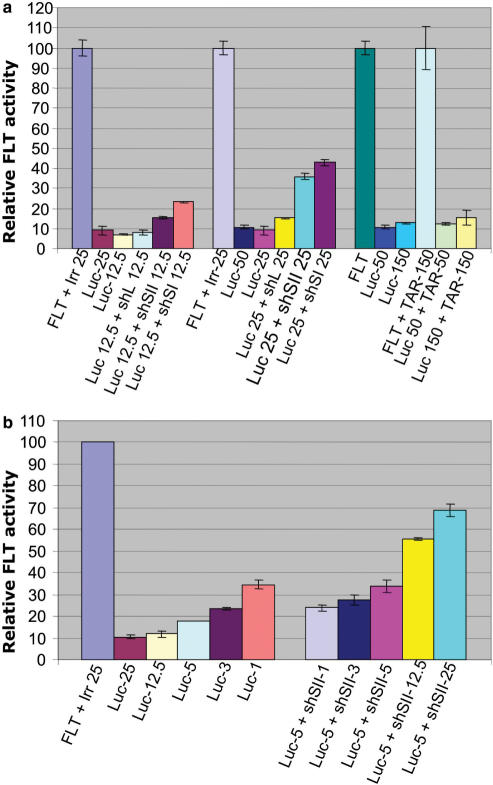
Different shRNA sequences compete with different strengths against the Luc shRNA. (a) Different concentrations of irrelevant shRNA-expressing plasmids (shL, shSII, shSI) were co-transfected with the firefly luciferase target (FLT) and the specific anti-luciferase shRNA (Luc). The amount used in each transfection is indicated in ng (12.5, 25, 50 or 150). The luciferase units for each sample were calculated as described in Figure 1 and in the Materials and Methods section. Each irrelevant shRNA was transfected independently with the luciferase target to monitor non-specific effects. Each Luc co-transfection experiment is normalized to its corresponding target-irrelevant control and to the Renilla luciferase transfection control. However, for convenience only one bar is shown to represent the target for each group and it is indicated by FLT+Irr (Irrelevant). Bluescript was used to adjust the total amount of DNA transfected in each sample. TAR indicates the co-transfection of a U6 construct expressing a mutated HIV-1 TAR structure (see text). (b) Non-saturating amounts of shRNAs can still compete for incorporation into RISC. A titration of U6 shLuc (Luc) was used to establish a concentration in the linear range for activity (left side of the chart). Five nanogram of U6sh Luc were then selected to be co-transfected with increasing amounts of a shRNA competitor (shSII) (right side of the chart). The numbers 1–25 indicate the amount in nanograms used in the reactions.
Figure 3.
Figure 3.
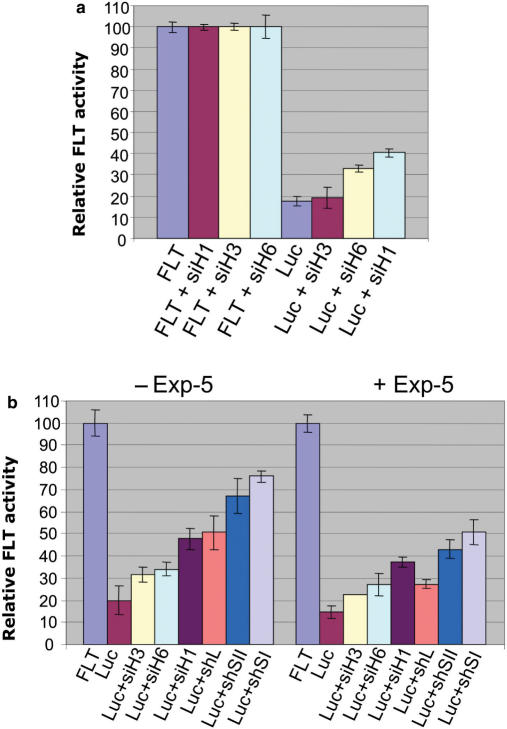
(a) Synthetic siRNAs can reduce the ability of a shRNA to down-regulate its target. A 10 nM concentration of each synthetic siRNA (siH3, siH6 and siH1) was co-transfected with the firefly luciferase target (FLT) independently or together with the anti-firefly shRNA (Luc). The firefly luciferase units were normalized against Renilla luciferase, which was used as transfection control. (b) Over-expression of Exportin-5 decreases shRNA competition but does not eliminate competition among interfering RNAs. Twenty nanomolar of each synthetic siRNA (siH3, siH6, siH1) or 50 ng of each shRNA construct (shL, shSII, shSI) were co-transfected with the luciferase target and the Luc shRNA with or without 100 ng of the Exportin-5-expressing plasmid (Exp-5) as indicated in the figure (+Exp-5, -Exp-5). Firefly luciferase units were calculated as previously described.
Figure 4.
Figure 4.
ShRNAs reduce the activity of microRNA constructs while microRNAs are not effective competitors. (a) A target site for the Mir-B and Mir-CG is inserted in the 3′ UTR of the Renilla luciferase gene, which is used as reporter construct in this experiment (RLT). Co-transfection of an irrelevant shRNA (shSI) nearly abolished the activity of the microRNAs (compare Mir-B and Mir-CG with Mir-B+shSI, Mir-CG+shSI) while an irrelevant microRNA (Mir-Irr) had no effect on Mir-B and Mir-CG (Mir-B+Mir-Irr and Mir-CG+Mir-Irr). The Renilla luciferase units were normalized against the firefly luciferase which was co-transfected with the experimental samples and used as an internal transfection control. (b) An irrelevant shRNA (shSI) strongly reduces the efficacy of Luc (Luc versus Luc+shSI), but an irrelevant microRNA (Mir-B or Mir-CG) did not have a significant effect on the activity of the specific shRNA (compare Luc versus Luc+Mir-B and Luc+Mir-CG). The units of the firefly reporter target were normalized against the Renilla luciferase which was used as internal transfection control. (c) Left; northern analysis of total RNA from 293 cells transfected with shSII or mirCG. A 4-fold excess of mirCG over shSII was used for the transfection. The probe is complementary to the mature SII which is the sequence expressed from both constructs. A probe complementary to the endogenous U6snRNA (U6) was used as control. Right; shSII or mirCG were used as competitors against the shLuc construct. Five hundred nanogram or 5 ng of mirCG and shSII respectively were used to compete against 5 ng of shLuc. (d) Synthetic si and shRNAs, but not expressed microRNAs, can compete with the endogenous microRNA pathway. A stable clonal cell line with an integrated EGFP gene that includes the target site for the endogenous mir21 at its 3′ end (HCT116-GFPmiR21) was mock transfected (Lip-2000) or transfected with: (i) a 2′O-Me-oligonucleotide designed to bind and block mir21 activity (Mir-21–2′O-Me), (ii) an irrelevant 2′O-Me-oligonucleotide to test for non-specific reactivation of EGFP (IRR-2′O-Me), (iii) a microRNA construct expressing the SII guide sequence (Mir-CG), (iv) an shRNA construct expressing the SII guide sequence (shSII) and (v) a synthetic siRNA (siH1). EGFP reactivation indicates interference with the activity of the endogenous mir21.
Figure 5.
Figure 5.
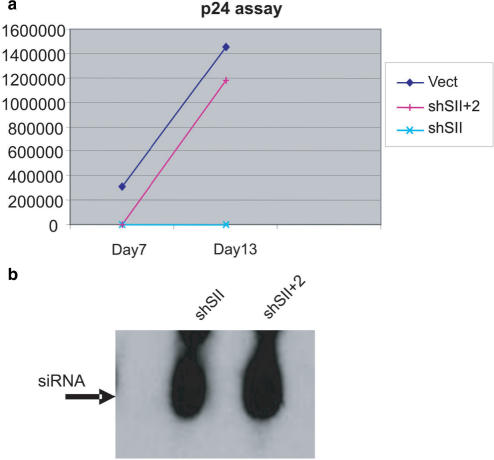
(a) p24 HIV challenge assay shows escape from RNAi when multiple shRNAs are simultaneously expressed. Stable CEM cells expressing shSII (shSII) are protected from HIV infection. This protection is lost when two other shRNAs are expressed simultaneously. Cells transduced with the vector backbone (Vect) are used as control. (b) Northern analysis shows comparable expression of shSII in transduced cells when expressed alone (shSII) or in combination with two other shRNAs (shSII + 2). A probe complementary to the mature SII RNA sequence was used to detect the processed siRNA. Probes for the other two shRNAs also revealed robust expression (data not shown).
Figure 6.
Figure 6.
(a) Gel shift assay shows loss of complex formation when TRBP depleted cellular extracts are mixed with labeled siRNAs. A 32P end-labeled anti-EGFP siRNA (without cellular extracts in lane 1) was mixed with: lane 2, total cellular extract; lane 3, extracts depleted of β-tubulin; lane 4 extracts depleted of TRBP. (b) Western detection of TRBP and β-tubulin after immunodepletion. Extracts were treated with TRBP or β-tubulin antibodies and precipitated as described in the Materials and Methods section. S, supernatant; P, pellet. The supernatant fractions show to be substantially depleted of TRBP or β-tubulin and were subsequently used in the gel shift assay for detection of complex formation (a). (c) Western analyses of lysates from cells treated with (+) or without (−) TRBP siRNA as described in Materials and Methods section. Lysates from cells transfected with a TRBP-expressing plasmid (TRBP) were used for size determination. Detection of β-tubulin was used as an internal control. (d) TRBP down-regulation eliminates the differential competition among interfering RNAs. Twenty nanomolar of each synthetic siRNA (siH3, siH6, siH1) or 50 ng of each shRNA construct (shL, shVif, shSII, shTAT, shSI) were co-transfected with the firefly luciferase target (FLT) and the Luc shRNA in cells that were pre-treated for 5 days with a siRNAs targeted against TRBP. Firefly luciferase units were calculated as previously described.

References

    1. Fire A, Xu S, Montgomery MK, Kostas SA, Driver SE, Mello CC. Potent and specific genetic interference by double-stranded RNA in Caenorhabditis elegans. Nature. 1998;391:806–811. - PubMed
    1. Meister G, Tuschl T. Mechanisms of gene silencing by double-stranded RNA. Nature. 2004;431:343–349. - PubMed
    1. Tomari Y, Zamore PD. Perspective: machines for RNAi. Genes Dev. 2005;19:517–529. - PubMed
    1. Meister G, Landthaler M, Patkaniowska A, Dorsett Y, Teng G, Tuschl T. Human Argonaute2 mediates rNA cleavage targeted by miRNAs and siRNAs. Molecular Cell. 2004;15:185–197. - PubMed
    1. Song JJ, Smith SK, Hannon GJ, Joshua-Tor L. Crystal structure of Argonaute and its implications for RISC slicer activity. Science. 2004;305:1434–1437. - PubMed

Publication types

MeSH terms