


Aspartate biosynthesis is essential for the growth of Streptococcus thermophilus in milk, and aspartate availability modulates the level of urease activity
- PMID: 17660309
- PMCID: PMC2074928
- DOI: 10.1128/AEM.00533-07
Aspartate biosynthesis is essential for the growth of Streptococcus thermophilus in milk, and aspartate availability modulates the level of urease activity
Abstract
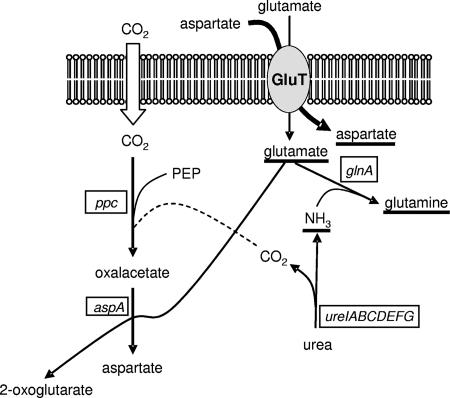
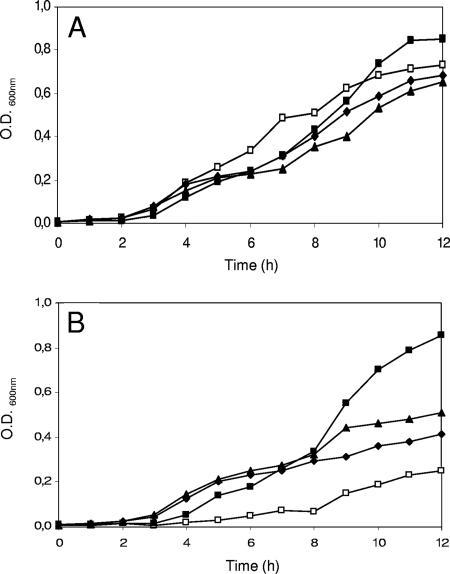
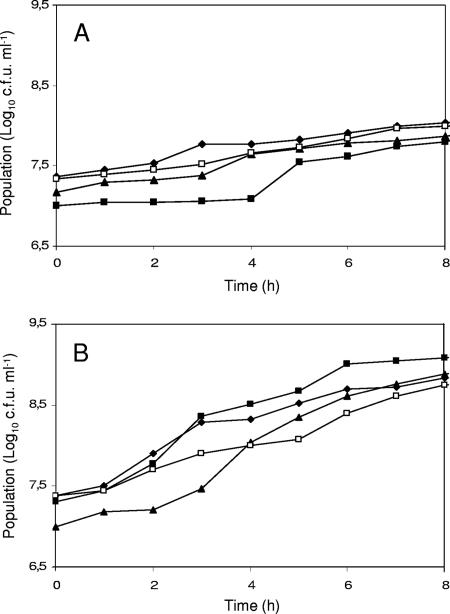
We investigated the carbon dioxide metabolism of Streptococcus thermophilus, evaluating the phenotype of a phosphoenolpyruvate carboxylase-negative mutant obtained by replacement of a functional ppc gene with a deleted and inactive version, Deltappc. The growth of the mutant was compared to that of the parent strain in a chemically defined medium and in milk, supplemented or not with L-aspartic acid, the final product of the metabolic pathway governed by phosphoenolpyruvate carboxylase. It was concluded that aspartate present in milk is not sufficient for the growth of S. thermophilus. As a consequence, phosphoenolpyruvate carboxylase activity was considered fundamental for the biosynthesis of L-aspartic acid in S. thermophilus metabolism. This enzymatic activity is therefore essential for growth of S. thermophilus in milk even if S. thermophilus was cultured in association with proteinase-positive Lactobacillus delbrueckii subsp. bulgaricus. It was furthermore observed that the supplementation of milk with aspartate significantly affected the level of urease activity. Further experiments, carried out with a p(ureI)-gusA recombinant strain, revealed that expression of the urease operon was sensitive to the aspartate concentration in milk and to the cell availability of glutamate, glutamine, and ammonium ions.
Figures


References
-
- Bolotin, A., B. Quinquis, P. Renault, A. Sorokin, S. D. Ehrlich, S. Kulakauskas, A. Lapidus, E. Goltsman, M. Mazur, G. D. Pusch, M. Fonstein, R. Overbeek, N. Kyprides, B. Purnelle, B. Prozzi, K. Ngui, D. Masuy, F. Hancy, S. Burteau, M. Boutry, J. Delcour, A. Goffeau, and P. Hols. 2004. Complete sequence and comparative genome analysis of the dairy bacterium Streptococcus thermophilus. Nat. Biotechnol. 22:1554-1558. - PMC - PubMed
-
- Bracquart, P., J.-Y. Le Deaut, and G. Linden. 1989. Uptake of glutamic acid by Streptococcus salivarius subsp. thermophilus CNRZ 302. J. Dairy Res. 56:107-116. - PubMed
-
- Bradford, M. M. 1976. A rapid and sensitive method for the quantitation of microgram quantities of protein utilizing the principle of protein-dye binding. Anal. Biochem. 72:248-254. - PubMed
-
- Castresana, J. 2000. Selection of conserved blocks from multiple alignments for their use in phylogenetic analysis. Mol. Biol. Evol. 17:540-552. - PubMed
Publication types
MeSH terms
Substances
LinkOut - more resources
Full Text Sources
Molecular Biology Databases
