Review
doi: 10.1128/EC.00178-07.
Epub 2007 Jul 27.
Mitosis, not just open or closed
Affiliations
- PMID: 17660363
- PMCID: PMC2043359
- DOI: 10.1128/EC.00178-07
Item in Clipboard
Review
Mitosis, not just open or closed
Eukaryot Cell.
2007 Sep.
No abstract available
Figures
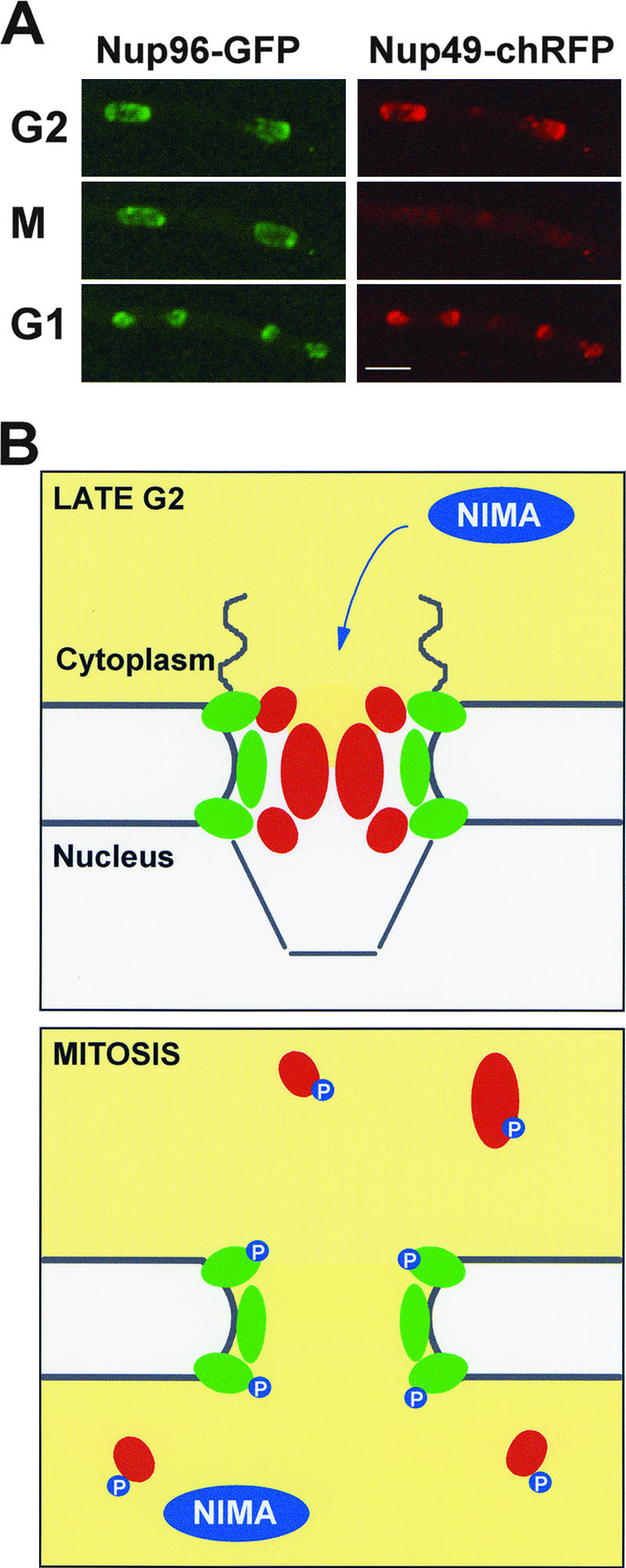
Partial NPC disassembly during mitosis in A. nidulans. (A) Time-lapse images of Nup96 labeled with GFP and Nup49 labeled with the mCherry variant of red fluorescent protein (chRFP) in the same cell (43). During G2, both Nups locate to NPCs at the nuclear periphery. However, as the cell enters mitosis, Nup49 disperses throughout the cell, while Nup96 remains at the nuclear periphery. As cells exit mitosis, Nup49 reassociates with the nuclear periphery of the G1 nuclei (see movie S1 in the supplemental material). Bar, ∼4 μm. (B) Schematic model of an A. nidulans NPC during late G2 and mitosis. In late G2, FG-repeat Nups (red) occupy the central channel of the NPC, restricting passive diffusion and helping to facilitate active transport. Accumulation and activation of the NIMA kinase during G2 trigger the dispersal of central channel Nups, while core Nups (green) remain associated with the nuclear envelope. Putative phosphorylation of Nups by NIMA is indicated. Opening of the NPC central channel compromises active transport and also allows passive diffusion through the NPC. This allows equilibration between the cytoplasm and the nucleus and thus tubulin to gain access to nuclei specifically during mitosis.
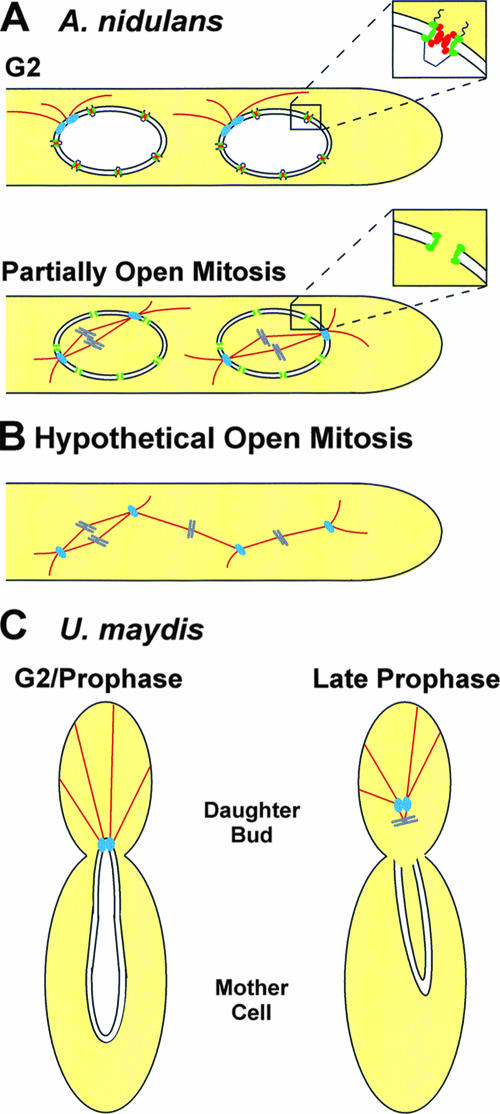
Variant forms of mitosis change nuclear envelope permeability by different mechanisms. (A) Two A. nidulans nuclei in a common cytoplasm. During G2, the spindle pole bodies (blue) nucleate microtubules in the cytoplasm. The NPC is composed of core Nups (green) and FG-repeat Nups (red), which occupy the NPC central channel and restrict diffusion. Upon mitotic entry, FG-repeat Nups disperse from the central channel, allowing nuclear entry of tubulin and thus spindle formation. Insets show a magnification of a single NPC. Note that the nuclear envelope may prevent inappropriate microtubule connections between the spindle pole bodies and the chromosomes of the two nuclei which are in mitosis at the same time. (B) An illustration of the predicted outcome of an A. nidulans cell undergoing a hypothetical open mitosis. As mitosis is no longer enclosed by the nuclear envelope, microtubules can potentially connect to chromosomes from either nucleus. (C) Mitotic entry during the yeast-like budding phase of U. maydis. During late G2 and early prophase, microtubules pull the tip of the nucleus into the daughter bud in a dynein-dependent manner. Upon mitotic entry, the nuclear envelope breaks down near the spindle pole bodies, and the spindle begins to form in the daughter bud, while most of the nuclear envelope remains in the mother cell. This localized breakdown of the nuclear envelope may help facilitate nuclear envelope permeability. Based on the model depicted by Straube et al. (adapted from reference with permission of the publisher).
References
-
- Bourett, T. M., J. A. Sweigard, K. J. Czymmek, A. Carroll, and R. J. Howard. 2002. Reef coral fluorescent proteins for visualizing fungal pathogens. Fungal Genet. Biol. 37:211-220. - PubMed
-
- Copeland, C. S., and M. Snyder. 1993. Nuclear pore complex antigens delineate nuclear envelope dynamics in vegetative and conjugating Saccharomyces cerevisiae. Yeast 9:235-249. - PubMed
-
- Dasso, M. 2002. The Ran GTPase: theme and variations. Curr. Biol. 12:R502-R508. - PubMed
Publication types
MeSH terms
Grants and funding
LinkOut - more resources
Full Text Sources
Medical