. 2007 Oct;177(2):801-8.
doi: 10.1534/genetics.106.068486. Epub 2007 Jul 29.

Male development time influences the strength of Wolbachia-induced cytoplasmic incompatibility expression in Drosophila melanogaster

Affiliations

Male development time influences the strength of Wolbachia-induced cytoplasmic incompatibility expression in Drosophila melanogaster

Ryuichi Yamada et al. Genetics. 2007 Oct.

Abstract

Cytoplasmic incompatibility (CI) is the most widespread reproductive modification induced in insects by the maternally inherited intracellular bacteria, Wolbachia. Expression of CI in Drosophila melanogaster is quite variable. Published papers typically show that CI expression is weak and often varies between different Drosophila lines and different labs reporting the results. The basis for this variability is not well understood but is often considered to be due to unspecified host genotype interactions with Wolbachia. Here, we show that male development time can greatly influence CI expression in D. melanogaster. In a given family, males that develop fastest express very strong CI. The "younger brothers" of these males (males that take longer to undergo larval development) quickly lose their ability to express the CI phenotype as a function of development time. This effect is independent of male age effects and is enhanced when flies are reared under crowded conditions. No correlation is seen between this effect and Wolbachia densities in testes, suggesting that a more subtle interaction between host and symbiont is responsible. The observed younger brother effect may explain much of the reported variability in CI expression in this species. When male development time is controlled, it is possible to obtain consistently high levels of CI expression, which will benefit future studies that wish to use D. melanogaster as a model host to unravel CI mechanisms.


Figures
F<sc>igure</sc> 1.—
Figure 1.—
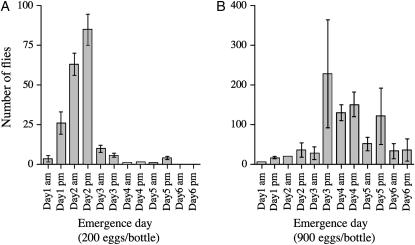
Distribution of fly emergence in uncrowded conditions with 200 eggs per bottle (A) and crowded conditions with 900 eggs per bottle (B). wMel(BNE) flies were kept on a 12-hr-light/dark cycle and emerging flies were counted every morning (9:00 am) and evening (5:00 pm). Bars, mean number of flies emerging per bottle (n = 3). Error bars indicate SEM.
F<sc>igure</sc> 2.—
Figure 2.—
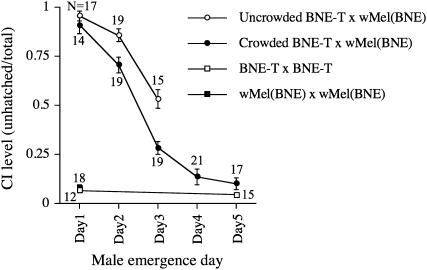
Younger brother effect on the level of CI in wMel-infected D. melanogaster. Crosses were performed as follows: open circles, BNE-T females × wMel(BNE) males grown under uncrowded conditions of 200 eggs per bottle; closed circles, BNE-T females × wMel(BNE) males grown under crowded conditions of 900 eggs per bottle; open square, BNE-T females × BNE-T males compatible cross control; closed square, wMel(BNE) females × wMel(BNE) males compatible cross control. Values beside circles and squares represent number of single-female replicates. Error bars indicate SEM.
F<sc>igure</sc> 3.—
Figure 3.—
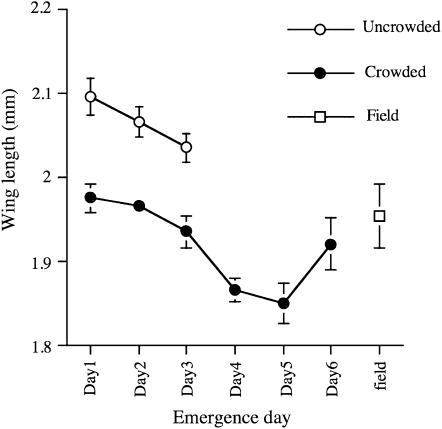
Mean wing length of male flies. Open circles, wMel(BNE) males grown under uncrowded conditions of 200 eggs per bottle. Closed circles, wMel(BNE) males grown under crowded conditions of 900 eggs per bottle. Open square, field-collected (Brisbane) male D. melanogaster. Error bars indicate SEM (n = 10).
F<sc>igure</sc> 4.—
Figure 4.—
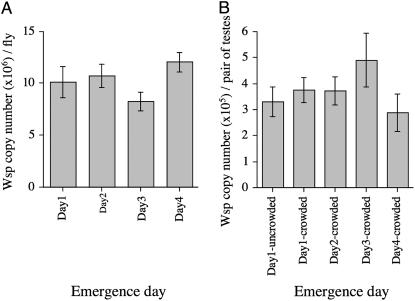
Mean Wolbachia density as determined by quantitative PCR. (A) Mean Wolbachia density for wMel(BNE) adult males eclosing over different days and grown under crowded conditions of 900 eggs per bottle. (B) Mean Wolbachia density for wMel(BNE) testes taken from males eclosing over different days and grown under crowded conditions of 900 eggs per bottle and uncrowded conditions with 200 eggs per bottle. Error bars indicate SEM (n = 5).
F<sc>igure</sc> 5.—
Figure 5.—
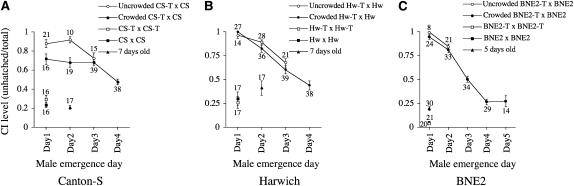
Younger brother effect on the level of CI in different D. melanogaster lines. (A) Canton-S line. (B) Harwich line. (C) BNE2 line. Crosses were performed as follows: open circles, uninfected females × infected males grown under uncrowded conditions of 200 eggs per bottle; closed circles, uninfected females × infected males grown under crowded conditions of 900 eggs per bottle; open square, uninfected females × uninfected males compatible cross control; closed square, infected females × infected males compatible crosses control; closed triangle, uninfected females × 7-day-old infected males (A and B) and uninfected females × 5-day-old infected males (C). Values beside circles and squares represent number of single-female replicates. Error bars indicate SEM.

References

    1. Bordenstein, S. R., M. L. Marshall, A. J. Fry, U. Kim and J. J. Wernegreen, 2006. The tripartite associations between bacteriophage, Wolbachia, and arthropods. PLoS Pathog. 2: e43. - PMC - PubMed
    1. Bourtzis, K., A. Nirgianaki, P. Onyango and C. Savakis, 1994. A prokaryotic dnaA sequence in Drosophila melanogaster: Wolbachia infection and cytoplasmic incompatibility among laboratory strains. Insect Mol. Biol. 3: 131–142. - PubMed
    1. Bourtzis, K., A. Nirgianaki, G. Markakis and C. Savakis, 1996. Wolbachia infection and cytoplasmic incompatibility in Drosophila species. Genetics 144: 1063–1073. - PMC - PubMed
    1. Braig, H. R., W. Zhou, S. L. Dobson and S. L. O'Neill, 1998. Cloning and characterization of a gene encoding the major surface protein of the bacterial endosymbiont Wolbachia pipientis. J. Bacteriol. 180: 2373–2378. - PMC - PubMed
    1. Breeuwer, J. A., and J. H. Werren, 1993. Cytoplasmic incompatibility and bacterial density in Nasonia vitripennis. Genetics 135: 565–574. - PMC - PubMed

Publication types

LinkOut - more resources