


Tachyphylaxis of the ECL-cell response to PACAP: receptor desensitization and/or depletion of secretory products
- PMID: 17660849
- PMCID: PMC1978265
- DOI: 10.1038/sj.bjp.0707385
Tachyphylaxis of the ECL-cell response to PACAP: receptor desensitization and/or depletion of secretory products
Abstract
Background and purpose: Rat stomach ECL cells secrete histamine and pancreastatin in response to gastrin and pituitary adenylate cyclase-activating peptide-27 (PACAP). This study applies microdialysis to explore how ECL cells in situ respond to PACAP and gastrin.
Experimental approach: Both peptides were administered by microinfusion into the gastric submucosa. The microdialysate was analysed for histamine and pancreastatin (ECL-cell markers) and for somatostatin (D-cell marker).
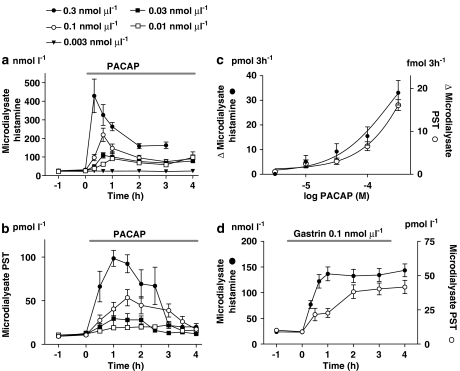
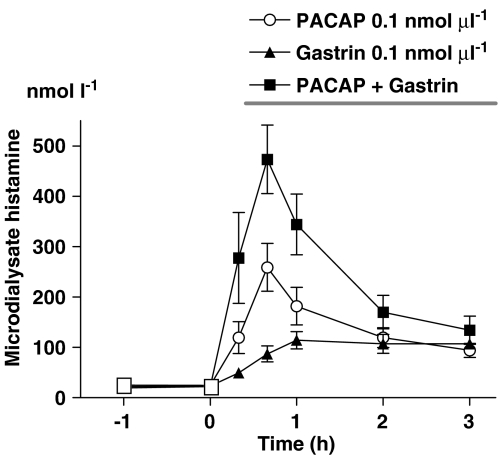
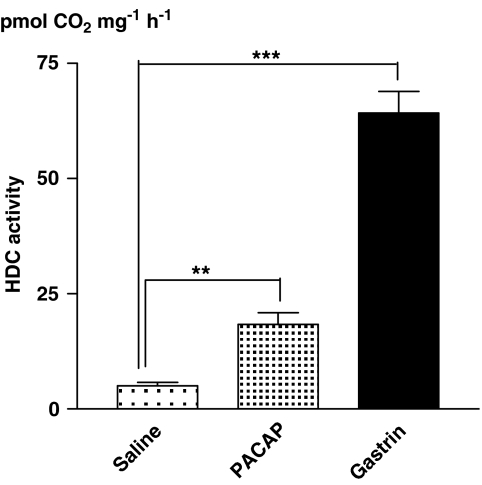
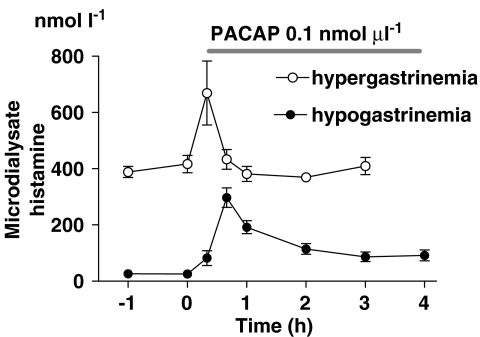
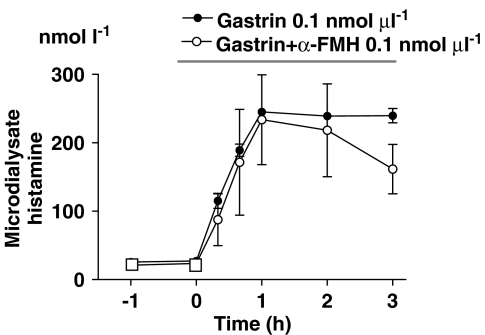
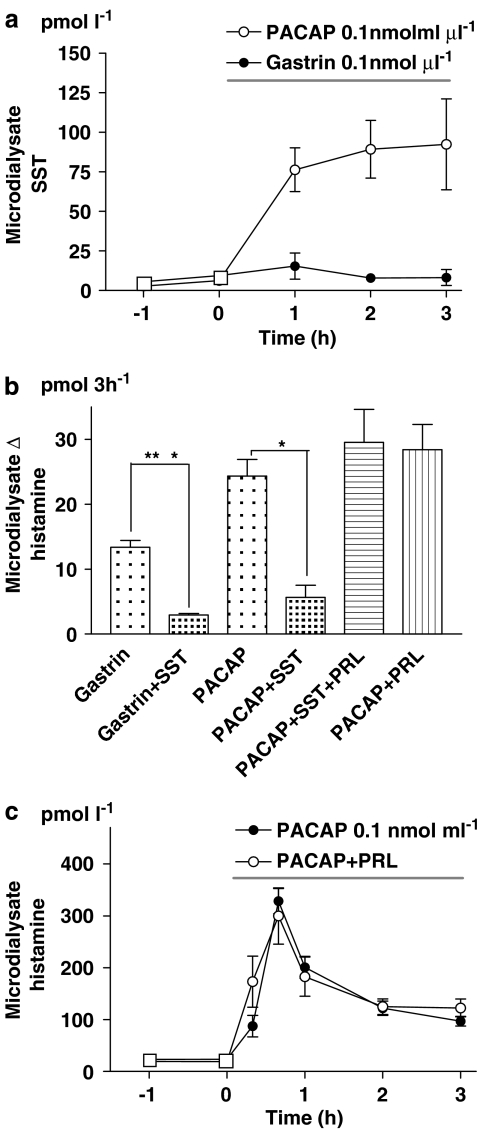
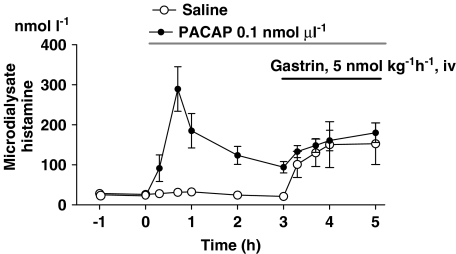
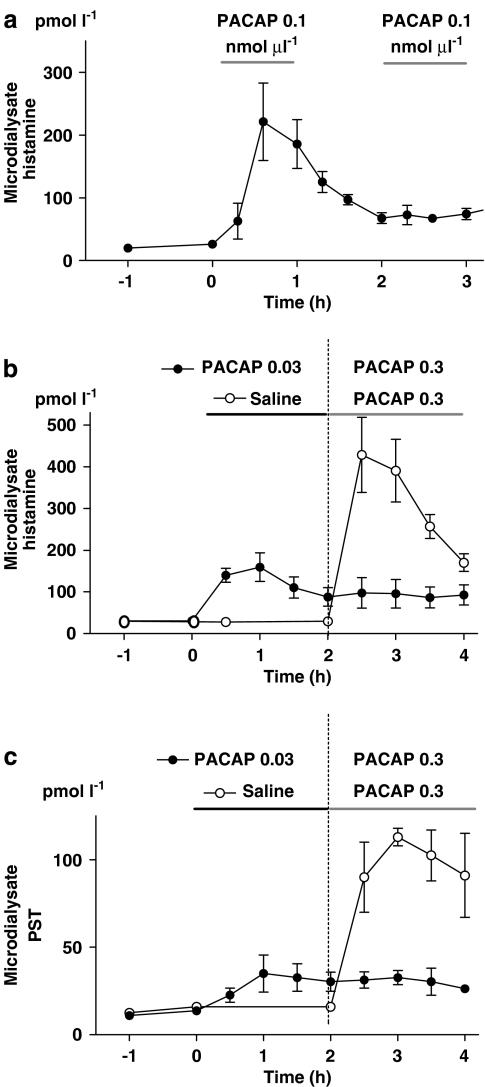
Key results: Microinfusion of PACAP (0.01-0.3 nmol microl(-1)) raised microdialysate histamine and pancreastatin dose-dependently. The response was powerful but short-lived. The response to gastrin was sustained at all doses tested. It is unlikely that the transient nature of the histamine response to PACAP reflects inadequate histamine synthesis, since the pancreastatin response to PACAP was short-lived too, and both gastrin and PACAP activated ECL-cell histidine decarboxylase. Unlike gastrin, PACAP mobilized somatostatin. Co-infusion of somatostatin abolished the histamine-mobilizing effect of PACAP. However, pretreatment with the somatostatin receptor type-2 antagonist (PRL-2903) did not prolong the histamine response to PACAP, suggesting that mobilization of somatostatin does not explain the transient nature of the response. Repeated administration of 0.1 nmol microl(-1) of PACAP (1 h infusions, 1 h intervals) failed to induce a second histamine response. Pretreatment with a low dose of PACAP (0.03 nmol microl(-1)) abolished the response to a subsequent near-maximal PACAP challenge (0.3 nmol microl(-1)).
Conclusion: The transient nature of the histamine response to PACAP reflects desensitization of the PACAP receptor and/or exhaustion of a specific storage compartment that responds to PACAP but not to gastrin.
Figures
References
-
- Andersson K, Chen D, Håkanson R, Mattsson H, Sundler F. Enterochromaffin-like cells in the rat stomach: effect of α-FMH-evoked histamine depletion. A chemical, histochemical and electron microscopic study. Cell Tissue Res. 1992;270:7–13. - PubMed
-
- Björkqvist M, Bernsand M, Eliasson L, Håkanson R, Lindström E. Somatostatin, misoprostol and galanin inhibit gastrin- and PACAP-stimulated secretion of histamine and pancreastatin from ECL cells by blocking specific Ca2+ channels. Regul Pept. 2005;130:81–90. - PubMed
-
- Black JW, Shankley NP. How does gastrin act to stimulate oxyntic cell secretion. Trends Pharmacol Sci. 1987;8:486–490.
-
- Chen D, Monstein H-J, Nylander A-G, Zhao C-M, Sundler F, Håkanson R. Acute response of rat stomach enterochromaffin-like cells to gastrin. Secretory activation and adaptation. Gastroenterology. 1994;107:18–27. - PubMed
-
- Ekblad E, Ekelund M, Graffner H, Håkanson R, Sundler F. Peptide-containing nerve fibers in the stomach wall of rat and mouse. Gastroenterology. 1985;89:73–85. - PubMed
Publication types
MeSH terms
Substances
LinkOut - more resources
Full Text Sources
Molecular Biology Databases
