


Material properties in unconfined compression of human nucleus pulposus, injectable hyaluronic acid-based hydrogels and tissue engineering scaffolds
- PMID: 17661094
- PMCID: PMC2223355
- DOI: 10.1007/s00586-007-0443-6
Material properties in unconfined compression of human nucleus pulposus, injectable hyaluronic acid-based hydrogels and tissue engineering scaffolds
Abstract
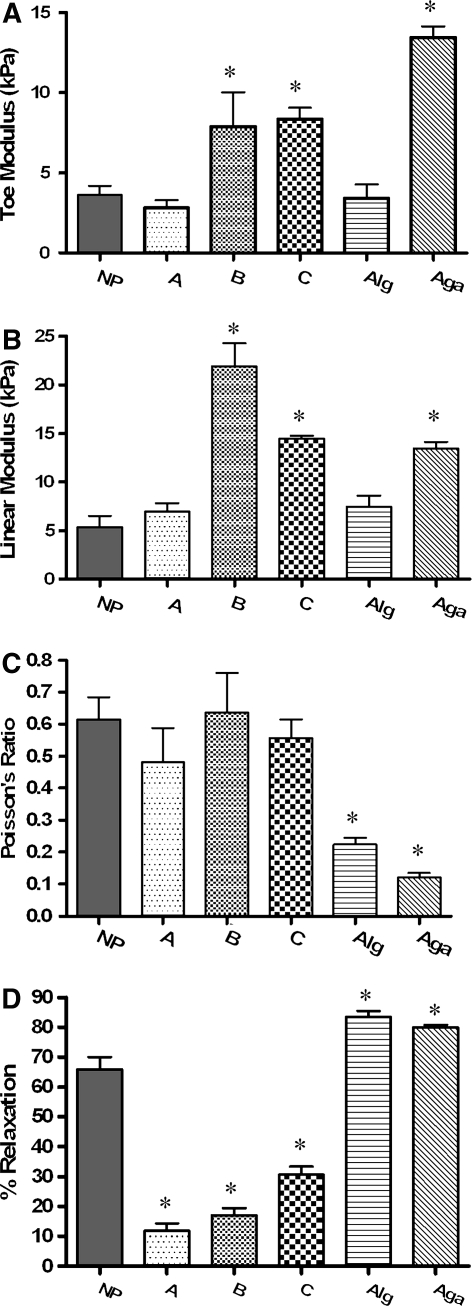
Surgical treatment for lower back pain related to degenerative disc disease commonly includes discectomy and spinal fusion. While surgical intervention may provide short-term pain relief, it results in altered biomechanics of the spine and may lead to further degenerative changes in adjacent segments. One non-fusion technique currently being investigated is nucleus pulposus (NP) support via either an injectable hydrogel or tissue engineered construct. A major challenge for either approach is to mimic the mechanical properties of native NP. Here we adopt an unconfined compression testing configuration to assess toe-region and linear-region modulus and Poisson's ratio, key functional parameters for NP replacement. Human NP, experimental biocompatible hydrogel formulations composed of hyaluronic acid (HA), PEG-g-chitosan, and gelatin, and conventional alginate and agarose gels were investigated as injectable NP replacements or tissue engineering scaffolds. Testing consisted of a stress-relaxation experiment of 5% strain increments followed by 5-min relaxation periods to a total of 25% strain. Human NP had an average linear-region modulus of 5.39 +/- 2.56 kPa and a Poisson's ratio of 0.62 +/- 0.15. The modulus and Poisson's ratio are important parameters for evaluating the design of implant materials and scaffolds. The synthetic HA-based hydrogels approximated NP well and may serve as suitable NP implant materials.
Figures


References
-
- Bain A, Sherman T, Norton B (2000) A comparison of the viscoelastic behavior of the lumbar intervertebral disc before and after the implantation of a prosthetic disc nucleus. In: Advances in bioengineering. ASME, New Orleans, pp 203–204
Publication types
MeSH terms
Substances
Grants and funding
LinkOut - more resources
Full Text Sources
Other Literature Sources
Miscellaneous
