


Naive CD8+ T cells differentiate into protective memory-like cells after IL-2 anti IL-2 complex treatment in vivo
- PMID: 17664293
- PMCID: PMC2118678
- DOI: 10.1084/jem.20070543
Naive CD8+ T cells differentiate into protective memory-like cells after IL-2 anti IL-2 complex treatment in vivo
Abstract
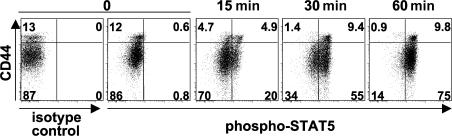
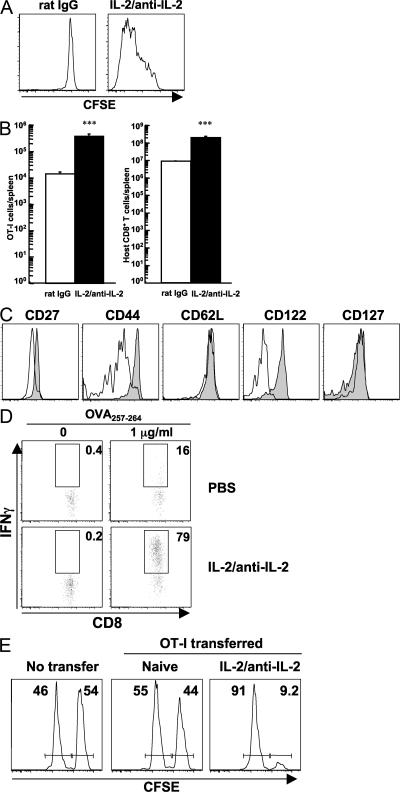
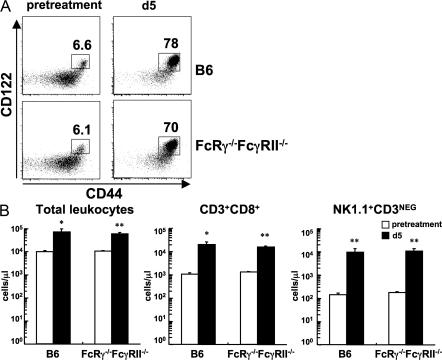
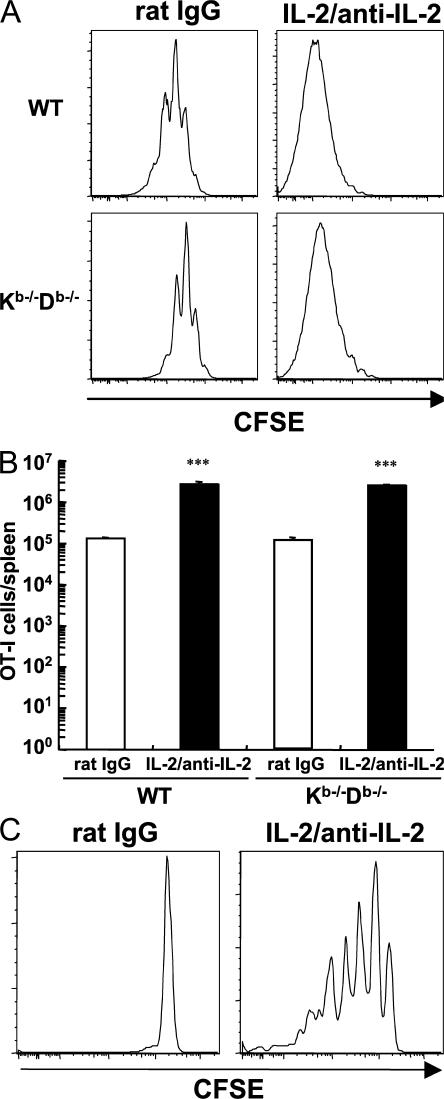
An optimal CD8(+) T cell response requires signals from the T cell receptor (TCR), co-stimulatory molecules, and cytokines. In most cases, the relative contribution of these signals to CD8(+) T cell proliferation, accumulation, effector function, and differentiation to memory is unknown. Recent work (Boyman, O., M. Kovar, M.P. Rubinstein, C.D. Surh, and J. Sprent. 2006. Science. 311:1924-1927; Kamimura, D., Y. Sawa, M. Sato, E. Agung, T. Hirano, and M. Murakami. 2006. J. Immunol. 177:306-314) has shown that anti-interleukin (IL) 2 monoclonal antibodies that are neutralizing in vitro enhance the potency of IL-2 in vivo. We investigated the role of IL-2 signals in driving CD8(+) T cell proliferation in the absence of TCR stimulation by foreign antigen. IL-2 signals induced rapid activation of signal transducer and activator of transcription 5 in all CD8(+) T cells, both naive and memory phenotype, and promoted the differentiation of naive CD8(+) T cells into effector cells. IL-2-anti-IL-2 complexes induced proliferation of naive CD8(+) T cells in an environment with limited access to self-major histocompatibility complex (MHC) and when competition for self-MHC ligands was severe. After transfer into wild-type animals, IL-2-activated CD8(+) T cells attained and maintained a central memory phenotype and protected against lethal bacterial infection. IL-2-anti-IL-2 complex-driven memory-like CD8(+) T cells had incomplete cellular fitness compared with antigen-driven memory cells regarding homeostatic turnover and cytokine production. These results suggest that intense IL-2 signals, with limited contribution from the TCR, program the differentiation of protective memory-like CD8(+) cells but are insufficient to guarantee overall cellular fitness.
Figures
References
-
- Haring, J.S., V.P. Badovinac, and J.T. Harty. 2006. Inflaming the CD8+ T cell response. Immunity. 25:19–29. - PubMed
-
- Williams, M.A., and M.J. Bevan. 2007. Effector and memory CTL differentiation. Annu. Rev. Immunol. 25:171–192. - PubMed
-
- Lin, J.X., and W.J. Leonard. 2000. The role of Stat5a and Stat5b in signaling by IL-2 family cytokines. Oncogene. 19:2566–2576. - PubMed
-
- Malek, T.R., and A.L. Bayer. 2004. Tolerance, not immunity, crucially depends on IL-2. Nat. Rev. Immunol. 4:665–674. - PubMed
-
- Sakaguchi, S., M. Ono, R. Setoguchi, H. Yagi, S. Hori, Z. Fehervari, J. Shimizu, T. Takahashi, and T. Nomura. 2006. Foxp3+ CD25+ CD4+ natural regulatory T cells in dominant self-tolerance and autoimmune disease. Immunol. Rev. 212:8–27. - PubMed
Publication types
MeSH terms
Substances
Grants and funding
LinkOut - more resources
Full Text Sources
Other Literature Sources
Research Materials
