


The behavior of osteoblast-like cells on various substrates with functional blocking of integrin-beta1 and integrin-beta3
- PMID: 17665129
- PMCID: PMC2233710
- DOI: 10.1007/s10856-007-0166-6
The behavior of osteoblast-like cells on various substrates with functional blocking of integrin-beta1 and integrin-beta3
Abstract
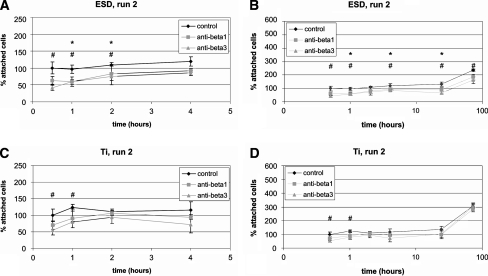
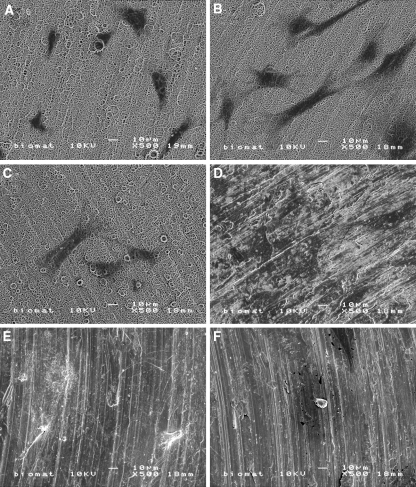
This study was designed to examine the influence of integrin subunit-beta1 and subunit-beta3 on the behavior of primary osteoblast-like cells, cultured on calcium phosphate (CaP)-coated and non coated titanium (Ti). Osteoblast-like cells were incubated with specific monoclonal antibodies against integrin-beta1 and integrin-beta3 to block the integrin function. Subsequently, cells were seeded on Ti discs, either non coated or provided with a 2 microm carbonated hydroxyapatite coating using Electrostatic Spray Deposition. Results showed that on CaP coatings, cellular attachment was decreased after a pre-treatment with either anti-integrin-beta1 or anti-integrin-beta3 antibodies. On Ti, cell adhesion was only slightly affected after a pre-treatment with anti-integrin-beta3 antibodies. Scanning electron microscopy showed that on both types of substrate, cellular morphology was not changed after a pre-treatment with either antibody. With quantitative PCR, it was shown for both substrates that mRNA expression of integrin-beta1 was increased after a pre-treatment with either anti-integrin-beta1 or anti-integrin-beta3 antibodies. Furthermore, after a pre-treatment with either antibody, mRNA expression of integrin-beta3 and ALP was decreased, on both types of substrate. In conclusion, osteoblast-like cells have the ability to compensate to great extent for the blocking strategy as applied here. Still, integrin-beta1 and beta3 seem to play different roles in attachment, proliferation, and differentiation of osteoblast-like cells, and responses on CaP-coated substrates differ to non coated Ti. Furthermore, the influence on ALP expression suggests involvement of both integrin subunits in signal transduction for cellular differentiation.
Figures

References
Publication types
MeSH terms
Substances
LinkOut - more resources
Full Text Sources
Miscellaneous
